The morning sun has barely risen over Nyamkeria Village in North Kabuoch, Homa Bay County, but the sound of machines already echoes from a modest workshop tucked into the rural landscape.
Inside, five young people—two women and three men—are immersed in their work. A young man in a red T-shirt takes measurements around a cut bamboo pole, while two colleagues in green and white T-shirts polish finished products and drill holes through freshly cut bamboo poles.
Nearby, two women scratch and peel the outer skin from freshly harvested bamboo. Several bamboo poles treated with Borax and boric acid lean against a wall, waiting to be transformed into furniture and other products. A large boiler designed to accommodate cut bamboo poles is also visible within the compound.
It is more than an ordinary village workshop.
Behind the bamboo products is an initiative that has brought together environmental conservation, youth employment, women’s economic participation and community enterprise.
This is the story of Jipange Eco Champion Self Help Group, a community initiative that is using bamboo to address plastic waste while creating economic opportunities for young people and women.
George Brighton, the group’s representative, recalls how the idea began.
“In 2021, we looked around our community and realized we had two serious problems. Many young people had completed school but had no employment opportunities. At the same time, plastic waste was becoming more visible in our homes, so we decided to look for a solution.”
That solution was bamboo. The group now has more than eight acres of bamboo and sources additional raw material from Okota, Obera and Rangwe. Brighton says the group also supplied seedlings to many of its bamboo suppliers in those areas.
“Out of over 1,600 species of bamboo, we only use the two giant species, Dendrocalamus asper and Dendrocalamus giganteus,” he says.
The group began planting bamboo in 2021, seeing an opportunity to build both an environmental and economic enterprise around a plant that could be harvested repeatedly.
“We started by selling bamboo seedlings, but we kept asking ourselves what could be done with a mature bamboo plant,” says Brighton.
Bamboo is a fast-growing grass that can regenerate after harvesting. Depending on how it is cultivated and managed, bamboo can provide environmental benefits, including helping to protect soil and storing carbon. Its ability to regenerate makes it a potentially renewable source of raw material.
The group began exploring how it could turn the mature plants into products.
In 2024, the members registered Jipange Eco Champion Self Help Group, bringing together young people and women to produce bamboo products while improving household incomes.
Today, what began as a small experiment has developed into a functioning village enterprise.
From Bamboo Pole to Finished Product
Inside the workshop, every bamboo stem undergoes several stages before becoming a finished product.
“One misconception people have is that bamboo is ready for use immediately after harvesting,” explains Brighton. “If it is not properly treated, insects can destroy it, or it can develop cracks after drying.”
After harvesting, the bamboo is cut into sizes that can fit into the group’s boiler. Holes are then drilled through the poles to allow the treatment solution to penetrate.
“After harvesting them from our farms, we cut them into sizes that will fit into our boiler, then we drill holes through them for ease of penetration of our treatment chemical solution,” says Brighton.
The group uses two treatment processes.
For kitchenware, drilled bamboo poles are soaked in boiling water for two hours before being left in the open air to dry. For products that are not intended for kitchen use, such as furniture and jewellery, the group uses Borax and boric acid.
After treatment and drying, skilled artisans cut, split, sand and polish the bamboo before assembling the finished products.
“Bamboo products are very strong and durable,” says Brighton, as he demonstrates the strength of a cooking stick by striking it against a wall.
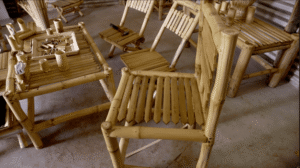
The workshop produces mugs, key holders, furniture, cooking sticks, pen holders, trays, lampshades and other household accessories.
The products are intended to provide alternatives to some household items commonly made from plastic.
“When someone buys a bamboo mug instead of a plastic cup, it may seem like a small decision,” says Brighton. “But when many people make that choice, together it reduces plastic waste.”
The group’s decision to distribute bamboo seedlings has also helped secure its supply of raw material.
“The decision we made in 2021 to sell bamboo seedlings has cushioned us against running out of supply. We can easily source raw materials,” Brighton says.
Nothing Goes to Waste
The group’s approach extends beyond the finished products.
Bamboo offcuts, leaves and other leftover pieces accumulate during production. Instead of discarding all of this material, the group uses some of the waste as fuel for the boiler used during bamboo treatment.
The ash that remains after burning the bamboo waste is then collected and used to make briquettes.
“We mix the ashes with binders such as cassava flour, molasses or even soil,” explains Brighton.
The group sees the briquettes as another way of making use of material that would otherwise be discarded.
“With bamboo, we are striving to end dependence on trees for charcoal because it can regenerate, contributing to environmental conservation,” says Brighton.
The approach, however, does not mean every environmental claim can be assumed. The extent to which bamboo products replace plastic or bamboo briquettes reduce demand for wood charcoal would require further measurement.
For Jipange Eco Champion, the immediate focus is to make greater use of the material available to them while creating an income-generating enterprise.
Empowering Young People
For many young people in Nyamkeria Village, limited employment opportunities meant spending months or years looking for work.
Since its inception, the group says it has trained more than 200 young people and women. It currently has 25 employees.
Isaiah Owuor, Jachim Japheth, Cynthia Anyango and Zilpha Pauline are among the young people who joined the initiative after completing secondary school.
Artisans receive a 40 percent commission from every successful sale, according to the group.
“Today we have valuable skills that allow us to earn a living without leaving the community,” says Cynthia.
For the young people working at the workshop, the initiative offers more than short-term employment. It provides practical skills in bamboo processing, product development and marketing that can potentially be used beyond the workshop.
Women Take Part in Production and Decision-Making
Women have also become an important part of the initiative.
They participate in sanding, polishing, finishing, assembling, packaging and marketing the products.
Quinter Owino joined the group after her husband died, leaving her to provide for their children.
“My husband died leaving me with small children, and discovering Jipange Eco Champion is the best thing that happened to me,” she says.
Owino says the income has helped her meet household needs, including school fees.
Eighteen women are currently working with Jipange Eco Champion, among them Immaculate Onsagwa and Millicent Odongo.
“Women are no longer just helping with production,” says Brighton. “They are decision-makers and skilled artisans.”
The group says income earned through the enterprise contributes to school fees, household expenses and small personal investments among its members.
A Local Response to a Global Problem
Plastic pollution is a growing global environmental problem. The United Nations Environment Programme estimates that global plastic waste could nearly triple by 2060 if current trends continue.
For communities such as Nyamkeria, the challenge is also local. Plastic waste can be seen around homes, roads and other parts of the community, prompting residents to explore alternatives that can also generate income.
Jipange Eco Champion has also engaged with local climate and environmental initiatives. The group says it championed discussions around the amendment of the Climate Change Act at the Homa Bay County Assembly, including the adoption of carbon credits as part of climate action.
The initiative has received support from Financing Locally-Led Climate Action (FLLoCCA), Kenya Forest Service, the National Environment Management Authority, the Kenya Forestry Research Institute and SHOFCO, according to the group.
But the enterprise faces challenges.
Its rural location and unreliable electricity supply have affected production.
“We know our products have potential to make an impact,” says Brighton. “Power was cut here, and we applied for reconnection from Kenya Power, and they gave us a quote of KSh1,557,824.”
For a small community enterprise, the cost presents a significant barrier to restoring reliable electricity.
The group sells its products at between KSh100 and KSh500.
“Environmental sustainability is our main focus,” says Brighton. “That is why we sell our products at affordable prices.”
The pricing is intended to make the products accessible to more households while allowing the group to sustain its operations.
What the Model Shows
Jipange Eco Champion’s experience demonstrates how a community can build an enterprise around resources available locally.
The group began by planting and selling bamboo seedlings. It later moved into processing mature bamboo, producing household goods, training young people and women, and finding uses for production waste.
The approach has created several connected activities around one resource: bamboo cultivation provides raw material, processing creates products and employment, while some production waste is reused as fuel and converted into briquettes.
The model is not without limitations. Reliable electricity remains a challenge, and the scale of its contribution to reducing plastic pollution or dependence on charcoal has yet to be quantified.
Still, the experience offers practical lessons for communities seeking to turn locally available resources into economic opportunities while responding to environmental challenges.
As the day draws to a close, smaller finished bamboo products are neatly displayed on a bamboo dining table, surrounded by foldable bamboo chairs and stools.
Standing among stacks of polished bamboo products is Brighton and his team.
“When people buy our products, they are supporting much more than a business,” he says.
For Jipange Eco Champion, the bamboo enterprise represents an attempt to connect environmental action with livelihoods.
It may not eliminate plastic pollution or deforestation on its own. But in Nyamkeria Village, the group is testing whether a locally available resource can be turned into products, skills, jobs and new uses for waste.