As rice consumption doubles and imports continue to supply around half of the country’s needs, researchers are developing higher-yielding varieties designed for local conditions. The challenge now is getting those seeds into farmers’ hands.
Burkina Faso’s rice production faces a growing challenge as demand for the staple continues to rise. According to the International Atomic Energy Agency (IAEA), rice consumption in the West African country has doubled over the past decade, while around half of the rice consumed is imported. The figures, reported by the IAEA in its 15 October 2026 article, highlight the pressure to strengthen domestic production and reduce reliance on imported supplies.
In a move aimed at addressing this challenge, researchers in Burkina Faso have developed eight new rice varieties using mutation breeding, a scientific technique that uses radiation to accelerate genetic variation in plants.
Supported by the IAEA and the United Nations’s Food and Agriculture Organization (FAO) through their Atoms4Food initiative, the varieties offer higher yields and shorter growing periods than many varieties previously listed in the country’s national catalogue. Their development represents a step towards improving domestic rice production, although wider access to the seeds and evidence of their impact at scale will be essential to determining how much they can contribute to food security.
Improving What Farmers Can grow
The challenge affecting the country’s rice breeding programme was not simply to develop another variety of rice but to identify plants with characteristics that could help farmers increase production while responding to local growing conditions and consumer preferences.
Existing varieties in Burkina Faso’s national catalogue typically yield between four and six tonnes per hectare and take longer to mature. The eight newly released varieties have reported yields of between nine and eleven tonnes per hectare, with maturity periods ranging from 95 to 106 days.
That difference could be significant for farmers. A crop, for example, that matures sooner can shorten the wait between planting and harvesting, while a higher-yielding variety offers the possibility of harvesting more rice from the same area of land.
However, these figures describe the varieties’ reported performance, not a guarantee that every farmer will achieve the same results. Actual yields depend on growing conditions, water availability, soil fertility and farm management.
The researchers used mutation breeding, a technique in which radiation induces genetic variation in plant material. Scientists then select plants displaying desirable characteristics and evaluate them through successive stages of development and testing.
The technique does not involve simply irradiating rice in farmers’ fields. Instead, it is used during the development process to help researchers identify plants with traits worth advancing.
In Burkina Faso, the work received technical support from the International Atomic Energy Agency (IAEA) and the Food and Agriculture Organization of the United Nations (FAO) through their Atoms4Food initiative.
The collaboration helped strengthen national expertise and supported the process of taking promising rice lines from laboratory research to field evaluation and official registration.
The solution extends beyond yield
Producing more rice is only part of the challenge. A variety that performs well in a field may still struggle to gain acceptance if its grain characteristics do not match what farmers and consumers want.
Burkina Faso’s researchers therefore considered qualities beyond productivity.
Among the eight varieties are two with large grains, two rich in resistant starch and one waxy, or sticky, rice variety. The selection reflects an effort to develop rice that responds to different preferences rather than treating all consumers as having identical needs.
This matters because agricultural innovation does not succeed on scientific performance alone. Farmers need varieties suited to their circumstances, and the grain must have qualities that make it useful and desirable in the market.
The work has also strengthened the country’s capacity to continue developing improved crops.
Imaël Henri Nestor Bassolé of Université Joseph Ki-Zerbo said the achievement went beyond the release of the eight varieties, pointing to the scientific expertise Burkina Faso had built to continue responding to changing growing conditions and the needs of farmers and consumers.
That capacity is an important part of the intervention. Instead of relying solely on improved varieties developed elsewhere, national researchers are gaining experience in identifying, evaluating and advancing crop varieties within their own agricultural system.
The journey from research to the field
Developing a promising variety is one thing. Making it available to farmers is another.
Before new rice varieties can be released, researchers must establish how they perform under local conditions, assess their relevant characteristics and take them through the country’s official registration process.
Demonstration fields in Bama and Banzon have helped researchers evaluate the new varieties beyond the laboratory.
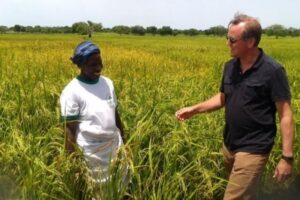
One of these evaluations took place in the Banzon rice-growing plain, where agricultural engineer and PhD candidate Gloria Kabré worked with farmers to assess one of the mutant varieties. The variety achieved yields of up to 11.76 tonnes per hectare, according to the IAEA.
The result offers evidence of what the improved varieties can achieve in a field setting. It does not, on its own, establish the yields farmers will obtain across the country, but it provides a practical basis for further evaluation.
In June 2025, eight of eleven advanced mutant rice lines were officially registered in Burkina Faso’s National Catalogue of Plant Species and Varieties.
That registration was a crucial step. Without formal approval, promising research cannot easily progress into wider agricultural use. With it, attention can turn towards producing sufficient seed and making the varieties accessible to farmers.
The distinction is important. Research can demonstrate what is possible, but farmers can benefit only when the resulting varieties are available and suited to the conditions in which they work.
The unfinished work of food security
Burkina Faso has now moved the eight varieties through an important stage of development. The next test is whether their availability can expand enough to make a meaningful contribution to domestic rice production.
The IAEA reports that efforts are underway to increase seed production and distribute the varieties more widely. That work will be central to determining the reach of the innovation.
If seed multiplication and distribution fall behind, farmers may not be able to adopt the varieties at the scale needed to influence national production. Access alone will not settle every challenge, either. The varieties must perform reliably across different farming conditions, and farmers need the resources to cultivate them successfully.
There is also a difference between demonstrating that a variety can produce a high yield and establishing that it will reduce a country’s dependence on imports. The latter requires evidence of adoption, production volumes, market demand and changes in the balance between domestic supply and consumption.
Those outcomes have not yet been established by the information available on the programme.
In May 2025, Burkina Faso hosted the first joint Atoms4Food Assessment Mission, which identified priority areas for further support. The wider initiative brings together nuclear and related technologies to address challenges across food production, soil and water management, livestock health, food safety and nutrition.
The approach recognises that food security cannot be secured through crop improvement alone. Higher yields can help increase the supply of food, but sustained results also depend on the systems that allow farmers to produce, store, distribute and sell it.
The immediate priority for the Troure – led country, is to move from the release of improved varieties towards their wider use. The longer-term question is whether the gains demonstrated in research and field evaluations can be sustained at a scale that changes domestic rice production.
A promising intervention, with results still to prove
Burkina Faso’s experience illustrates how scientific research can be directed towards a specific agricultural challenge. Rather than treating food insecurity as a problem requiring only more land or more imports, researchers have worked to improve the productivity and characteristics of a crop that is already central to the country’s food supply.
The early results are encouraging: eight registered varieties, reported yields considerably above those of many existing catalogue varieties, shorter maturity periods and grain characteristics developed with consumers in mind.
But the strongest evidence of success will come later, when more farmers have access to the seed and the programme’s contribution can be measured in actual production.
The country has until now, established a promising route from scientific research to agricultural application. Whether that route ultimately narrows the country’s rice production gap will depend on what happens next: how widely the varieties are adopted, how they perform under farmers’ conditions and whether increased domestic production becomes a lasting feature of the country’s food system.
The science has opened a door. The real test is how far the benefits travel beyond the research fields.