
“I am a person living with Type 1 diabetes, and my journey with the condition has been both challenging and life-changing,” says Beavon Mugoshi melancholically, as we begin our interview.
As diabetes continues to ravage the African continent, the big question remains: what is inside the food we eat? On May 6, 2026, the rising toll of Non-communicable Diseases (NCDs) pushed a broad coalition of Kenyan Civil Society Organizations, the Food Policy Coalition Kenya, to launch a powerful campaign calling for clear labels on pre-packaged, ultra-processed foods, arguing that such products contain high levels of sugar, salt and unhealthy fats that are driving NCDs such as high blood pressure, heart diseases, cancer, and Diabetes. It was a campaign aimed at saving consumers.
With such a shocking report, awareness is only the beginning of a better health space, as championed by the Merck Foundation. For people living with Diabetes, the real challenge is what comes after diagnosis — access to treatment, accurate information, supportive communities and health systems that can keep pace.
Beavon Mugoshi, a National NCD advocate affiliated with NCD Alliance Kenya and a Type 1 diabetes patient, still remembers it clearly. There had been signs such as excessive thirst, frequent urination, unexplained weight loss, fatigue and blurred vision. At the time, Beavon did not know what the symptoms meant, nor did the people around him.
Then came the test, and the result was Type 1 diabetes, something that had never been part of Beavon’s vocabulary, became part of his everyday life.
Insulin delivery, blood glucose monitoring, carbohydrate matching with insulin, needles, lifestyle habits and health appointments became the new order of the day. The realization that insulin was not optional dawned on Beavon, but being a brave man, he took the new life positively.
“It changed everything,” Beavon, a type 1 diabetic now an NCD advocate, says.
“Living with diabetes has not always been easy, but it has also given me a better understanding of what many people living with the condition go through,” reiterates Beavon
For millions of people across Africa, diabetes is no longer a distant health problem discussed in hospitals or during international health days. It is increasingly a daily reality whose burdens have not spared even the financially constrained families surviving on meagre wages.
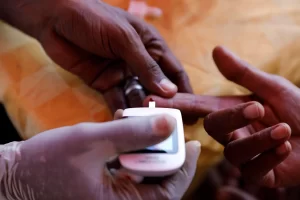
According to the World Health Organization, an estimated 54 million adults in the WHO African Region were living with diabetes in 2022, up from 12 million in 1990. The prevalence among adults rose from 6.4% in 1990 to 10.5% in 2022. More than half of those living with diabetes were undiagnosed, while more than 34 million remained untreated.
Behind the whopping statistics is a person. With the witnessed burgeoning trend, the big question is: what is next?
Around the globe, diabetes is often reduced to a conversation about sugar. Eat less sugar, exercise more, lose weight and get tested. These are messages that often may not make sense to people living with Type 1 diabetes, an autoimmune condition in which the pancreas produces little or no insulin. People living with it require insulin for survival. Type 2 diabetes, by contrast, occurs when the body cannot effectively use insulin or does not produce enough of it or sometimes the body’s cells resist it (insulin resistance).
“Having experienced this firsthand, I saw it as wise to act as a light to others and become an advocate,” says Beavon.
Beavon’s advocacy journey started when he discovered that many people living with diabetes were struggling silently. For some, the biggest challenge was not the condition itself but the lack of money to buy insulin, testing supplies, and other essential diabetes care. Others lacked the information about the disease.
“I felt that I could not remain silent when I was experiencing some of these challenges myself. I decided to use my lived experience to speak up and make sure the voices of people living with diabetes are heard,” says Beavon.

Often questions are asked such as: Did you eat too much sugar? Are you sure you have diabetes? Can’t you just stop eating certain foods? For Beavon, secretary of Diabetes and Hypertension Campaigners (DHC) and Treasurer of the National NCDAK Caucus of People Living with Non-Communicable Diseases, how one responds to such questions matters.
Beavon is also a trained NCD Advocate and NCD Champion.
“Through these roles, I have had the opportunity to participate in national policy discussions, stakeholder meetings, awareness campaigns, media interviews, and conferences focused on improving the lives of people living with diabetes and other NCDs,” says Beavon.
Beavon says diabetes awareness is critical, as misinformation about it can influence when people seek care, how families support a diabetic patient and how communities treat those living with the condition.
The numbers are growing, the gaps remain, and the global picture of the disease is stark.
WHO says the number of people living with diabetes worldwide increased from about 200 million in 1990 to 830 million in 2022. The figure doubled from approximately 7% to 14% in the 32 years. The rise has been particularly rapid in low- and middle-income countries.
The International Diabetes Federation’s 2025 Diabetes Atlas estimates that about 25 million adults aged 20–79 were living with diabetes in Africa in 2024, with approximately 72.6% undiagnosed. It projects the number could reach about 60 million by 2050.
Different estimates use different definitions and methods, but they point in the same direction: diabetes is becoming an increasingly important public-health challenge across the continent, and the consequences extend far beyond blood sugar.
Uncontrolled diabetes can contribute to blindness, kidney failure, heart attacks, stroke, nerve damage and lower-limb amputation. Aware of this, Beavon has used his personal health journey to inspire lifestyle adjustments and behavioural change.
In the WHO African Region, more than half of adults living with diabetes were estimated to be unaware of their condition in 2022. Type 2 diabetes can be particularly difficult to detect because symptoms may be mild or develop gradually. Complications are likely to develop without the knowledge of the patient. With poor eating habits being at the centre of the complication, Dr Shukri Mohammed, a Research Scientist at the African Population and Health Research Center (APHRC), said that “Research and testing of front-of-pack labelling in Kenya shows that simple, clear labels help consumers quickly identify healthier options”.
These sentiments were endorsed by Timothy Wafula, Programme Manager at Kenya Legal and Ethical Issues Network (KELIN), who reiterated the value of improving how information is presented on food packages.
“When people begin questioning what is in their food, they become more empowered to demand better labels that will dictate their choices,” said Wafula.
As messages of healthy living are preached, screening, testing, accessible primary healthcare, trained health workers and systems capable of managing the disease are crucial. Often, treatment becomes a challenge after diagnosis. High financial costs, availability of medicine, among other concerns, have made it difficult for patients to cope.
For people living with Type 1 diabetes, access to insulin is not a lifestyle choice. It is essential for survival. WHO notes that affordable access to insulin and other diabetes treatment is critical, even though access remains limited in many low- and middle-income countries.
Dr Catherine Karekezi, Executive Director at NCD Alliance Kenya, says that the conversation has to move beyond individual behaviour.
“Raising awareness and empowering consumers with clear information is essential to reversing the trends.”

Dr Catherine was grieved by the fact that a person may successfully obtain a diagnosis today and still face barriers to care tomorrow.
A recent study conducted at urban and rural retailers throughout Kenya, as presented by the International Institute for Legislative Affairs, found that ultra-processed foods accounted for 60% of all advertised food products and 40% of food items available in modern retail outlets.
As of 2025, 90% of televised food and beverage advertisements featured ultra-processed products, and over 55% were featured on radio.
This, Food Policy Coalition Kenya argues, impacts the fight for healthy living.
Many have argued that the growing burden of diabetes is a policy issue. What should governments do then?
Celine Awuor, the CEO of the International Institute for Legislative Affairs (IILA), says that “Kenyans deserve clear and understandable information about the food sold in the market and the government should be at the forefront in ensuring that Kenyans consume healthy foods.”
Celine pushed for a sustained fight within national health policy.
Across the region, countries have developed strategies and programmes aimed at addressing NCDs. But the existence of a policy does not automatically guarantee implementation.
The gap between policy and practice can be found in questions such as:
Are essential medicines consistently available?
Are people being screened early?
Are health workers adequately trained?
Are rural communities receiving the same services as urban populations?
Are people living with diabetes involved in designing the programmes intended to serve them?
These questions turn diabetes from an individual health story into a question of health-system capacity and accountability.
Imelda Namayi, Programme Manager, Education, Health and Nutrition at the National Council of Churches of Kenya (NCCK), postulated that “the general population should be enlightened about the disease’s causes and effects to make healthy choices that will be less disastrous to families”.
Schools and communities are important spaces for building health knowledge. Education, however, must be carefully framed.
Type 1 diabetes cannot simply be prevented by telling children to eat better or exercise more. Its causes and risk factors differ from those of Type 2 diabetes. WHO states that the causes and risk factors for Type 1 diabetes remain unknown and that prevention strategies have not been successful.
For Type 2 diabetes, lifestyle changes can help prevent or delay its onset. WHO recommends healthy diets, regular physical activity, maintaining a healthy body weight and avoiding tobacco use as part of prevention efforts.
Eating less sugar is therefore not a solution on its own. Individuals must understand their health, get tested and seek care early. Creating an environment that makes healthy choices possible is equally critical.
For many, challenges are enormous.
A rural patient cannot attend a clinic that is hundreds of kilometres away without transport.
A child cannot manage a chronic illness effectively if a school does not understand the condition.
And if the available information is misleading, an informed decision about diabetes cannot be made.
This is the gap where the voices of advocates, health professionals, policymakers and educators converge.
“One of the things I am most proud of is being able to bring the real experiences of people living with diabetes to the table whenever policies and programmes are being discussed,” says Beavon as he reiterates that “I have represented patients in discussions with government officials, healthcare professionals, researchers, and development partners, advocating for better access to insulin.”
For Beavon, the statistics may measure the scale of diabetes and explain the trends, but they may not capture what it means to wake up every morning knowing that managing the disease is part of staying alive.