A new initiative backed by The Rockefeller Foundation will test whether demand from artificial intelligence and other digital computing can generate new revenue for renewable energy systems serving communities with limited access to electricity.
The Emergent Grid Project, launched by the Mission 300 Accelerator on September 24, will examine whether computing facilities can use electricity that would otherwise go unused at renewable energy systems and, in turn, provide an additional source of income for the systems serving local communities.
The initial demonstrations are being conducted in Kenya, Sierra Leone and the Democratic Republic of Congo, with the project expected to expand or strengthen reliable electricity access for about 85,000 people. The initiative is backed by The Rockefeller Foundation through RF Catalytic Capital.
The proposition addresses a financial challenge that has accompanied the expansion of mini-grids and other distributed renewable energy systems across Africa. A system can have the capacity to generate more electricity than households and businesses currently consume, leaving part of its generation capacity idle while operators still have to meet the costs of running and maintaining the infrastructure. The Emergent Grid will test whether computing can become an additional paying customer for that unused capacity without taking electricity away from the communities the systems were built to serve.
The idea comes as Mission 300 moves from setting an ambitious continental target to finding different ways of financing and delivering the infrastructure required to meet it. The World Bank and African Development Bank Groups reported in June that more than 50 million people across 40 African countries had gained access to electricity
under Mission 300, which aims to reach 300 million people by 2030. Thirty countries had also launched National Energy Compacts setting out reforms and investment priorities for their energy sectors.
The progress is significant, but it has also reinforced the scale of investment required to reach communities that remain beyond the reach of conventional electricity networks. Rockefeller Foundation says nearly 600 million people in Africa still lack electricity and that roughly half of households that need new connections are expected to require off-grid solutions such as mini-grids and solar home systems. That makes the financial sustainability of distributed energy systems an important part of the wider electrification challenge.
In Kenya, five sites will test flexible computing alongside new solar-plus-storage systems serving communities of about 50,000 people. The Democratic Republic of Congo will use an existing solar plant whose generation capacity is underused and which already supplies more than 30,000 people, more than 350 small and medium-sized businesses and between 30 and 40 social institutions.
Sierra Leone will test the model at three rural mini-grid sites that already serve local communities but have additional generation capacity available.
The financial model is intended to create another customer for electricity systems while community demand develops. Computing customers would pay for electricity used to run digital workloads, creating an additional revenue stream that could strengthen the finances of a mini-grid, reduce dependence on grants and subsidies and potentially make projects more attractive to private investors. The approach is consistent with the wider Mission 300 push to bring more private capital into electricity access, including the Private Sector Council launched earlier this year Council launched earlier this year by the World Bank, African Development Bank and Rockefeller Foundation.
But the experiment comes with a condition that could determine whether the model is useful beyond the demonstration sites. Households, businesses, schools, health facilities and other essential services will have priority access to electricity, while computing loads can be reduced, shifted or potentially relocated when community demand increases. The project’s stated principle is that computing should strengthen community electricity access rather than compete with it.
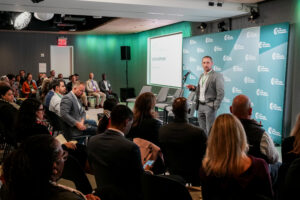
Andrew Herscowitz, CEO of the Mission 300 Accelerator, speaking during the launch of the project said that it is intended to connect the growing global demand for computing with communities where additional electricity demand could help make energy systems financially viable.
“Global demand for compute doesn’t have to push electricity costs higher for people. We think it can actually do the opposite,” he said, adding that the project is testing whether that demand can become a reason for reliable electricity infrastructure to be developed and sustained in places where it would otherwise struggle to attract sufficient investment.

The approach follows a direction that Mission 300 and its partners have already been pursuing through different forms of financing and infrastructure support.
In March, Rockefeller Foundation and the Global Energy Alliance for People and Planet said they had committed more than $100 million to Mission 300, supporting government delivery capacity, private investment, project pipelines and electrification efforts in nearly two dozen African countries.
The Rockefeller Foundation has also backed efforts to attract longer-term private capital to distributed renewable energy projects, including mini-grids and solar home systems.
Mission 300 has also linked electricity access to productive use, particularly by businesses and small enterprises. In eastern Zambia, Zeferino Tembo’s family replaced diesel-powered sunflower oil extractors with electricity from a solar mini-grid, reducing operating costs and enabling the business to expand. The experience illustrates why stronger electricity demand matters to the financial sustainability of mini-grids, where higher consumption can create more revenue for operators while supporting local economic activity.
That experience points to the importance of electricity demand beyond household connections. Businesses and institutions that use power productively can create additional demand for mini-grids as local electricity consumption grows. Emergent Grid is testing whether computing can provide another source of demand, including at a time when electricity use in surrounding communities may still be relatively low.
The same logic has appeared in other parts of Mission 300’s work. In Zambia, the Energy Demand Stimulation Incentive has been used to encourage productive electricity use by mini-grid customers, linking electricity supply with increased consumption rather than treating access as the end point. The Emergent Grid takes a different route to the same broader question of how energy systems can generate enough demand and revenue to remain viable after they are built.
The Rockefeller Foundation’s wider energy work has also moved beyond simply funding new connections. Its Smart Power Africa programme has supported mini-grid development and financing mechanisms for rural energy, while its current Mission 300 strategy combines technical assistance, policy reform, distributed renewable energy and private-sector mobilisation. The Emergent Grid therefore adds another financial experiment to an existing portfolio of attempts to make electricity systems more sustainable.
There is another dimension to the experiment. Computing infrastructure requires reliable electricity and connectivity, while communities gaining access to more dependable power can potentially use digital services for education, financial services, healthcare, commerce and business. The project is expected to examine whether combining energy and digital infrastructure can produce wider economic benefits rather than simply creating another electricity customer.
The demonstrations will be assessed on whether the technology works, whether computing generates enough additional revenue to improve the economics of the energy systems and whether communities experience meaningful benefits.
Independent monitoring and evaluation will also examine electricity affordability and reliability, electricity access, project economics and wider socioeconomic effects.
Senior Vice President at NRECA International, Kate Steel, said the financial sustainability of rural power systems remains a challenge even after the infrastructure has been built.
Senior Vice President at NRECA International, Kate Steel, said the financial sustainability of rural power systems remains a challenge even after the infrastructure has been built.
“Building rural power systems is only part of the challenge as we work to bring electricity to communities in Africa. The broader issue is ensuring those systems remain financially and operationally sustainable to deliver long-term benefits,” she said.