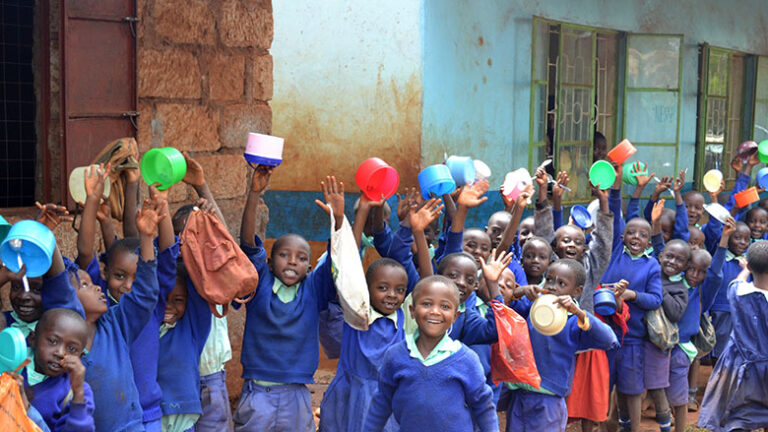
A new nationwide campaign seeking to confront two of Kenya’s most persistent education challenges, school hunger and period poverty, has been launched with an ambitious 1,000 kilometre endurance run stretching from the coastal town of Kilifi to Busia at the Kenya Uganda border.
The initiative, dubbed Miles4MealsAndDignityRun, is being spearheaded by The Africa Feature Network (AFN), a Pan African media and advocacy organisation that says the campaign is intended to move beyond awareness and directly mobilise resources for vulnerable learners.
According to organisers, the run will begin on September 14, 2026, and conclude on October 11 with a public engagement event in Busia County after traversing several counties across the country.
At the centre of the campaign are two issues that continue to affect thousands of children in Kenya every school term: lack of access to nutritious meals and inadequate menstrual health support for girls.
AFN says it intends to raise over KSh13 million through the initiative to support a school feeding programme targeting 1,000 learners in six primary schools, as well as a menstrual health intervention expected to benefit 5,000 school going girls.

The organisation’s Founder and CEO, Peter Aowa, who is expected to lead the run, in his address to the media last week, said the campaign is rooted in the growing reality that many children across Kenya continue to attend school under conditions that undermine both learning and dignity.
“Too many children are sitting in classrooms hungry, while too many girls are missing lessons simply because sanitary towels remain inaccessible or unaffordable,” he said
Mr. Aowa added that the campaign seeks to use storytelling, public mobilisation, athletics, and community participation to drive practical interventions rather than limiting advocacy to media conversations.
The campaign will feature several public participation race categories including 2 kilometre Chipukizi race, 5 kilometre Tumaini category, 10 kilometre Umoja race, 15 kilometre Utu challenge and 20 kilometre Maendeleo category.
Organisers say the race categories are intended to accommodate children, students, families, fitness enthusiasts, running clubs, and corporate institutions seeking to participate in the nationwide initiative.
Registration for the children’s 2 kilometre category has been set at KSh500 (USD4), while individual students will register at KSh1,000 (USD8). General public participants will pay KSh2,000 (USD15), couples KSh3,500 (USD27), and family packages accommodating up to five people KSh6,000 (USD46).
Running clubs and organised groups of up to 12 participants will register at KSh15,000 (USD92).
Corporate participation has additionally been divided into three categories, with the Silver package accommodating up to 10 participants at KSh30,000 (USD115), the Gold package covering up to 20 participants at KSh55,000 (USD230), and the Platinum package for up to 30 participants set at KSh100,000 (USD385).
Hunger Still a Barrier to Learning
The campaign comes at a time when food insecurity continues to affect many households across Kenya.
Education stakeholders and child welfare advocates say hunger remains one of the leading but often underreported contributors to poor concentration, absenteeism, low classroom participation, and school dropout among vulnerable learners.
Recent policy discussions around school feeding in Kenya have highlighted the growing pressure on families struggling with rising living costs and food insecurity.
A 2025 Nairobi City County School Feeding Policy noted that many children in low income communities rely heavily on meals provided at school, while irregular meals continue to affect learning outcomes and classroom performance.
The policy further linked school feeding programmes to improved enrolment, retention, transition rates, and overall educational achievement among children from vulnerable households.
In many rural and informal settlement communities, teachers and parents say children often report to school without breakfast and remain in class throughout the day with little or no food.
Development practitioners argue that school feeding programmes have increasingly become not just nutrition interventions, but also education retention strategies.
The issue has also drawn public debate online and within communities, where Kenyans continue sharing concerns about the number of learners relying on school meals as their only reliable source of food each day.
For AFN, the campaign is designed to create a direct link between public participation and community support.
Organisers say schools participating in the feeding programme will also establish “School Green Labs,” a sustainability framework aimed at integrating local farmers, women’s groups, and surrounding communities into food production and supply systems supporting the schools.
The model, according to AFN, seeks to reduce overdependence on short term food donations by encouraging local food production and community ownership.
Period Poverty Continues to Disrupt Girls’ Education
Alongside school hunger, the campaign is placing significant focus on menstrual health and what activists describe as the ongoing crisis of period poverty affecting girls across Kenya.
Despite years of advocacy and policy conversations, access to sanitary products remains a challenge for many households, especially in low income urban settlements and rural communities.
Studies and advocacy reports have consistently shown that thousands of girls miss school every month because they cannot afford sanitary towels.
Recent reports by Kenya News Agency and education advocates indicated that more than one million girls in Kenya continue missing three to four days of school every month due to lack of access to menstrual products and menstrual health support.
According to a UNESCO study from 2016,on average one in ten girls in Sub-Saharan Africa misses school during their menstrual cycle, with the figure rising to one in four girls in some countries — amounting to as much as twenty percent of a given school year. At the individual level, a girl can miss four to five days of school every month, causing her to fall behind in her studies and perform worse than boys when exams come.
Teachers and health advocates warn that the impact often extends beyond absenteeism.
In some communities, girls experiencing prolonged menstrual health challenges eventually drop out of school altogether, while others face stigma, psychological distress, and increased vulnerability to exploitation.
In Kilifi County, education stakeholders recently raised concerns over increased absenteeism among girls in schools where access to sanitary towels remains inconsistent.
AFN says its Pad a Girl Initiative will seek to provide sanitary towels and menstrual health support to girls living along the campaign corridor.
The organisation argues that addressing menstrual health should no longer be treated as a peripheral welfare issue, but as a core education and dignity concern.
“Menstrual health is directly connected to education continuity, confidence, and opportunity for girls,” Aowa said.
Athletics Meets Advocacy
While charity runs and awareness campaigns are not new in Kenya, organisers say the scale and structure of the Miles for Meals and Dignity initiative are intended to create sustained national engagement over nearly a month.
The run will feature organised community participation activities in different counties, with categories ranging from 5 kilometre to 20 kilometre public runs.
Major public engagements are planned in Mombasa, Nairobi, Nakuru, and Eldoret, where organisers expect to host awareness forums, media briefings, and mobilisation activities involving schools, fitness groups, institutions, and corporate partners.
The campaign is also expected to involve athletes, youth organisations, universities, civil society groups, and media stakeholders.
AFN says the registration portal for institutions, schools, corporate teams, and individual participants will officially open on May 29, 2026.
The organisation is additionally seeking partnerships with county governments, development organisations, manufacturers, financial institutions, and media houses to support both the logistical and programme implementation aspects of the campaign.
Beyond the fundraising target, the initiative also reflects AFN’s broader philosophy around solutions journalism, an approach that focuses not only on highlighting social problems, but also on driving conversations around practical responses and community led interventions.
The organisation says media institutions increasingly have a responsibility to support civic engagement and sustainable social action, especially around issues affecting children and vulnerable communities.
This is going to be the first longest charity run in Kenya to be livestreamed entirely from Kilifi along the corridor all the way to Busia town in the border of Kenya and Uganda.
Want to be part of this campaign? You can write to us at info@africafeaturenetwork.com or call us on 0782621983 for more details