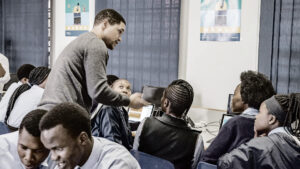
Its 2025 annual report documents gains in school performance, digital learning and youth development, while a nearly R50 million innovation fund backs locally led solutions across South Africa.
The Trevor Noah Foundation is redefining how it measures success in education, placing greater emphasis on what schools, educators and communities can sustain independently than on the programmes it delivers or the resources it provides.
In its recently launched 2025 annual report, Deepening Impact, Shifting Ownership, the foundation outlines a shift from implementing education interventions directly towards strengthening the institutions and local organisations expected to carry them forward. The approach reflects a central question on what will continue, who will lead it, when external support is withdrawn.
The report documents progress across South Africa, where the foundation works with public schools and education partners, as well as initiatives in East and Central Africa that support educators and community-based innovators. Its interventions range from literacy development and psychosocial support to digital skills, career guidance, school infrastructure and flexible funding for organisations developing solutions to education challenges.
What changed in 2025, according to the report, was not that commitment but how the foundation intended to pursue it.
Instead of measuring progress principally through the activities it funds, it increasingly looked at whether schools were incorporating successful interventions into their own systems, whether local institutions could continue programmes beyond external funding cycles, and whether community leaders were taking greater responsibility for decisions.
Moving from programmes to lasting change
The foundation’s experience in its Khulani Schools Programme illustrates the distinction between delivering an intervention and embedding it in an institution.
In its three partner secondary schools, the foundation reports matric examination pass rates of 100 per cent at Siyabonga Secondary School, 95.7 per cent at Willow Crescent Secondary School and 88.5 per cent at Eqinisweni Secondary School. These results, according to the report, reflect six years of sustained partnerships involving school leadership, literacy, digital skills, psychosocial support and other interventions rather than a single year of assistance.
The foundation’s work also extends beyond examination results to the barriers that prevent learners from progressing into further education and employment.
In 2025, 399 Grade 12 learners across the three schools received support through the Gradesmatch Bridge App, which helps learners navigate education and career pathways. Of these, 113 enrolled in higher-learning institutions, while support through South Africa’s National Student Financial Aid Scheme unlocked more than R6.24 million in educational funding value.
The report also identifies a persistent gap between learners’ ambitions and their preparation for available opportunities. Some learners aspire to highly competitive university courses without receiving career guidance or pathway planning early enough to make informed decisions.
That finding points to a broader challenge for education programmes: helping learners understand not only what they hope to achieve, but also the practical steps, qualifications and financial support required to get there.
The foundation has also expanded psychosocial support in its partner schools. Participation, the report indicates, increased from three learners in 2024 to 336 in 2025, while literacy initiatives engaged 70 caregivers and households, extending reading activities beyond the classroom.
When schools take ownership
One of the clearest examples in the report concerns the transition of literacy activities from a foundation-supported programme into school-funded work.
The Khula Funda literacy initiative had supported seven schools in Braamfischerville, South Africa. When the programme cycle ended, three schools retained former Story Sparkers as permanent, school-funded staff. At one school, staff independently trained 20 early childhood development practitioners to establish reading corners, dedicated reading periods and continuing reading clubs.
The significance lies in what happened after the original programme ended. The schools did not simply lose an intervention when its funding cycle closed. Instead, they retained personnel and practices that could continue supporting children’s literacy.
A similar transition is taking place in digital learning.
At Willow Crescent Secondary School, more than 200 Grade 8 learners accessed coding and robotics as a formally integrated curriculum subject. The report attributes the development to two years of support involving information and communication technology facilities, coding and robotics laboratories, teacher training and curriculum integration with Sifiso Learning Group.
Moving the subject from an after-school intervention into the formal timetable represents a change in how the school delivers learning. It also creates a route through which the activity can become part of routine teaching rather than remaining dependent on a separate project.
The foundation, across its school network, reports that 10 schools absorbed three ICT learning centres, four coding and robotics laboratories, and trained project staff into permanent school-owned infrastructure and human resources.
More than 4,800 learners accessed technology-enabled learning through the foundation’s work. The report also records the completion of a 1,044-square-metre community hall at Eqinisweni Secondary School, built by trained local young people and designed to accommodate 300 people.
The hall serves a school community of approximately 2,550 learners and 85 educators. Beyond its physical value, the project connects infrastructure development with youth skills and participation in the construction process.
Investing in locally developed solutions
The foundation’s shift towards local ownership is also reflected in its approach to funding other organisations.
In April 2025, Noah announced the Khulani Nathi Innovation Fund at the Skoll World Forum in Oxford. The fund, co-founded with Microsoft, was initially announced as a R30 million initiative and subsequently expanded to nearly R50 million over three years.
Its purpose is to provide flexible funding to South African education organisations developing approaches to teacher development and youth opportunity pathways.
The fund addresses a challenge faced by many community-based organisations: funding can be available for specific activities while leaving limited room to cover the wider costs of developing an organisation, adapting a programme or responding to changing circumstances.
Through multi-year, unrestricted support, the foundation seeks to give selected organisations greater room to make decisions based on their experience and the needs of the communities they serve.
The response to the fund was substantial. The foundation received more than 580 concept notes from education innovators across South Africa. By the end of 2025, nine organisations had been selected, with more than R13.5 million in first-year catalytic funding committed and disbursed.
The inaugural grantees included Citizen Leader Lab, Digify Foundation NPC, Ilitha Labantu, INMED South Africa, Ntataise Youth Power, Phola NPO, Sign Language Education & Development, the Equal Education Law Centre Trust and The Valley Trust.
Their work spans different aspects of education and youth development, including educator support, inclusive learning, youth leadership, language access and pathways connecting learning with economic opportunity.
The foundation’s role is not limited to transferring funds. It also seeks to connect grantees, facilitate peer learning and provide access to networks that can help promising approaches develop and reach more communities.
In May 2026, the foundation announced a further expansion of the fund, with Microsoft Elevate joining as a co-funding partner to support five additional South African nonprofit organisations. The expansion came after the 2025 reporting period but indicates that the funding model continued to develop beyond the year covered by the report.
Supporting education leaders across Africa
Although much of the foundation’s direct school-based work is concentrated in South Africa, its Education Changemakers programme extends its influence into East and Central Africa.
The initiative supports education leaders working on locally relevant challenges, including foundational learning, inclusion, youth employability and teacher development. Participants develop leadership skills and pursue solutions suited to their own contexts, with seed funding available for selected initiatives.
The 2025 report records 286 Education Changemakers graduates across 28 countries, alongside US$100,000 in seed funding disbursed to participants developing innovative solutions.
Several examples show how relatively targeted interventions can respond to barriers that differ from one community to another.
In Tanzania, OMOM Maasai reported an increase in school enrolment from 20 per cent to 60 per cent in a pastoralist community. In Uganda, Shine Reusable Ministry supported 662 girls across 15 villages with menstrual health interventions linked to school retention.
Another Ugandan initiative, Creative Learning Africa+, trained 200 teachers and produced 22 Maths Rap Comics to support numeracy learning.
Kenya’s Kuze Kuze assessed 169 learners using AI-assisted diagnostic tools intended to help teachers identify learning gaps and target support more effectively.
In South Sudan, the East African Institute for Sustainable Transformation equipped more than 40 displaced young people with employable skills, while in Ethiopia, Abrihot connected 94 parents of neurodivergent children through a support network intended to reduce stigma and strengthen early intervention.
These initiatives address different problems, but they share a common principle: solutions should respond to the circumstances of the learners and communities concerned.
The report also highlights the Regional Leadership Centre East Africa’s decision to continue the Education Changemakers programme after complementary USAID funding ended in June 2025. Working with Kenyatta University, the centre developed a sustainability plan and delivered a second cohort, training 63 participants from 13 countries, all of whom graduated.
The example is particularly relevant to the foundation’s argument about ownership. Rather than allowing the programme to end when one funding source disappeared, a regional institution secured the commitment needed to continue it.
It also demonstrates the importance of partnerships between funders, universities and local institutions in maintaining programmes beyond individual grants.
Technology, inclusion and the future of learning
Digital learning is another important part of the foundation’s work.
Through its partnership with Microsoft, the foundation has supported technology-enabled learning and teacher development across its Khulani Schools Programme. Its 2025 reporting includes coding and robotics, ICT learning centres and efforts to strengthen teachers’ capacity to use emerging technologies.
The emphasis is not simply on placing equipment in schools. For technology to improve learning, teachers need training, learners need opportunities to use the tools, and schools need to incorporate the resources into their teaching systems.
The foundation’s work with AI-assisted learner assessment in Kenya similarly illustrates how technology can support educators by identifying areas where learners need additional attention. Such tools can inform teaching, but their value depends on how effectively teachers interpret the results and adapt instruction.
The report also gives attention to inclusive education and support for learners who face barriers that conventional classroom approaches may not adequately address.
Its broader approach recognises that education systems must respond to different learning needs while ensuring that access to technology does not become another source of inequality.
Financial sustainability and the cost of transition
The foundation’s financial statements show the scale of resources behind its programmes and the changing priorities reflected in its expenditure.
For the year ended 31 December 2025, the combined financial statements for the Trevor Noah Foundation in South Africa and the Entertainment Industry Foundation recorded total income of R49.61 million, down from R53.44 million in 2024.
Total expenditure rose from R42.64 million to R47.93 million, leaving a reported surplus of approximately R1.68 million, compared with R6.34 million the previous year.
Direct programme expenditure reached R37.28 million, accounting for 77.8 per cent of total expenditure. The comparable share in 2024 was 75 per cent.
The Khulani Nathi Innovation Fund accounted for R13.55 million in programme expenditure in its first year, making it the largest individual direct programme expenditure line in 2025. Education Changemakers expenditure reached R6.20 million, while direct programme salary costs totalled R5.60 million.

Infrastructure expenditure through the Faranani project fell sharply from R16.47 million in 2024 to R881,091 in 2025. The foundation attributes the earlier figure to a major capital phase that was completed in 2024.
The financial results reflect a year in which the foundation continued supporting established programmes while committing substantial resources to a new funding model.
They also underline the importance of financial sustainability to the foundation’s longer-term strategy. Schools and partner organisations cannot maintain programmes indefinitely if the resources, personnel and institutional commitments required to operate them disappear.
The report’s emphasis on diversifying partnerships and reducing dependence on a single funder is therefore central to its definition of lasting impact.
The Trevor Noah Foundation’s 2025 report presents an approach to education development that places local leadership alongside academic results, technology access, teacher support and infrastructure.
Its examples offer evidence of progress: sustained matric pass rates across partner schools, learners moving into higher education, literacy activities continuing after programme cycles end, and education organisations across Africa developing solutions to barriers in their own communities.
The report is also an account of a transition still underway. The long-term test will be whether schools can maintain the programmes and assets they have absorbed, whether locally led initiatives produce measurable improvements in learning, and whether the foundation’s funding model helps successful solutions endure and expand.
Its central proposition is that development organisations should not measure their contribution only by the activities they deliver or the funding they distribute. They should also examine whether the institutions and communities they support become better equipped to act independently.
For education systems facing limited resources, uneven access to technology and growing demand for relevant skills, that question is consequential. Lasting change requires more than introducing a successful intervention; it requires creating the conditions in which schools, educators and communities can continue to make it work.
The foundation, established in 2018 by South African comedian and television host Trevor Noah, has built its work around the belief that access to quality education depends on more than classroom instruction. The conditions in which young people learn, the capacity of teachers, the support available to families and the opportunities open to learners after school all influence educational outcomes.