
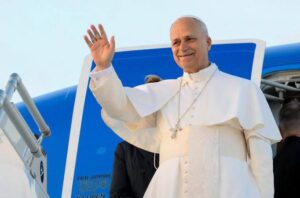
Pope Leo XIV //photo courtesy
On a Tuesday morning in late 2023, a parish priest in the Northwest Region of Cameroon received a phone call he had been expecting for three days. A school principal, two teachers, and a catechist had been abducted by an armed group on the outskirts of Bamenda.
The priest, who had spent two years building cautious lines of communication with commanders on multiple sides of the Anglophone conflict, began making calls. By Thursday evening, all four were released. No ransom was confirmed. No government official was involved.
The negotiation was conducted entirely through a network of Catholic clergy and local community elders that has become, in the absence of functional state mediation, one of the most reliable conflict resolution mechanisms operating in the Northwest today.
This is the reality that Pope Leo XIV will enter when he arrives in Cameroon from April 15 to 18, 2026, for his first visit to Africa. His stop in Bamenda on Thursday April 16, where he will hold a Peace Meeting with the local community at Saint Joseph Cathedral, will draw global attention to a crisis that has claimed several thousand lives and displaced more than 700,000 people since 2017. But the more consequential story is not what the Pope brings with him. It is what he will find already built on the ground, and whether his visit can finally give it the resources and international visibility it has never had.
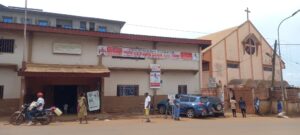
The Catholic Church in Cameroon’s Northwest and Southwest Regions has spent the better part of a decade doing something that neither the government nor the armed separatist movements have managed. It has maintained trusted channels with multiple sides simultaneously. That positioning did not happen by accident. It is the product of deliberate institutional investment, and in several documented instances, it has contributed to de-escalation and humanitarian access in ways formal processes have struggled to achieve.
The Bamenda Archdiocesan Justice and Peace Commission, operating under the leadership of Archbishop Andrew Fuanya Nkea, has functioned as one of the region’s most active civilian mediation bodies throughout the conflict. Its work has included facilitating the release of abducted civilians, negotiating temporary suspensions of ghost town lockdowns to allow food distribution and medical access, and convening dialogue sessions between community representatives and intermediaries linked to armed actors. In a conflict where shutdowns have periodically halted economic life for days at a time, even brief negotiated openings can mean the difference between access to food and total deprivation.
Caritas Cameroon, the Church’s humanitarian arm, has simultaneously maintained one of the few operational networks capable of reaching internally displaced communities in areas where government and international NGO access has been inconsistent or restricted. Its programmes have supported health facilities, distributed emergency assistance, and provided psychosocial care to conflict affected populations through Church affiliated structures. This reach is not only humanitarian. It underpins the Church’s credibility as a relatively neutral actor, which is essential to its mediation role.
At the community level, a quieter and less documented set of structures has also taken hold. In several parishes across the Northwest, clergy and lay leaders have established informal spaces of encounter. These are regular gatherings that bring together displaced families, host communities, and in some cases individuals seeking to disengage from armed groups. These spaces rarely produce formal agreements. What they foster instead is sustained social contact across lines of conflict, which practitioners increasingly recognise as critical to long term reintegration and reconciliation.
None of this work is adequately resourced. Church affiliated mediation and humanitarian efforts in the region operate under significant financial constraints relative to the scale of the crisis. Parish level initiatives in particular often depend on personal commitment and informal support networks rather than structured funding. The fragility of these locally effective systems remains one of the least examined dimensions of the conflict.
It is precisely here that the papal visit acquires its most concrete potential significance. Pope Leo XIV does not arrive in Bamenda as a negotiator. The official framing of the Apostolic Visit presents him as a witness to peace and a servant of reconciliation, not a broker of political agreements. But the visibility of such a visit, combined with the attention it draws from Vatican agencies, global Catholic networks, and international donors, has the potential to channel resources toward structures that are already functioning. It is an opportunity to reinforce existing efforts rather than create new ones.
Archbishop Nkea has framed the visit in these terms, emphasizing that the Church is not waiting for peace to be achieved before inviting the Pope, but is seeking to strengthen the ongoing work of peacebuilding. In that sense, the visit is as much a signal to the international community as it is a pastoral gesture to the faithful.
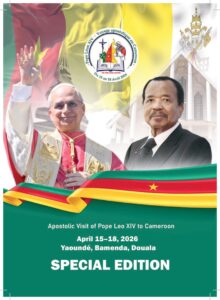
Cameroon is no stranger to the institutional weight of the Catholic Church. With a vast network of schools and health facilities and a Catholic population estimated at roughly a third of the national total, the Church functions as a major provider of social services, particularly in areas where state presence is limited. This infrastructure forms the backbone of its peacebuilding role.
The theme chosen by Cameroonian bishops for the visit, That They All May Be One, drawn from John 17:21, signals a deliberate reframing of the Anglophone crisis. It is presented not only as a political issue but also as a moral and spiritual challenge. For practitioners on the ground, this framing reinforces both the legitimacy and urgency of their work within communities where the Church remains one of the most trusted institutions.
With this visit, Cameroon joins the small group of African countries to have hosted three pontificates. Pope John Paul II visited in 1985 and 1995, and Pope Benedict XVI in 2009. Each visit generated periods of heightened international Catholic engagement. While such moments did not resolve structural challenges, they did increase attention and support for Church affiliated initiatives. The question now is whether that attention can be sustained and translated into longer term backing.
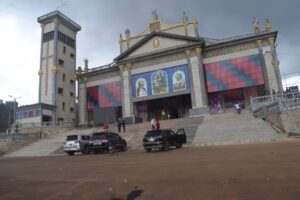
Beyond the Northwest, the visit also engages Cameroon’s youthful demographic. On April 18, Pope Leo XIV will meet students and academics at the Catholic University of Central Africa in Yaoundé. In the conflict affected regions, many young people have experienced prolonged disruptions to education, and some have been drawn into armed movements. Church led education and youth programmes have sought to provide alternative pathways, helping maintain connections to schooling and community life despite instability.
The timing of the visit adds further symbolic weight. It falls within the octave of Divine Mercy Sunday, a celebration instituted by Pope John Paul II emphasizing forgiveness and reconciliation. In a region marked by cycles of violence and grievance, that message resonates beyond theology and touches directly on the realities communities face.
Supporters argue that sustained moral attention at this level could help reopen humanitarian space and reinvigorate stalled dialogue efforts. Skeptics caution that the underlying drivers of the conflict, including political grievances, governance challenges, and economic marginalisation, remain unresolved, and that international attention often fades without structural impact.
Both perspectives risk overlooking what already exists. The more relevant question is not whether the Pope can create peace, but whether his visit can strengthen the systems that are already quietly sustaining it. The Church’s mediation networks, humanitarian operations, and community level initiatives are active and tested, and are constrained primarily by limited resources.
As the official message of the visit acknowledges, reconciliation cannot be imposed. It must be built gradually within communities themselves.
In Cameroon’s Northwest, that process has been underway for years, largely out of the spotlight. The visit of Pope Leo XIV will not resolve the Anglophone crisis. But if it succeeds in directing sustained attention and support toward those already engaged in the work of peace, it could mark a turning point. Not in ending the conflict, but in strengthening the foundations on which any lasting resolution will depend.
