
The story of Africa has for a long time been told through a narrow lens of hopelessness, which highlights war, starvation, and refugees undertaking perilous journeys in search of greener pastures in Europe and America. However, there is a bigger part of the story which hardly receives the deserved coverage. One which embodies a culture of hard work, resilience, social cohesion, steady infrastructural development and dignity.
Perhaps we could begin telling the African story the African way by piecing together the brighter and darker sides for the collective good.
That story begins with a trip to Daboya—a historic salt mining town that sits on the fringes of the White Volta and serves as the capital town of the North Gonja District in the Savannah Region of Ghana. For centuries, salt from Daboya gave taste to cuisines far and wide. The White Volta is the twin sister of the Black Volta. These two rivers traverse arid territories and grasslands and have played a pivotal role in the civilisation of millions of people.
We left Tamale, the largest city in the entire northern half of Ghana, on an expedition to Daboya. We were uncertain of what lay ahead. Were the roads good and safe? How would the people react to seeing strangers in the communities taking random pictures, recording videos and asking questions about their way of life? Would we be seen as the good people seeking to bring improvement with our cameras and voices or the villains seeking to merely broadcast their deprivations to the world?
Nonetheless, we had to proceed in order to bring the story of this captivating area to light. Far beyond our expectations, the road from Tamale through Tolon and then the southern bank of the White Volta was good. We were embraced by the cool breeze of the harmattan and rays of sunlight piercing through the windshield of our vehicle like a sharp sword through butter. A view of the countryside was awesome. Rocky terrain, marshlands, livestock grazing on vast grasslands, people gathering around springs dotted along the way, and children taking a mile walk to school in the quest for knowledge.
After nearly three hours, a signpost indicated that we had entered Daboya. There was still nothing but a few traditional houses to the left and right. Momentarily, high hopes nearly melted into despair. Then came the end of the asphalt road, and we began dancing through potholes and dust. Spotted on the horizon was a large military base strategically placed on a hill. It is the Ghana Army Special Operations Training School (A.S.O.T.S).
Just a few meters beyond, there lay the beautiful and majestic White Volta. She flows in humility and calmness. To strangers, she is not the kind that could unleash chaos, but those who have seen her in a fit of rage attest to her destructive tendencies. She has swallowed many homes and people in fury. She has given life to millions but has equally taken back hundreds. Regardless, she is loved and respected. She is an unbreakable part of their culture and routine, and hence, fear gives way to reverence.
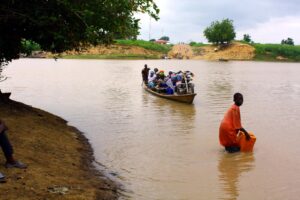
For centuries, people have ferried goods across the river using only canoes. Small canoes made of wood, which are spacious enough for at most ten passengers or even less when goods and motorbikes have to be loaded. The trip across lasts about five minutes. Each canoe is manned by a single captain who knows which parts of the river are safe to use and also does the paddling. These canoes do not run on outboard motors. They are an exact copy of those used centuries ago.
At first glance, one might tremble seeing women, children and men smiling as they board without any safety gear or life jackets. It is a sight to behold. Do they not think about worst-case scenarios? There have been many incidents where even larger boats and pontoons capsized after hitting tree stumps beneath the Volta River, leading to mass casualties. Why are people still going about it casually?
It did not take long before we found the perfect response. It is sheer willpower, courage and the determination to keep going in the midst of deprivation. The canoes have no life jackets for passengers and some are old and leak badly. Yet, the spirit of the people is undying. They will not fold their arms and wait for perfect conditions before acting. They basically endure, improvise, adapt and overcome. Threats are turned into new avenues for survival wherever luxury is a distant dream.
Daboya has, over the years, seen a steady transformation.
From a settlement of a few thousand inhabitants with little infrastructure a few decades ago, it is evolving into a peri-urban community retrofitted with all the necessary infrastructure and a growing population. Mud houses with thatched roofs are being replaced by modern ones, dusty roads are getting tarmaced, financial institutions are springing up, and businesses are emerging.
Unlike centuries ago, salt mining is no longer the main economic activity. The focus has shifted to the coastal towns of Ada, where there’s an endless deposit of easily extractable salt for nearby refineries. The sea never runs short of salt, as is generally accepted. Daboya is an economic hub. Expansion of farming activities is evident. There are a number of sheanut processing factories and Non-Governmental Organisations (N.G.Os) focusing on health, education and skill development.
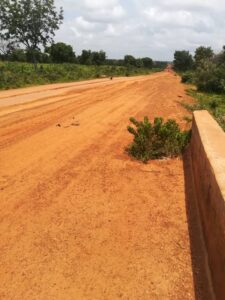
The district is very large, and the next large settlement from Daboya is Mankarigu, more than 100 kilometres away. This part of the journey, however, was not as serene as the initial one from Tamale. It was more than 100 kilometres of dust and potholes. Roads and bridges were under construction over waterways as excavators worked to level the inundated area. For such a large district with sparse settlements, the task of meeting developmental needs is herculean. Nonetheless, it is inspiring to witness a semblance of governance and institutions doing their best.
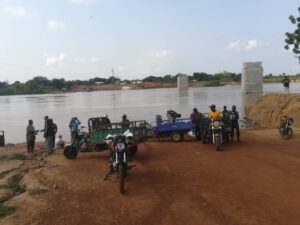
Another worthy observation is the construction of a bridge over the White Volta at Daboya. This would link the two banks of the river, allow vehicular movement and improve public safety. The canoes have served people with distinction, but it is time for civilisation to take over. The dawn of a new awakening and a beckoning socio-economic transformation of African communities.
The story of Daboya is not exclusive. It is the ticking clock representing how individuals, NGOs, the government and the community are collaborating for the welfare and development of communities. Daboya’s development is proof of how communities defy the odds and trample upon obstacles on the road to development. It is through such strides that Africa’s strength is felt.


