In the quiet hills of Nkwen village in Cameroon’s North West Region, now part of the Bamenda III Council, red-earth paths snake past small farms. Here, children still walk to school clutching books, firmly believing in the promise their parents once believed in: work hard, get educated, and the “Land of Promise” will reward you. For many young Cameroonians today, the situation is ironic, as many graduates with degrees are jobless.
A decade ago, Mathias Asongwe Fobi, also known as “Mal”, defied all the odds to become a doctor. A doctor who would go on to revolutionise weight-loss surgery and earn global recognition as Hollywood’s “surgeon to the stars.” As the world marked World Obesity Day on 4th March 2026 under the theme “8 Billion Reasons to Act on Obesity,” his story stood out.
With obesity rates rising sharply across Africa, threatening a new wave of diabetes, heart disease and other non-communicable diseases (NCDs), the breakthrough pioneered by a son of these hills may hold an unexpected key to the continent’s health future.
For decades, Africa’s public health agenda has focused on infectious diseases such as Malaria, HIV and Tuberculosis.
The numbers are increasingly difficult to ignore. According to the World Health Organization (WHO), adult obesity in the African region rose from 8.6% in 2010 to more than 12% by 2022, reflecting the continent’s fast-changing diets, urban lifestyles and declining physical activity. Projections from the World Obesity Federation suggest the trend could accelerate dramatically. By 2030, nearly half of African women may be overweight or obese, a shift that signals profound changes in population health.
Even more alarming is what is happening among children. Africa now accounts for about 28% of the world’s overweight children under five, a statistic that underscores how early the crisis is taking root and how long its consequences may last.
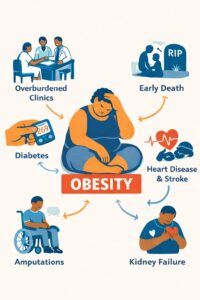
Cameroon mirrors these continental trends. Recent health estimates suggest around 40% of adults are overweight, and projections from the World Obesity Atlas indicate obesity prevalence could reach 28% by 2035. The economic implications are equally serious. By 2035, obesity-related diseases, including diabetes, cardiovascular illness and certain cancers, could cost Cameroon around 1.6% of its GDP annually through healthcare spending and productivity losses.
Public health experts warn that the continent is entering what epidemiologists call a “double burden of disease,” where infectious diseases persist while chronic illnesses rise rapidly.
“The obesity epidemic in Africa is accelerating faster than our health systems can adapt,” says Nomathemba Chandiwana, chief scientific officer at the Desmond Tutu Health Foundation. “If we do not act now, millions of Africans will face preventable diseases linked to obesity.”
The consequences are already visible. Diabetes, hypertension, cardiovascular disease and obesity-related cancers, once considered illnesses of affluent societies, are increasingly common across African cities and towns.
The Boy Who Refused to Stay in His Lane
Born in the summer of 1946 to Vincent Tamfu Fobi, a farmer, and Barbara Ngeche Fobi, a housewife, Mathias was the seventh child in a humble farming family. He began his education at the Roman Catholic Mission, St. Joseph School of Mankon. In 1961, he was among the first students at the newly opened Sacred Heart College, Mankon, where he and his classmates helped physically build the school brick by brick. Those formative years instilled in him perseverance, discipline and hard work.
His passion for medicine was ignited by a childhood event he never forgot: watching Dr Dibue administer a life-saving treatment for his mother’s severe Asthma attack. In 1965, his stellar performance won him a medical scholarship to Lovanium University in the Congo. But favouritism in Cameroon led to its unjust revocation. Undeterred, young Mathias spent his savings on a two-day journey to plead his case with Vice President John Ngu Foncha of the then Federal Republic of Cameroon. He was turned away by the secretary – a rejection that left him disheartened but wiser.
Years later, a similar incident in Los Angeles, where a man shared his failed attempts to meet Dr Fobi, revealed the unintentional barriers that power can erect. That realisation reinforced Dr Fobi’s lifelong commitment to remaining accessible to those who seek his help.
In 1966, resilience paid off. He received an offer from the American Scholarship Programme for African Universities (ASPAU) and left Cameroon for the United States. He completed a five-year Pharmacy programme at the University of Michigan in just four years, then graduated from the University of Cincinnati College of Medicine in 1974. With extra time, he returned to Cameroon to explore the medical landscape at Hôpital Enongal EPC in Ebolowa. That experience confirmed his decision to specialise in surgery – a unique choice that would set the stage for a career spanning continents.
Back in the United States, Dr Fobi completed a four-year general surgery residency at Martin Luther King Jr. Community Hospital in Los Angeles, rising to become Chief of the General Surgery Division. There, he encountered a patient suffering severe complications from an intestinal bypass for weight loss. Despite her suffering, she told him she preferred her new, lighter self because people treated her with respect rather than disdain. That pivotal moment deepened his understanding of the societal prejudice surrounding obesity and steered him toward bariatric surgery.
Inspired by Edward E. Mason, the father of obesity surgery, Dr Fobi performed his first gastric bypass in February 1976, successfully alleviating the patient’s complications. Demand became overwhelming. In 1981, he opened the Centre for Surgical Treatment of Obesity in Los Angeles, the first U.S. centre dedicated exclusively to obesity surgeries. There, he innovated “The Fobi Pouch,” using a silicone ring (the Fobi ring) to enhance weight loss by 10-15% compared to traditional methods. The results were striking: 90% of his patients maintained substantial weight loss within five years. Today, versions of the Fobi Pouch are used worldwide and remain among the most effective long-term treatments for severe obesity and metabolic disorders.

His influence extended beyond the operating room. Dr Fobi pioneered the recognition of hormonal changes after surgery to combat type 2 diabetes, hypothesising the role of incretins in modifying patients’ responses to food. This insight led to the identification and study of GLP-1, which later advanced treatments for diabetes and obesity through GLP-1 analogues.
His work earned him the nickname “Surgeon to the Stars,” with patients including Randy Jackson and Roseanne Barr. He became a founding member of the American Society for Bariatric Surgery and later served as President of the International Federation for Surgery of Obesity (IFSO) from 2008 to 2009, as well as President of the American Society of Metabolic and Bariatric Surgery Foundation (2006–08). He held esteemed roles at Cedars Sinai Medical Center and other leading institutions, where he established ASMBS-accredited Centers of Excellence.
Today, Dr Fobi is the Director of Clinical Affairs and Research at Mohak Bariatrics & Robotics and Clinical Professor of Surgery at Sri Aurobindo Medical College & PG Institute. He is a Fellow of the American College of Surgeons (FACS), the American College of Nutrition (FACN), and the International College of Surgeons (FICS). He is credited with 20 research projects on the surgical treatment of obesity, has made more than 450 presentations and lectures, and has contributed over 40 publications on obesity and bariatric surgery. Fobi saw this crisis coming decades ago. While the rest of the world was still focused elsewhere, he was building solutions.
The journey has been challenging, says Dr Fobi. When he sought approval from the U.S. Food and Drug Administration (FDA) for his Fobi ring, the agency required five years of data. His two-year follow-up data met less than half the required scientific standards. Financial pressures mounted, and European partners developed their own versions of the device. To avoid economic collapse, Dr Fobi and his wife chose to cease further investment, closing Bariatec Corporation, the company that produced the Fobi ring in 2019. He reflects on the difficulty of securing financing as a Black entrepreneur in the US. Still, his resolve remained unbroken. “I am satisfied that I contributed to mankind, and I have been richly rewarded,” he says.

Here is the question that keeps public health experts awake at night: How many more Fobis are we losing?
Brain drain is more than an academic term; it is a silent haemorrhage of Africa’s brightest minds. Scientists, doctors, engineers, and innovators from across the continent are achieving their greatest breakthroughs far from home. Individually, they thrive. Collectively, Africa loses.
Consider the Fobi Pouch. This medical device has saved countless lives; it is widely used except in Africa, a symptom of a system that fails to nurture, retain, and deploy its own talent.
“Africa must invest in its scientific talent if it wants sustainable solutions to emerging health crises,” says Professor Simplice Asonganyi, a Cameroonian public health expert. “Dr Mal Fobi shows what African minds can achieve when given the right opportunities. But when these minds leave, the continent loses more than a career; it loses the very solutions it urgently needs.”
This is about more than individual success; it is about national and continental survival. Every innovator who leaves takes with them potential breakthroughs, mentorship for the next generation, and the leadership needed to navigate Africa’s complex health challenges.
Addressing brain drain means more than incentives; it means building ecosystems, locally funding research institutions, supporting start-ups, better infrastructure, and creating career pathways where innovation meets impact. Africa can no longer afford to be a training ground for the world’s institutions while it bears the cost of unrealised potential.
The Man Who Never Forgot Home
Despite becoming a U.S. citizen in 1990, Dr Fobi has always held close to his Cameroonian heritage. He has been a beacon of support for international medical graduates arriving in the US, helping them prepare for licensing exams and offering paid positions to sustain their families. For this, he earned the affectionate nickname “Uncle Mal”, more a paternal figure than a colleague.
Through the NGWEBIFOR Foundation, named in honour of his grandmother, he has shipped containers of medical supplies and computers to Cameroon. He provided scholarships for family members to attend university, covering more than a year’s financial needs, and pioneered an HMO-like health insurance scheme for his extended family. His philosophy, “The greatest investment you can make is in people,” has impacted many.
In April 2014, Dr Fobi retired with ambitious plans to return to Cameroon and significantly enhance its healthcare system. But the escalating Anglophone crisis in the North West & South West (NWSW) Regions thwarted his return. Undeterred, he helped found the Association of Cameroonian Physicians in the Americas (ACPA) in 2016 following the tragic death of Monique Koumatekel in 2015. His dream is to reach “a critical mass to achieve the desired outcomes,” building a network for diaspora medical professionals to actively contribute to Cameroon’s healthcare landscape.
At 80, his contributions in the medical field have been immense. He has met with Presidents Gerald Ford in 1978 and Paul Biya in Los Angeles alongside Mayor Tom Bradley in 1985. He has operated on celebrities. He has trained surgeons from around the world. He has watched his innovation save countless lives.

Dr Fobi’s vision extends beyond Hollywood and India. In a message shared from his current base, he says: “Namaste! People globally are getting morbidly obese due to their improper lifestyle, genetic and environmental factors. I have spent a considerable amount of time in the USA working with such patients, and I have conducted extensive research, inventing new processes and products. I wish to replicate this success in India too—by transforming those overweight and obese lives.”
His words carry an unspoken challenge for Africa: If his methods can travel from Cameroon to the United States and on to India, why not back home? Why not a network of trained African bariatric surgeons? Why not a Fobi Pouch programme in Yaoundé or Nairobi?
His legacy is not measured in awards or famous patients. It is proof that when Africa nurtures its talent, the world benefits. It is proof that our solutions can be global solutions. It is proof that the boy from the hills can change the world. As he himself says: “The more you receive, the more responsibility you have to help others.”
As obesity tightens its grip on the continent, Africa faces a choice. We can wait for others to save us. Or we can remember the boy from Bamenda who refused to stay in his lane. We can invest in our own. We can build our own solutions. We can write our own future.
Because Africa is not just a continent confronting global health challenges; it is also a source of solutions. The Fobi Pouch exists because a Cameroonian boy dreamed beyond what his circumstances allowed. How many more solutions are walking our red-dirt paths right now, books under their arms, waiting for someone to believe in them?
This feature article was compiled by The Africa Feature Network’s Cameroon-based correspondents: Akere Maimo and Colbert Gwain.