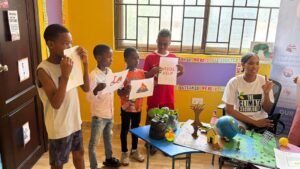
Emmaryn Leuzi, Founder- The Climate Sociologist at Climate Sociologist’s Climate education outreach for elementary school //Photo courtesy
Across Ghana, the effects of climate change are evident in the farms, markets, and homes of ordinary people. Farmers struggle with unpredictable rain patterns that affect planting and crop yield, while fishermen witness declining fish stocks in the once-booming waters. Coastal communities in the Volta, Greater Accra, and Central regions are watching homes and livelihoods disappear as rising sea levels creep inland. Food prices remain unstable as a result, and health risks such as meningitis continue to increase in communities in the Northern and Ashanti regions.
Despite these realities, climate knowledge in many schools and communities remains scarce or purely theoretical, even though the United Nations Sustainable Development Goal 13 calls for urgent action to combat climate change and its impacts. Learners are often introduced to climate topics through classroom theory, yet few connect these lessons to their daily lives or the challenges facing their communities. Despite interventions by governments, private agencies, and civil society organisations, the gaps in understanding remain.
For Emmaryn Leuzi, Founder of The Climate Sociologist, a community-oriented climate education organisation, this gap is more than an educational issue; it is a societal one. Drawing on her background in sociology, she observed that environmental interventions often fail because they overlook the human experience. She believes that scientific reports and policies benefit no one when they do not resonate with the people most affected.

In her words, whatever policy or environmental decision is made, “it is made by humans for humans,” and people embrace change only when it feels connected to their lived experience. To her, environmental issues are also social issues, and communities need to understand the world around them before they can protect it.
Leuzi expresses her conviction that the most urgent climate challenge facing Ghana and Africa is not infrastructure, money, or technology but education. Without climate literacy, communities cannot recognise problems, demand solutions, or safeguard their livelihoods. She warns that the absence of climate education limits the capacity to respond to rising conflicts over grasslands, declining food quality, dying animals and dispersal of families, adding that communities cannot demand what they do not understand.
Climate change touches every part of daily life in Ghana. Food scarcity drives prices up, livelihoods are disrupted, and communities face difficult choices. Even everyday tools, machines, and vehicles wear out faster due to higher temperatures and humidity.
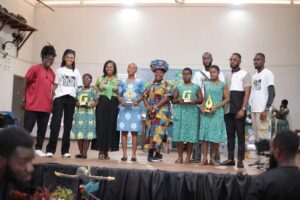
To address these gaps, The Climate Sociologist has developed a multi-level education model targeting children, youths, students, and adults. The approach is practical, community-centred, and culturally relatable. Young children are introduced to climate concepts through playful, hands-on learning that explains ecosystems and sustainability in simple ways. Mid-level students engage in creative projects that link climate ideas to everyday experiences. Senior High School students participate in Green Tales, an inter-school competition that blends climate learning with Ghanaian culture through research, poetry, drama, art, and quizzes.
For the youth and general public, the organisation uses socially engaging campaigns such as Ahaban, a mobile, music-driven activity that encourages the use of leaves instead of single-use plastics. Emmaryn and her team create an atmosphere filled with music, bicycles and approach street vendors to ask if they have leaves available. If not, they politely decline to buy. This creates a gentle but persuasive nudge that is both educational and entertaining. Rather than protests, the team relies on culture, energy, and positive peer influence to encourage behaviour change.
The results of these interventions, Leuzi says, have been visible. Vendors now offer leaves to customers, youth groups are designing creative packaging from local leaves, and students who previously saw climate change as an abstract topic are now asking about sustainability careers. Teachers are also adopting local examples to make lessons more relevant. Environmental institutions such as the Environmental Protection Authority and relevant ministries have opened their doors to youth-led input, while some companies are beginning to track carbon footprints and adopt environmentally responsible practices.
Schools that previously had to be visited are now contacting the organisation themselves, requesting climate sessions and partnerships. Still, challenges persist. Some institutions deny the reality of climate change, while others consider environmental issues secondary. Leuzi is convinced the biggest barrier is not financial but behavioural. She believes that attitude and sociological behaviour can drive change faster than money.
She argues that effective climate action requires merging scientific knowledge with social understanding and community behaviour. Climate science identifies the problems, sociology explains community responses, and behavioural insight ensures that change lasts. She observes that climate vulnerability is unequal and shaped by social structures, making interventions that are culturally aware essential for fairness. Communities adopt sustainable practices such as recycling or tree planting more willingly when they are embedded within shared norms rather than imposed from above.
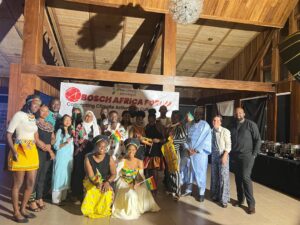
Looking ahead, Leuzi believes that the Climate Sociologist’s model can be replicated across Africa if adapted to local cultures. She observes that strong collaborations between educational institutions, civil society groups, climate-focused organisations, financial institutions, and manufacturers can accelerate progress more effectively than international conferences alone. Partnerships can embed climate education in school curricula and inspire youth-led innovations that address local challenges.
Her motivation comes from watching young people step into climate roles, including those outside the sciences. She points to financial institutions seeking advice on reducing carbon footprints and manufacturers adjusting their systems as signs of progress. Recent global meetings, including the Brazil conference of parties, showed a visible shift with young Africans demanding climate justice for their countries.
Through education, engagement, and cultural connection, communities in Ghana are beginning to see climate challenges not as distant global issues but as realities that require their participation. Leuzi believes that meaningful change starts with understanding, involvement, and small daily actions that collectively shape a better future for all.
This story has been featured in the just-launched Luminate Africa Journal, the first edition of The Africa Feature Network’s end-year magazine, and can be downloaded from the journal page. the journal page.