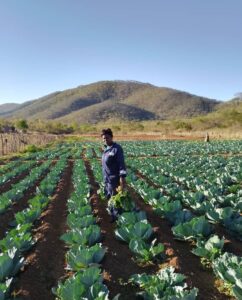
One of the irrigation gardens. Photo: Tafadzwa Mwanengureni AFN.
For most of her life, Beauty Fambi never imagined she would become a full-time irrigation farmer. She grew seasonal crops such as maize and soybeans while her husband supported the family through welding work. Farming was primarily for household consumption, not for income.
That changed in 2017 when Fambi, a mother of four, joined a garden irrigation scheme introduced by Women and Land in Zimbabwe (WLZ) in her community in the Makonde district, just outside Chinhoyi. This initiative marked a turning point that transformed her livelihood and financial stability.
WLZ is a membership-based organization that empowers rural women, particularly regarding land rights and climate change adaptation.
“Before I joined this initiative, my typical yield was one tonne of beans and soya beans each. Since 2017, I now get at least six to eight tonnes per harvest,” Fambi told Africa Feature Network (AFN).
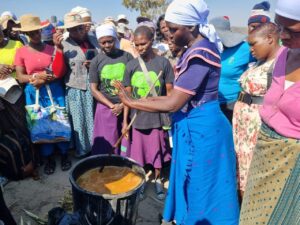
Launched in 2017, WLZ’s Irrigation Schemes Programme has revived dysfunctional irrigation systems and established new ones across 23 districts in eight provinces in Zimbabwe. The program has created more than twenty-five-hectare garden irrigation schemes, each directly benefiting about 50 women.
Women make up an estimated 70% of Zimbabwe’s agricultural workforce, placing them at the centre of food production.
Despite this, many remain highly vulnerable to climate change. Most communal farmers, the majority of whom are women, lack access to climate-resilient farming information, training, and financing, leaving them exposed to increasingly erratic weather patterns. Heavy reliance on rain-fed agriculture has further threatened rural livelihoods.
Speaking to Africa Feature Network, Olga Nhari, Founder and National Coordinator of the Women in Agriculture Union (WAU), said that Zimbabwean agriculture faces several intersecting challenges in the context of climate change. These included limited access to climate-smart financing, land tenure insecurity, gender-based barriers, and the impact of extreme weather events.
Through WLZ training and workshops, Fambi and thousands of women across Zimbabwe have gained access to irrigation infrastructure, farming tools, and knowledge, enabling them to transition from subsistence farming to cash crop production. This shift has significantly improved food security and household incomes.
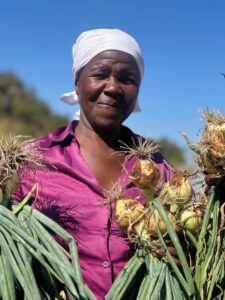
“They have acquired skills in good farming practices and agroecological methods, producing food without chemicals. Many have successfully uplifted their lives,” said Gloria Makahwi, WLZ Gender and Advocacy Officer.
“We have also trained them in market linkages and financial literacy, connecting them with financial institutions such as Econet, which provides loans and life insurance policies.” She added.
Despite the progress, climate challenges persist, as years of erratic rainfall led to water shortages at the irrigation scheme Fambi belonged to, forcing members to ration water. Many women dropped out during the dry season, returning only when the rains resumed. Determined to continue farming year-round, Fambi took matters into her own hands.
She drilled a borehole at her homestead and began replicating the WLZ irrigation model independently.
“Our garden engine was overwhelmed by demand from all members, so I couldn’t reach my desired yields,” she said. “I drilled a borehole at home and started applying everything I learned through the scheme.”
Today, Fambi grows cash crops including cabbage, beans, tomatoes, and green peppers throughout the year. She earns approximately US$250 per week from sales.
When the 2023–2024 El Niño-induced drought hit Southern Africa, Fambi’s household was spared from hunger. Her irrigation skills and diversified crops provided a reliable income stream.
“I learned how to make natural fertilizers using cow dung and urine, and how to use Cucumis ficifolius as a pesticide,” she said. “WLZ also taught us market research, record-keeping, and the importance of joining savings clubs.”
Makahwi explained that WLZ’s work is anchored on three pillars: solidarity, urgency, and empowerment. Through collective action, women amplify their voices, challenge patriarchal barriers, and advocate for their rights.
Fambi says women in her community now work closely with agricultural extension officers through study circles, where they discuss farming techniques as well as broader social issues affecting their lives.
Speaking to journalists ahead of the International Day of Cooperatives commemorations in August, Zimbabwe’s Minister of Women’s Affairs, Community, Small and Medium Enterprises Development, Senator Monica Mutsvangwa, highlighted the role of cooperatives in advancing inclusive development.
“Cooperatives operate at the heart of communities, benefiting marginalized groups, fostering inclusivity, and strengthening social cohesion,” she said.
“They uphold the principles of equality, solidarity, and self-help, and are instrumental in advancing gender equality, women’s leadership, and economic empowerment,” she added.
Nhari welcomed the continued focus on women farmers, noting that empowering them is critical for national resilience.
“Empowering women in agriculture is not just about gender equity,” she said. “It is central to food security and climate resilience.”
This story was featured in the just-launched Luminate Africa Journal first edition of The Africa Feature Network’s end-year magazine, and can be downloaded on our website at the Journal page.