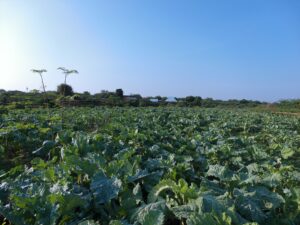
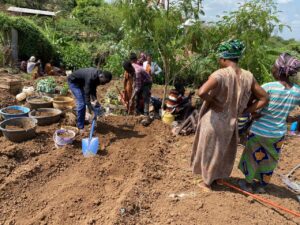
A sukuma wiki farm owned by Wamama Twaweza at Kakuma Refugee Camp. Photo: Sefu Sabila AFN.
Millions of people across Africa are forced to leave their homes every year, displaced by conflict, persecution or the effects of climate change. According to the United Nations High Commissioner for Refugees (UNHCR), more than twenty-three million Africans were displaced in 2024, including refugees, internally displaced persons and stateless individuals.
For these communities, refugee camps provide essential shelter and humanitarian assistance, yet life within them is often marred by harsh conditions, with limited access to food, water and opportunities to rebuild livelihoods. These camps, though temporary, have become spaces where resilience is forged and innovation begins.
Kakuma Refugee Camp in Turkana County, Kenya, the largest in Africa, is home to over 800,000 people from South Sudan, Somalia, the Democratic Republic of Congo and other countries, according to data by UNHCR. The camp is situated in an arid landscape where drought, hunger and scarce resources shape daily life.
Flash floods in 2024 damaged shelters and infrastructure, making survival even more precarious for both refugees and the host Turkana community. For many who reside in Kakuma, dependence on humanitarian aid has been the only means of survival. Into the bargain, the supply of food is never enough to meet the needs of all families.
Amid this challenging environment, Andrea Malilo, a Congolese refugee who has spent sixteen years in Kakuma, founded Hope for Refugee Life (HRL) in 2022.
“It has been a journey that began in June 2022. The idea of Hope for Refugee Life was born through personal experiences from Congo and here in the camp. Waiting for WFP to supply food, which has never been enough for families in the camp. I knew something had to be done. Sustainable and smart agriculture was the way to go, as I understood farming, as we always practiced back at home, before disaster struck,” Malilo explained.
Driven by personal experience and a desire to empower women, he began training refugees in sustainable agriculture to increase food access and create income opportunities. What started with two women working on a small, dry plot of land has grown into Wamama Twaweza, a Swahili word which translates to ‘As Women We Are Able’.
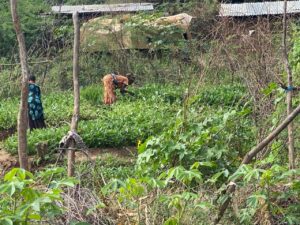
Malilo recalls the early days when convincing women to believe that vegetables could grow in arid soil seemed impossible, yet their determination turned that vision into reality.
Because refugees are not allowed to own land, HRL introduced creative approaches such as growing vegetables in containers, old tyres, raised beds and wooden boxes. The women learned to select crops suited to the local environment and to use a shared solar-powered pump to water their plants efficiently.
They grow amaranth, jute mallow, sukuma wiki, spinach, moringa, cassava and sweet potatoes, which are used for home consumption and sold in camp markets, providing both nutrition and income. When yields of sukuma wiki began to decline, they switched to other crops, resulting in a bumper harvest of mrenda and mchicha.
Ensuring continued productivity, Malilo and the team further provide farmers with seeds, tools, distribution of compost manure and seedlings. With only one solar pump, each woman is given the pump for two days to water their farm, so that their crops do not dry up.
Additionally, due to limited resources, the team introduced a loaning scheme, Village Service Loan (VSL), which includes farmers from Wamama Twaweza, who save a portion of their profits and later take up loans to boost their production or venture into other businesses. Malilo says this was to cushion them during extreme conditions and train them on financial management and discipline.
“We came with VSL, as a majority of women did not plan well with their profits. In VSL, women contribute 20% of their profits, which they can access after six months. We encourage them to do other income-generating activities to support them as a backup plan when the conditions become unbearable,” Malilo explained.
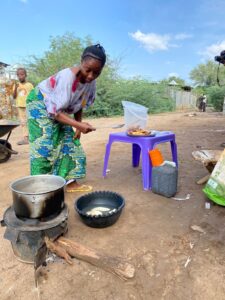
Machozi Kasongo, a Congolese and a beneficiary of VSL, says her savings from the scheme enabled her to open up her fried cassava business at Kakuma One, a unique venture warmly embraced by other refugees aside from their normal cultural foods.
“My current business is a product of VSL. It has supported me so much. My savings from vegetable sales have enabled me to order cassava as far as Kitale, and sometimes within Kakuma. As Wamama Twaweza, we want this programme to be long-term. Many of us can now fully provide for our families without donations,” Kasongo said.
Her colleague Vumilia Isia, also a Congolese, said not only VSL, but her farming has enabled her to fully provide for her family, and access better healthcare services within Kakuma.
“This was lifesaving. I’m proud of Hope for Refugee Life taking me through farming. From the little sales of my vegetables, I can buy other foods to complete the vegetables. Most importantly, as refugees, it is difficult to access quality medical services. We are often offered painkillers without diagnosis, but with my money, I can now access medical services at the hospital of my choice, and receive better services,” Isia said.
Other than Machozi and Isia, the initiative has transformed many lives in the camp. Achol Kiir, a South Sudanese farmer and vendor in Hong Kong Market within the camp, can now supply vegetables to her family, the camp and hopes to reach Kakuma Town and Kalobeyei Settlement. Nyamol Nyapiir, a deaf South Sudanese woman, has also gained independence and dignity through farming, among many others.
Though making some strides in the camp, Malilo attributes the lack of funds to their success as organisations. “Access to financial services is one, running an organisation voluntarily is not easy, we have limited funds as some of our members are not working, making it difficult to make the monthly contribution. We do train monthly, the number keeps growing, we end up lacking structures to hold these women,” he explained.
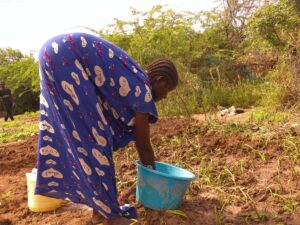
Despite this, over two hundred women have been empowered through Wamama Twaweza, and the initiative continues to grow. HRL also encourages the planting of fruit trees to meet the high demand for fresh produce within the camp and works alongside organisations such as Farming Health Education, which has constructed over eight hundred kitchen gardens.
Hope for Refugee Life demonstrates that refugee-led initiatives can create lasting impact. Malilo and his team urge governments, NGOs and donors to support such organisations, recognising that refugees are not simply recipients of aid but innovators, leaders and change-makers.
Through perseverance, ingenuity and community solidarity, Kakuma is slowly transforming from a camp defined by dependence into a hub of opportunity and hope, where refugees are able not only to survive but to shape their own futures.
Efforts by HRL as well as Farming and Health Education (FHE) are closely aligned with the government’s programme of ensuring food security and zero hunger for all Kenyans by the year 2030, engraved on Sustainable Development Goal (SDG 2), which aims to end hunger, achieve food security, improve nutrition and promote sustainable agriculture.
This story was featured in the recently launched the Luminate Africa Journal first edition, and can be downloaded on our website journal page.