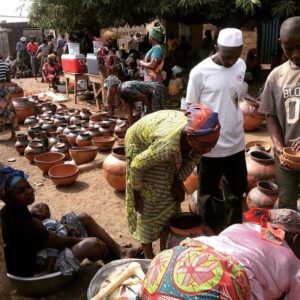
Pottery products by SWOPA for sale at a market in Sirigu in the Upper East Region of Ghana //Photo courtesy
The Sirigu Women Organisation for Pottery and Arts (SWOPA) in the Upper East Region of Ghana has played a crucial role in uncovering the potential and creativity of impoverished women in the Sirigu farming community.
Faced with declining yields from farming, it became not only important to revive the traditional arts of the women of Sirigu, but also to leverage them as an important source of income for the women and their families’ upkeep.
Due to low yields resulting from climate change, many youths migrated from the community to southern Ghana in search of greener pastures, which were scarce.
In the past, women sold their wares individually and hardly benefited. They could not get good prices for their wares. This prompted a 90-year-old retired educationist, Madam Melanie Kasise, to work towards establishing the organisation. Melanie wanted to give women group bargaining power in selling their wares locally, nationally and internationally.
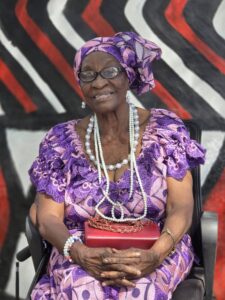
SWOPA started on April 25th, 1997, with only 54 women. The organisation was established for the Sirigu women to revive the dying traditional artworks, to serve as an eco-tourism site and to enhance their income. The Association was registered with Ghana’s Registrar General’s Department on October 16th 1997.
The organisation has also hosted many prominent people, including the late former United Nations (UN) Secretary-General, Mr Kofi Annan and his wife in 2004. The late Ghana’s Vice President Aliu Mahama and Ambassadors from many countries were also hosted by the organisation.
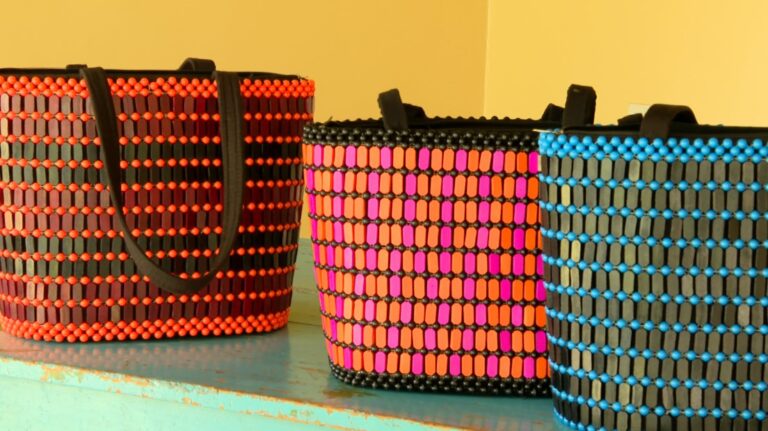
To date, the organisation has trained more than 400 women. They are made up of 50 basket weavers, 100 pottery makers, 50 canvas painters, 25 mat weavers, 20 batik tie-dye makers, 25 wall designers and 80 petty traders, among others.
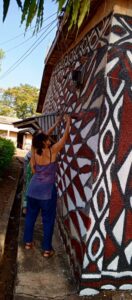
Indeed, the trained women in Sirigu have a peculiar style of painting that can be seen on the walls of their buildings. Their style of painting using red, black and white strokes has been passed through generations.
Their paintings also tell stories of their ancestors, beliefs and everyday activities. Notable among the wall paintings is the painting of a bird with a human head. Other wall paintings act as symbols for many things.
The drawing of a cow, for instance, on the wall is a symbol of wealth, while a bird symbolises hope for the future. A fish symbol shows a happy home, while a basket represents caring for one another. Bird and lizard symbols show friendship.
To keep arts and crafts alive, the organisation has been opening its arms to local women and tourists to visit the centre and be trained to make pots, weave baskets, paint walls or take home a piece of traditional, authentic local culture.
SWOPA, a women-centred Non-Governmental Organisation, also seeks to promote food security and the welfare of rural women in Sirigu and its environs.
In early 2002, it introduced canvas painting after tourists expressed admiration for the wall designs created on homes.
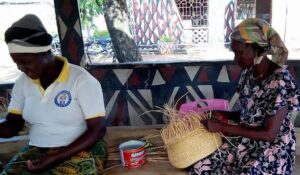
As a result of the numerous benefits enjoyed by members, many more women have joined the organisation, thereby increasing its membership.
By virtue of the positive impact SWOPA has made on the Sirigu community over the years, the community became the highest tourist arrival site in the region in 2019, with 1,064 tourist arrivals recorded for the area in that year.
It, therefore, did not come as a surprise when the organisation was subsequently adjudged the 2019 best tourist site in the Upper East Region by the Ghana Tourism Authority.
On the international scene, in 2015, SWOPA was honoured with a communications award from the International Cooperation and Development Directorate-General of the European Commission in Brussels.
The success story of this organisation was adjudged the best in West and Central Africa and the fourth in the world after the Business Sector Advocacy Challenge (BUSAC) Fund, which presented the organisation’s success story to the European Union (EU).
The BUSAC Fund also facilitated the extension of electricity to the SWOPA Centre, which has positively impacted the fortunes of the organisation by increasing production and sales of handicrafts and artworks by about 40%.
Since its establishment, the organisation has succeeded in promoting quality products that meet national and international market standards.
Furthermore, it has created sales outlets in the national capital, Accra. The ability of its members to cost their own products through empowerment sessions in basic costing and record-keeping training is another significant achievement. There has been a reasonable rise in the income levels of some members, leading to an improved standard of living.
The leadership of SWOPA has also created a forum for sharing ideas and honing skills among its membership.
It is significant to note that all the achievements by SWOPA did not happen in a vacuum, but were credited to Madam Melanie Kasise.
Madam Kasise conceived the idea of establishing the organisation at a time when many young women left the Sirigu community to find jobs elsewhere.
Madam Kasise is the daughter of a Sirigu woman who used her skills in pottery to pay for her education. Madame Kasise has now become a true success story, having appeared at the UN to talk on women’s issues. As the Founder of SWOPA, she continues to advocate for the rights and empowerment of women in the local community.
In her own words, Madam Kasise stated that “We provide a unique opportunity for women to come together to share and find solutions to common challenges, strengthen social ties, enhance our bargaining powers, improve our skills in the production of quality canvas painting, basket ware, pottery and art, and in so doing improve our incomes.”
Touching on the organisation’s plans, the Founder stated that they hope to train many young people every year in canvas painting and basket weaving. Madam Kasise further explained that drilling a borehole to support the women in their art production, searching for more market avenues to boost sales and launching the organisation’s cultural festival on the first Saturday of December every year are among other plans SWOPA hopes to implement.
Indeed, despite the achievements, challenges have persisted. The need for expansion and opening of more outlets has not been easy. Moreover, the poor road network within the Sirigu community has been a hindrance to moving cargo.
SWOPA’s work aligns with several Sustainable Development Goals (SDGs): SDG 1 – No Poverty; SDG 5 – Gender Equality; SDG 8 – Decent Work and Economic Growth; SDG 11 – Sustainable Cities and Communities, and SDG 4 – Quality Education (informal skills training).
The government of Ghana, development partners, public institutions and individual sponsors have been urged to support the organisation in improving the socioeconomic state of citizens.
This story has been featured in the just-launched Luminate Africa Journal, the first edition of The Africa Feature Network’s end-year magazine, and can be downloaded from the journal page.