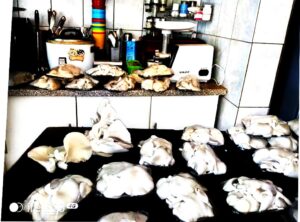
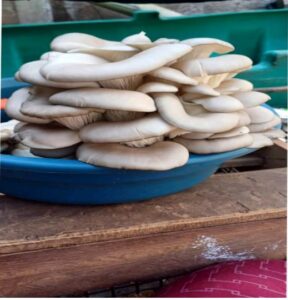
Oyster mushroom ready for sell-From Manicaland LOCADIA PUDURAI’S Javangwe mushrooms. Photo: Collen Maenda.
The Future of Hope Foundation, a non-governmental organisation headquartered in Zimbabwe, is a living testament to resilience, innovation, and the transformative power of sustainable livelihoods. The organisation was founded in 2013.
Today, the Foundation’s footprint stretches far beyond Zimbabwe. It has trained more than 1000 women in mushroom cultivation across the Democratic Republic of Congo, Tanzania, South Africa, and Mozambique, among other countries.
Its influence has also crossed continents—reaching indigenous communities in Australia and schools in India, where mushroom hubs are being adopted as tools for food security, income generation, and climate resilience.
This model aligns closely with the United Nations Sustainable Development Goals—advancing Zero Hunger (SDG 2) by improving nutrition and food access; Gender Equality (SDG 5) by economically empowering women and youth; and Climate Action (SDG 13) through a waste-to-mushroom cycle that reduces emissions while building local resilience.
These accomplishments reflect the Foundation’s mission: to capacitate, collaborate with, support, and mentor marginalised and vulnerable communities through entrepreneurship and self-development. By facilitating research, training, and innovation in sustainable food systems, the organisation is creating pathways to nutrition, income security, and human potential—one mushroom hub at a time.
Why Oyster mushrooms
At the heart of the Foundation is the remarkable story of its founder, Mrs Chido Govera. Mrs Govera grew up as an orphan, experiencing hardships not limited to hunger. Despite this, she transformed her ordeal into an empowering testimony of sustainability through mushrooms commonly found in most areas of Zimbabwe, especially in the rainy season. While still young, Mrs Govera had to fend for her siblings and learn adult tasks for survival.
What could have broken her instead became the seed of an extraordinary breakthrough after being introduced to Oyster mushroom farming using maize stalk waste. She learnt the art of growing mushrooms at her residence, turning a humble fungus into a lifeline for her family and others in the community.
As a young professional, she later refined the art of growing mushrooms with coffee grounds, a technique she pioneered and is now spreading worldwide.
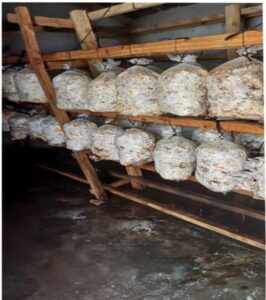
This mushroom-powered movement is now feeding thousands, funding education, empowering the less privileged and awakening a sleeping billion-dollar industry across Africa. Indeed, it is a true weapon for social change.
Oyster mushrooms stand out as a tool for food security and generate income. Among all mushroom species, this variety matures faster than the others, taking about 2 to 4 weeks to mature.
It sustains livelihood and provides a quick, ready and steady cash flow that cannot be realised from slow-growing crops, which take longer before maturity. Cultivation of Oyster mushrooms thrives on agricultural and natural waste. Farmers use what is already lying around, turning waste into valuable commodities for sustainability.
A kilogram of Oyster mushrooms requires only a small amount of water, which makes the plant suitable for drought-prone areas. Food is guaranteed even when the rains fail. Mushrooms generally provide a rich source of various nutrients for both children and adults.
They are sources of vitamins D, B, iron and zinc also suitable for pregnant women in food-insecure families. Additionally, they constitute cheap ways of addressing nutritional gaps.
It is gratifying to note that by promoting mushroom cultivation, Future of Hope Foundation is re-populating the environment for the good of mankind.
In a wide-ranging interview at Christon Bank, where Future of Hope Foundation is headquartered, Mrs Govera indicated that mushroom production has its fair share of challenges and chief among them is access to mother spawn culture, which enhances the cultivation of mushrooms.
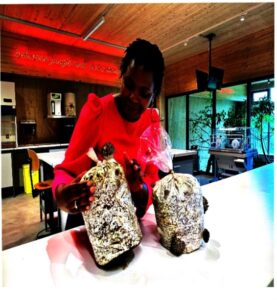
Currently, Zimbabwean mushroom farmers are relying on South Africa and Belgium for mother spawn culture production, which is negatively impacting sustained production.
The Foundation has therefore evolved strategies aimed at bridging the gap that exists for the networks of women and youth groups to access spawn culture that allows for the production of Oyster mushrooms at a relatively low cost.
Oyster Mushroom Community hubs
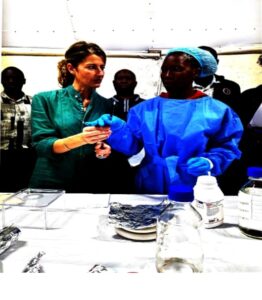
As part of the strategies to address the challenge, Future of Hope has established its mushroom spawn lab housed in a re-purposed shipping container where participants from across Zimbabwe and beyond learn the science and art of spawn production.
Additionally, Future of Hope and its partners have launched the Zimbabwe Mushroom Spawn Solutions, which aims to empower mushroom farmers through local mother spawn production.
Various spawn producers and representatives of key line ministries will be sharing knowledge to establish a resilient and self-sufficient mushroom value chain in Zimbabwe, thereby reducing reliance on imported material and facilitating preservation.
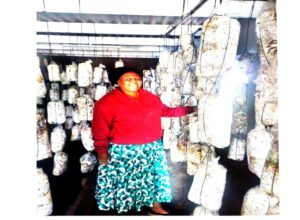
Over twenty fungi culture entrepreneurs are expected to undergo the training. The programme was made possible through funding by the European Union, and the Global Diaspora Facility of the International Centre for Migration Policy Development [ICMPD].
The Programmes Manager of the Foundation’s Christon Bank site, Mr Musariri Diza explained that “As a stopgap measure, Future of Hope had already started training some lead farmers in mother spawn production and multiplication to improve access to mushroom spawn in the areas where we have established mushroom cultivation hubs.”
The training, he said, will provide knowledge that will strengthen local mother spawn production capacity, as well as establish two mother Spawn Centres of Expertise.
It will also help develop a shared open-source mother spawn bank and establish a platform for mother spawn distribution, thereby entrenching the Future of Hope Foundation’s mission of empowerment and sustainability.
“With this project, we are bringing different players in spawn production and training them in advanced techniques that not only allow for spawn production but also cover strain selection, development and preservation. These new skills will enable us to venture into conservation of our local fungi in nature, Mrs Govera added.
According to Future of Hope Foundation, the global mushroom business is estimated at around $50 billion, and the African market sector is valued at $152 million, which is far lower than the global figure, meaning the market is waiting to be fully tapped.
Zimbabwe’s mushroom market size and growth are relatively small, fairly fragmented, with commercial farmers on one side and social-enterprise out-growers of women and youth groups feeding into the same chain.
That is why the Future of Hope Foundation has taken significant steps and established community projects in various parts of the country and region with established trainers in most areas. There are over sixty-five [65] community projects, over two hundred [200] community members and over five thousand [5,000] beneficiaries of the project.
In Zimbabwe, a group of women were fully equipped with the resources and is producing enough for consumption and sale. In Manicaland in Mutare town, a beneficiary, Mrs Locadi Pudurai, is doing the venture with her family under Javangwe Mushrooms.
She harvests about 20-30 pallets, which she packages into 200-gram (g) packs and sells to local people and travellers in Mutare town.
“I earn enough to cover everything that we need here at home and pay for my children’s education fees. The major problem we face is the acquisition of the spawn culture and contamination. We acquire our spawn culture from Harare, which is far away, which sometimes results in contamination of the spawn culture, and we lose a lot,” Mrs Pudurai said.
In Bulawayo, Zimbabwe’s second-largest city, Mrs Irene Sibanda is one of the beneficiaries of Future of Hope Foundation’s interventions. She went to Belgium to learn about Oyster mushroom production. She is now running her own Oyster mushroom hub at home and in another suburb in Hillside.
She said, “I train people who want to venture into Oyster mushroom farming in and around Bulawayo for a fee, as I am now a stand-alone entity, thanks to the Future of Hope Foundation programme by Aunt Chido. Oyster mushroom cultivation is a profitable business venture and easy to manage.”
In mid-Zambezi, home to the predominantly Korekore people, in Mbire, the Utariri Integrated Biodiversity Climate and Livelihoods Programme, funded by the Swedish Embassy in Zimbabwe, is supporting households. Over twelve thousand [12,000] households are beneficiaries of the programme.
The Utariri Communications Programmes Officer, Mrs Patience Ukama, indicated that the community initiatives have secured livelihoods through sustainable projects such as mushroom production and community gardens.
This story was featured in the recently launched the Luminate Africa Journal first edition, and can be downloaded on our journal page.