The World Bank Group’s economic overview as of 22/09/2025 highlighted that Kenya sustained steady economic growth over the last two decades, resulting in increased incomes, poverty reduction, and improved well-being among citizens. Further, the report indicated that the Gross Domestic Product (GDP) remained resilient in 2025 despite global uncertainties, with growth expectations of 4.5%.
With the labour market dwindling, employment growth declined from 4.4% in 2023 to 3.9% in 2024. Formal jobs stagnated at 15%.
To lessen the adverse ripple effects of unemployment in the village, a group of women in Migori County has founded a skill-based partnership to earn a living. From baskets to purses, cleaning detergents, knitting and necklace-making, Ober Women Group’s economic footprint has penetrated the village.
Deep in Kanyadgiro Village, Rongo Constituency, Migori County, we meet a vibrant community group affiliated with the Ober Seventh Day Adventist (SDA) Church.
Before the official launch of the group in 2023, Evelyne Anyango Ouma, the chairperson, who hails from the neighbouring Kameji village, postulates that the present registered members could hardly afford a meal for their families. Now two years old and still active, “Ober Christian Women Group” has brought about countless success stories in the village.
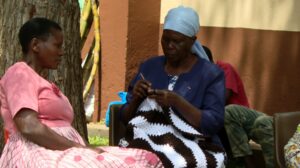
“We realized that women were just loitering in the village with nothing impactful to do. It is then that one of us, who is into the weaving business in Nairobi, shared the opportunity with us”, says Evelyne, who is flanked by a group of women engaged in different economic activities amidst our conversation.
It is not just basket weaving. Evelyne, with her team, was trained on several other economically impactful skill sets. Courtesy of the empowerment, the villagers are no longer wasting time on non-essential activities. These women redeem their leisure time on a newly found venture, a practice they say has limited their availability to potential village drama.
“All of us can make baskets, detergents, purses and necklaces. Each of us, however, decided to specialize in a specific art out of the choices we have so that we could train others competently”, states Evelyne, who has specialized in basket weaving, an art she says took her 3 days to learn.
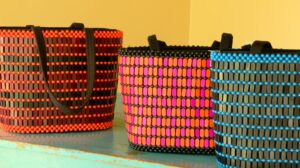
With the current membership standing at 16, Ober Women Group works tirelessly and collectively to produce artistic baskets from pieces of wood, which are painted in the style of the client’s choosing. Making a complete basket is a tedious and engaging process that requires a handsome reward, states Ober Women Group. The raw materials that make this stunning basket are ferried over 300 km away, from Kariokor, a market situated in Kenya’s capital, Nairobi.
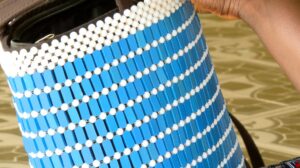
“We order in bulk these ready-made handbags, these woods, beads and fishing line. The beads and woods come in different colours. And to achieve this beautiful look, we join 64 or 68 woods with a fishing line, depending on the basket size. Thereafter, we count 10 sets of the 64 or 68 joined woods with beads and use the same to cover our ready-made black bag.”, says Evelyne as she weaves a blue-white patterned basket.
With the aid of a thread and a needle, the joined woods and beads are firmly bonded and cautiously stitched together.
Having mastered the skill, one should have beads, wood, fishing line, and a pair of scissors for cutting the fishing line. Weaving is a systematic process that requires time, as a single basket takes up to 4 days to complete.
Small, uniformly carved and uniquely painted woods with drilled-through holes are joined together with a fishing line to form an appealing colour pattern. In between the joined woods, bright-coloured beads are fixed to bring about the aesthetic appeal.
To differentiate a small basket from a big basket, a tape measure is used, but for experts like Evelyne, just a rough look and a quick hand estimate gives a desirable size. A big basket is size 30 while a small basket is size 28, and from the size, a price is determined.
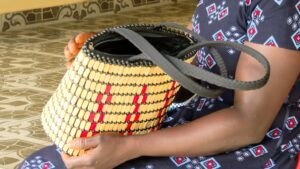
“A small basket consumes 64 woods times 10 lines up, and a big basket consumes 68 woods times 10 lines up. A good number of beads and fishing lines are also used”, says Evelyne, who assures potential clients of the durability of their products.
The products are not locally sourced. Evelyne and her group must pay the transportation cost from Nairobi to the village. They must also cater for the cost of buying the raw materials used to make these products.
“A packet of these ready-made woods is Kshs 480, a packet of beads, Kshs 480, we have to buy ready-made bags, a small one goes for Kshs 250, and a big one sells at Kshs 300, there is also transport cost from Nairobi to Rongo and from Rongo town to the village”, says Evelyne, who clarifies that the product cost is largely determined by the cost of production and the overall time spent in coming up with a finished product.
“A packet of these woods can produce two small baskets, with each small basket going for Kshs 1500 while a big-sized one goes for Kshs 1700. Another packet of beads also produces two small baskets”, says Evelyne
With its roots deep in the village, Ober Women Basket Weaving Group has carved out a name for itself in some of Kenya’s notable towns. Thanks to its culture of accepting membership widely, who act as good ambassadors.
Their success is attributed to the prioritization of customers’ needs and resilience. From the look, their products are undoubtedly attractive, hence the steady growth.
“We sell these baskets in Rongo market every Wednesday, and to promote growth, we welcome new members to join us at the end of every year after consolidating our finances”, says Evelyne, who expounds that the new members usually bring in fresh ideas which impact the success of the group.
“Like right now we have an opening for five, but we cannot just recruit, one has to show that he is not so preoccupied to the level that will hinder their role in the group, because this is a teamwork” says Evelyne.
A group that commenced as a community self-help now embodies a changemaker’s vision. Ober Women Group’s beehive of activities demands instant availability when called upon, an aspect that is keenly vetted for the new entrants. To uplift the socioeconomic status of the village, Ober Women group have set up two strategic training centres at St. Dalmas and at Winyo. They run the training free of charge.
“We often move around the village training people these skills, and we would want to have a reliable member who, when asked to spearhead these programmes, will willingly do it, not someone who is ever committed”, says Evelyne
To keep the group running, a portion of any profit made from sales is channeled to the joint account, and individual creators pocket a percentage for personal use. The Ober Women meet every Thursday to review and strengthen their growth.
“This money helps us in buying basic household items like cooking oil, soap, even books and pens for school-going children”, asserts Evelyne as she marvels at the financial strides they have made as a group, particularly on table banking.
“I used to hear the word table banking with other people, the fact that we are doing it ourselves today is an achievement, and I want to urge others to follow suit”, says Evelyne
It is an activity that, to them, has not rendered farming, the nation’s economic backbone, less important, as they strictly weave baskets during their free time.
“As we are speaking, we have a running project where we have a large-scale sweet potato farm and dairy farming, and this has been made possible with the little contribution we make in the group”, says Evelyne, who reiterates that they have done countless projects, from basket weaving.
On challenges faced, Evelyne recounts instances where certain members have in the past attempted to conceal profits from sales, thereby denying the group its share, something she fears could crumble their growth.
With the demanding economy, they sometimes struggle to get customers, or some customers pick baskets with the promise of paying only to become a nuisance and evasive. “The challenges are, however, unforeseen and should discourage anyone”, declares Evelyne.
With the widespread unemployment surge, Evelyne has encouraged all the youths and women, both employed and unemployed, to attend their weekly meeting on Thursdays at Ober SDA and be trained and empowered economically. This, she says, will ease pressure on family breadwinners by providing a source of income.
The Ober women Group is indisputably on a mission to defy the stereotype of old women not being able to fend for themselves, a challenge to the lazy youths. Echoing the words of the bible as a Christian community, they have reprimanded the youths that an idle mind is the devil’s workshop.
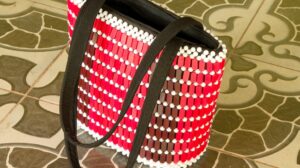
With local Competency-Based Curriculum (CBC), learners becoming beneficiaries of their undeniable weaving skills, Ober Women Group has undoubtedly positioned itself as a changemaker, beating all odds to reclaim the societal glory.
Their goal, challenging youths to create instead of seeking employment, many have welcomed this economic empowerment initiative that is redefining Kanyadgiro village.
This story was featured in the just-launched Luminate Africa Journal first edition of The Africa Feature Network’s end-year magazine, and can be downloaded on our website at the Journal page.