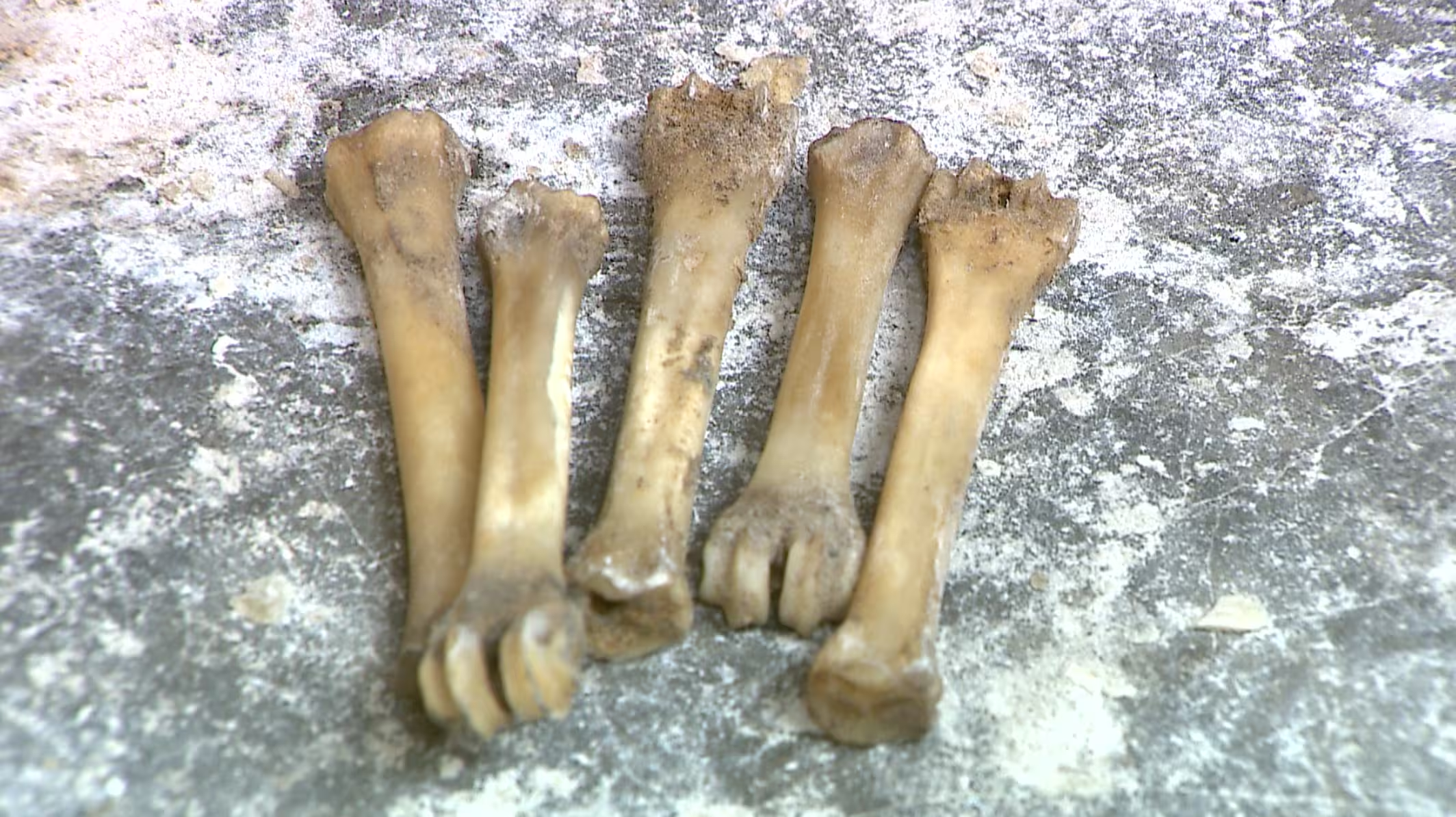
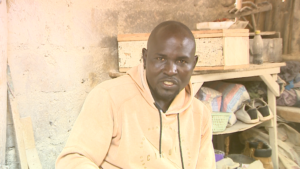
Kibera, Kenya – In the busy streets of Kibera, the largest slum in Nairobi, lies a gigantic structure, “Hawkers market”. Inside, a small action-packed shop dealing with animal bones is noticeable. Daniel Owino, a local resident, has been in this craft since 2001, doing rounds within the city to collect discarded bones and fabricate jewellery and artistic home decorations. Owino is holding a huge bone in his hand.
“This is a Camel bone, I source it from Burma Market along Jogoo road or Eastleigh, where animals are slaughtered”, says Owino “We work with goat, sheep, cow and Camel bones. The bones are shaped based on what is to be crafted”, reiterates Owino.
According to data released by Agroberichten Buitenland, meat consumption has risen, with Nairobi and Mombasa accounting for 75% of Kenya’s total consumption. 65% of the local production is locally consumed, 80% being red meat (mutton, camel, goat and beef).
The impact of the above figures on the environment is devastating. A quick check in Nairobi’s major slaughter zones usually gives an unpleasant image. Without a proper mask, the foul-smelling scenes of dumpsites adjacent to the slaughter areas can be unwelcoming.
Animal by-products such as bones, internal organs, skin, hooves and horns are openly dumped, and the result is usually unhygienic. A foul smell is creating discomfort in the neighborhood which additionally is a health hazard.
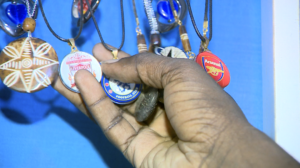
Owino’s craft not only increases the worth of bones perceived as valueless but also saves the environment from degradation. The seemingly untidy bones are picked, cleaned, processed, packaged and sold for more than the total input costs. The finished product is used for home and bodily beautification.
“Depending on how it is cut, we can create bangles, earrings, necklaces, bracelets, key holders, bottle openers, utensils, bag decorations and many other ornaments”, says Owino.
The Crafting Process
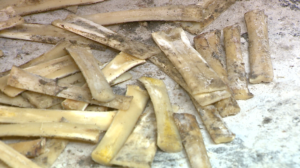
The craft starts by cutting off the two rounded heads of a humerus or femur, referred to as epiphysis, which fits into the hip socket. This is done on a grinding machine. The bone is later dissected across, to come up with flat pieces and further sized down to take the shape of earrings, bangle and necklace parts.
Owino powers on the grinding machine and carefully holds the two ends of the bone to cut off the two protruding ends (epiphysis). As the head drops down, Owino bends down, picks it up, tosses it and says, “We don’t use this one; however, there are people interested in it who use it elsewhere”.
Operating the machine requires caution. Owino reflects on past accidents that he has suffered on the job while tracing injury marks on the body.
After bones are cut into pieces, a powered rolling wheel covered with sandpaper is used to smooth their surface. The smoothened bones are then dipped into a mixture of Hydrogen Peroxide and water, overnight. The Peroxide is mixed with water to lower its corrosive effect on the hands.
“Peroxide extracts the oil remains, whitens and disinfects the bone”, says Owino.
After an overnight stay in Peroxide, the bones are removed and boiled in water to eliminate traces of Peroxide thereafter washed thoroughly before decoration starts.
Next, in a low heat, Owino melts candles and later immerse a small, sharp-pointed stick into the melted candle liquid and draws desirable patterns on treated bone surfaces. The drawn patterns cover parts that, when the bone is later soaked in a coloring liquid agent, will remain white as the uncovered parts turns to the color of the coloring liquid agent, hence forming beautiful multi-colored jewelry.
Here, a mixture of Potassium permanganate and water is used as a colouring agent. The bone is soaked in this solution overnight to achieve the candle-drawn pattern.
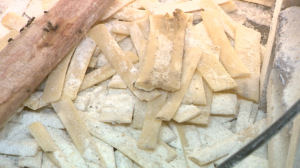
Once the pattern is achieved, using a piece of cloth, bathing is done to make jewellery shiny, and then the drilling of holes for suspension of threads and chains is done. Bathing involves intense rubbing.
Challenges and Success Stories
Owino appreciates the present technological advancement as he harks back to many years when he received this training from a group of elders from Suba area, in the Western parts of Kenya. Everything, including sandpaper smoothing, was done manually. The cutting was done with a hacksaw, which derailed the process.
All the individuals who started the venture with Owino went their separate ways, but still carried on with the craft.
The shortage of raw materials, such as bones, often hinders their operations. This is, however, celebratory news to the environment, which is relieved from the stressors of dumping. Sometimes their products do not move as they would wish. Owino has therefore urged the local government to come to their rescue by providing a ready market.
“International markets love Kenyan products as opposed to other products. The only challenge is penetration. If the government can help, in that we can greatly impact our country”, says Owino, who reiterates that “middlemen are reaping big from us”.
Locally, their products are exhibited at Maasai market, Village Market, Galleria, Sarit Centre, ABC and other markets. They also promote their products online. Their products are sold for as low as Ksh 200/= with others still selling at an affordable rate.
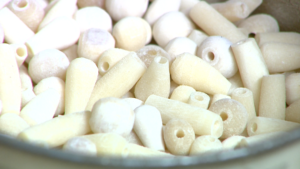
Often, Owino is forced to buy bones from restaurants to meet the growing demand for their products. Bone marrows are nutritious, and its soup is highly sought after in many hotels. Owino targets such places and buys these bones. Therefore, as hoteliers are forced to forego food to sell bones, the buyers must bear the cost. Going to his pocket to purchase the seemingly messy bones is a demonstration of passion in the craft. It is the kind of passion that leaves the environment improved.
“Whenever there is a shortage, we buy a camel bone at Kshs 70/= each and a cow bone at Kshs 15/= each”, says Owino, who reiterates that “some people move around collecting bones and deliver to our workshop at a cost. This clearly is a sign of employment creation”.
As many embrace this craft, competition is growing stiffer but the only way to remain relevant at the top is intentionality, professionalism and exceptional customer service. Owino welcomes others into the venture, he states, “When many join hands in this craft, our environment will improve, and families will have food on the table.
Owino’s workshop, packed with an assortment of jewellery, decorations, and utensils largely crafted from the supposedly worthless, smelly bones, is a testament to hard work and intentionality.
Advice to Jobless Youths
According to the World Bank Report, Kenya’s overall unemployment rate was approximately 5.4% to 5.6% between 2024 and 2025. Roughly 35% of Kenya’s population is youth, and over 1 million young people enter the labor market annually. To help in managing the burgeoning unemployment pressure, Owino has created a system where jobless youths are freely trained and absorbed in the workshop. Others are referred to available relevant opportunities.
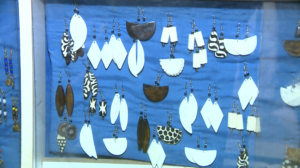
As Owino mainly focus on unemployed youths lacking advanced professional education certificates, graduates are not exempted. With the increasing urbanization in Africa, environmental pollution is sad a reality. There is, therefore, a dire need for startups focusing in environmentally-friendly businesses to come up.
Embracing ventures focusing on reducing waste and promoting reuse like in the circular economy is the way to a guaranteed sustainability.
“If we don’t stand to defend our environment against pollution, we will lose it, and sadly, we will die poor, but yet here, we have the opportunity to get rich while doing justice to the environment”, said Mike, a trainee.
“We provide our trainees lunch and breakfast, and sometimes a token to buy basic needs like bathing soap”, says Owino.
As many graduates focus on white collar jobs which are shrinking, Owino has challenged the youths.
“My advice to youths is to look around for problems they can solve, and they will be employed instantly. Let us avoid disdaining certain careers; all that matters is socioeconomic empowerment, career growth and food on the table,” says Owino as he wraps the interview with a smile.
Erick Oundah is a Multimedia Content Strategist and accomplished writer whose work delves deeply into Climate Change, Criminal Justice and Governance.