Waste management in Kibera, Nairobi’s largest informal settlement, has been a concern. Poor infrastructure and high population density form part of the hindrances to ending the waste menace. Research estimates that Kibera generates approximately 205 metric tonnes of waste daily, with a significant portion of it remaining uncollected. Studies show that approximately 50.8% of households dispose of waste in open areas.
Research also indicates that about 77% of waste in the settlement originates from households, including food leftovers, plastic packaging and paper wastes. Because most of it is not collected, it ends up blocking drainage systems, contaminating water sources and increasing the risk of water borne diseases.
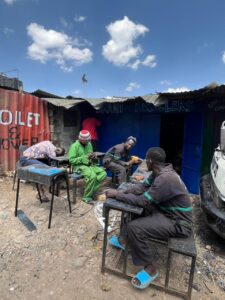
Solutions are largely driven by local youth groups such as Jirani Recyclers Kenya. Jirani Recyclers are repurposing plastic waste into useful products while empowering youth. The result of their effort is a hygienic environment. Today, piles of discarded bottles and bags are being transformed into school Desks, thanks to an initiative by Onyango Angila.
Across Nairobi, the city produces around 2000-2500 tonnes of waste every single day, yet a large portion of it litter the streets. Informal settlements are hardly hit. When it rains, waterways are blocked, and stagnant water bursts into residential areas, wreaking havoc.
“Waste blocks drainage systems and causes flooding during the rainy season”, explains the founder of Jirani recyclers. “It also creates breeding grounds for pests and diseases, and many plastics are burned, releasing harmful smoke that pollutes the air”, he reiterates.
Jirani Recyclers’ founder’s idea can be traced back to his childhood experience as a waste picker who would later scale up the ladder to a household collector. During his service as a waste collector, he experienced challenges such as poor waste management, which prompted him to create a solution.
“I grew up as a waste picker and later worked as a household waste collector in Kibera,” the founder explains. “ Through that experience, I saw firsthand the huge challenge of poor waste management in our community, especially the growing problem of single-use plastics,” said Onyango, founder of Jirani Recyclers Kenya.
“ I realized that waste was not just a problem but also a resource ,” reiterated Onyango. It is this realization that inspired the Jirani recyclers’ founder to launch the startup. Today, the initiative focuses on collecting plastic products and transforming it into useful products such as school desks while creating employment for young people in the community.
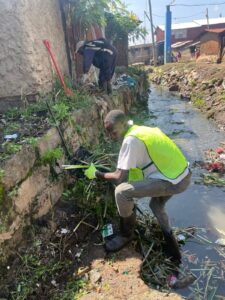
The work begins in the neighbourhood of Kibera, where waste collectors move from house to house gathering recyclable materials.
“We work with community members and waste collectors to gather waste from households, markets, and small businesses,” the founder says. “Our team organizes door to door collection and also works with informal waste pickers who help collect recyclables.” After wastes are collected ,they are transported to the recycling plant, where they are sorted and prepared for processing.
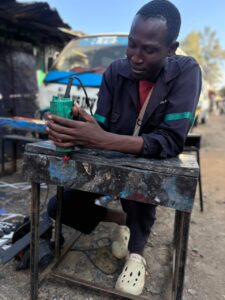
Inside the recycling facility, the waste undergoes a transformation. To begin the process, the plastic materials are sorted and then cleaned. They are then shredded into small pieces using specialized tools.
“The shredded plastic is heated and compressed using a heat press machine to create strong boards. These boards are then shaped and assembled to make durable school desks,” says Onyango. What was once discarded as trash has added value in the community.
The initiative also promotes sustainable solutions for organic waste. Food remains are composted into organic fertilizers which support urban farming.
“Food remains, and plant materials can be composted,” Onyango explains. “When composted, they turn into nutrient-rich fertilizer that can support urban farming.” In densely populated areas like Kibera, composting helps residents grow vegetables in small spaces while reducing the amount of waste sent to dumpsites.
Beyond environmental benefits, Jirani Recyclers is also addressing unemployment among young people in the community. “Our initiative has created opportunities for youths through waste collection, sorting, recycling and manufacturing recycled products,” the founder says. The organization also trains young people in environmental awareness and recycling skills. “This provides them with income opportunities while empowering them to become environmental champions in their respective communities.”
Since the project began, the founder says attitudes towards waste are slowly improving, and people are willingly embracing recycling. “Many residents now understand that waste has value,” Onyango says. Some households are starting to separate their waste, and more people are willing to participate in recycling activities.” Community awareness about environmental cleanliness is gradually increasing.
The Jirani Recyclers’ effort has, however, been met with hurdles. “One of the biggest challenges is limited infrastructure and resources for proper waste management”, the founder explains. Informal settlements often lack an organized waste collection system, and many community initiatives operate with limited resources. “There is still a need for more community awareness and more investment in recycling facilities,” says Onyango.
To expand its impact, Jirani recyclers collaborate with environmental organizations, community-based groups, and local authorities. “We work with community organizations, environmental groups, and the county government to support training and awareness programs,” the founder says. Onyango’s belief is that stringent policies could further support community-based recycling initiatives. “Policies that promote recycling, waste segregation, and support for grassroots recycling enterprises are very important,” he notes.
Looking ahead, the founder sees enormous potential for growth. “In the next five years, I see Jirani recyclers growing into a semi-automated recycling centre that can process more waste efficiently and create at least 200 green jobs for young people in Kibra,” he says. His ultimate vision is even more ambitious: a cleaner settlement where waste is no longer a problem but a resource. “I envision Kibra becoming a waste-free community where materials like plastics are recovered and transformed into useful products instead of polluting the environment.”
For the founder, the journey from a waste picker to an environmental entrepreneur carries an important lesson to many. When asked whether he hopes other communities will replicate the idea, he said many informal settlements across Africa face similar waste management problems.
Community-driven recycling initiative, he believes, can improve sanitation, create jobs, and protect the environment. His message to other young innovators is to believe in their ideas and start with anything they have.
“My message to young innovators is to believe in your ideas and start with what you have,” he says. “Many challenges in our communities can become opportunities if we approach them creatively. Stay committed, work with your community, and remember that even small solutions can create a big impact.”
In kibera, where waste once symbolized neglect, initiatives like Jirani Recyclers Kenya are proving that solutions can grow from the very problems communities face.