
Imagine coming face-to-face with death three times within a span of three hours. Each time a gun was pointed at you, ready to end your life, someone among your “killers” kept saying, “Don’t shoot her”.
That was how 28-year-old Elizabeth Achana, a native of Paga, in the Upper East Region of northern Ghana, narrowly escaped death in a terrorist attack in Burkina Faso. The attack claimed the lives of seven Ghanaian tomato merchants and left eight others severely injured.
“I saw my colleagues murdered right in front of me. Human life is nothing. Life itself is nothing to boast of. Love and humility are all we need,” those were Achana’s first tearful words in an interview with The Africa Feature Network in Accra. Achana recounted her traumatic experience, recalling the brutal murder of her colleagues during an ambush on a group of Ghanaian tomato traders.
According to her, when they reached Titao, tomato traders in that community asked them to stay so they could purchase tomatoes in larger quantities.
On Saturday, February 14, 2026, between 6:00 pm and 7:00 pm, Achana said that while travelling with her colleagues to purchase tomatoes, they suddenly heard gunshots and bomb explosions. The driver of their truck quickly steered the vehicle away from the scene, enabling them to escape unharmed. She added that a local leader later explained the violence was between Burkinabe groups, which led the Ghanaian tomato traders to downplay the potential risks associated with the incident. Unfortunately, the situation escalated when some armed attackers targeted the Ghanaian traders, killing seven of them instantly. Amid the chaos, one man managed to escape after most of his companions were killed. He later found refuge with Achana and her colleagues for safety.

She recounted regretfully that the armed attackers burnt their truck with people inside, and found the man who earlier sought refuge with the women traders and shot him dead.
Narrating her experience further, she explained that eventually help came from a Ghanaian who resides in Burkina Faso, popularly known as “Ambassador.” He made arrangements for the surviving Ghanaian victims to be evacuated back home.
“I want to thank Ghanaians and the government for their love and support. I pray for blessings upon the country’s leaders for the help they extended to us,” Achana said.
This tragic incident quickly went viral across various news platforms.
On Saturday, February 14, this year, Ghana’s Ministry of the Interior confirmed the incident.
A statement was issued on Sunday, February 15, by the Minister for the Interior, Mr Muntaka Mohammed-Mubarak, who described the information received from Burkina Faso as “disturbing”. He indicated that the attackers targeted a military camp in Titao, where some installations at the camp were damaged during the assault.
Titao, in northern Burkina Faso, has been facing repeated armed attacks in recent years and has been under siege by Islamist militants since 2019.
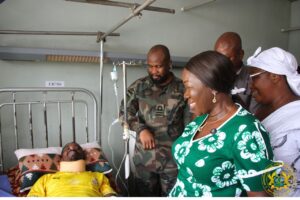
Ghana’s President John Dramani Mahama visited some of the victims at the 37 Military hospital in Accra. President Mahama, who was accompanied by the Chief of Staff, Julius Debrah, commiserated with the victims, describing the situation as unfortunate. He assured the victims that their medical bills would be covered by the government.
The Minister of Trade, Agribusiness and Industry, Elizabeth Ofosu-Adjare and the Minister of Transport, Joseph Bukari Nikpe also visited the injured tomato traders. Mrs Ofosu-Adjare condemned the attack, describing it as deeply unfortunate.
Following the incident, the Ghana National Tomato Traders and Transporters Association and the Ministry of Foreign Affairs temporarily suspended tomato imports from Burkina Faso. Burkina Faso, on the other hand, suspended all fresh tomato exports with immediate effect.
The decisions led to a sharp increase in tomato prices across Ghana.
At the Agbogbloshie market in Accra, for instance, the wholesale price of a basket of fresh tomatoes rose from GH¢3,000 (approximately $277), before the attack on the traders, to GH¢ 3,800 about (approximately $351) as of 19th March 2026. Ghana imports more than 400 million dollars’ worth of tomatoes annually from Burkina Faso. About 90 per cent of Burkina Faso’s tomato exports are destined for the Ghanaian market.
In Ghana, tomatoes account for nearly 40% of household horticultural spending, according to data from the International Food Policy Research Institute. Official estimates by the Institute put annual demand at 800,000 tonnes, driven by major urban centres including Kumasi, Accra and Takoradi.
The restriction has disrupted the thriving cross-border tomato trade between the two countries.
Without this trade, seasonal fluctuations and production shocks will directly and significantly affect tomato availability, dietary diversity and prices.
This incident highlights the growing risks faced by traders across Africa, including sexual harassment, extortion, corruption and violence. This attack represents a broader security threat to civilians as it disrupts regional economies and makes regional corridors unsafe.
Experts have called for a different approach to addressing insecurity in cross-border trade.
One of them, the Head of Security at the Ho Technical University, WO1 Issifu Zakaria (Rtd.), has proposed four key strategies to strengthen Ghana’s resilience amid regional instability.
First, he said Ghana must enhance intelligence-led diplomacy. Embassies in high-risk countries should function as real-time security advisory hubs, not merely administrative outposts.
Second, structured security coordination with trade associations must be institutionalized. Traders operating in volatile corridors require pre-travel risk briefings and, where necessary, escorted convoys.
Third, Ghana must invest aggressively in domestic agricultural resilience. Expanding irrigation and boosting local tomato production would reduce dependence on supply chains running through conflict zones.
It is significant to note that Ghana has already started implementing this recommendation.
In February 2026, Ghana introduced a National Tomato Production Strategy for the period (2026 to 2030). The plan seeks to reduce tomato paste imports from over $100 million annually to $20 million by 2030. It also aims to increase the share of locally produced tomatoes used by processors from seven per cent to 85 per cent.
On the fourth proposal, the security expert pointed out that bilateral security frameworks with neighbouring states must move beyond symbolic agreements and translate into operational border coordination.
WO1 Zakaria further insisted that regional instability must be treated as an extension of Ghana’s internal security environment, adding that “this tragedy demands strategic recalibration.”
“Security today is economic, diplomatic, and strategic, not merely military. If Ghana is to remain resilient in an increasingly unstable region, she must shift from reactive crisis management to proactive security architecture,” he concluded.
These recommendations by the security expert, if properly implemented, will ensure the effective execution of the African Continental Free Trade Area(AfCFTA) initiative, which aims to accelerate intra-African trade and strengthening Africa’s global trade position.