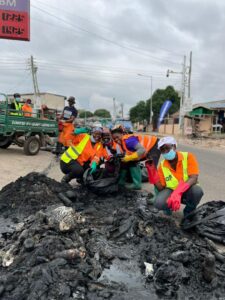
On a regular Saturday morning at Lapaz, a small community in Accra, Ghana’s capital, an elderly man stood among a group of other middle-aged men over a gutter, filled with plastic waste and mud. He worked passionately, taking his time as he scooped out the debris with a shovel. The street was, as usual, busy with murmurs of passersby, hooting of cars and individuals minding their business.
However, the exercise of cleaning gutters drew the attention of a few because it was an unlikely engagement in Accra unless the District and Municipal Assemblies organised clean-up exercises.
The old man’s volunteerism was motivated by Buzstopboys. He maintained that the kind of help communities needed to fight diseases, control flooding and combat other disasters was amongst them and that individuals had to make a concerted effort to improve their surroundings.
Although it was a straightforward comment, it revealed something deeper: a change in mindset. Their decision to clean that gutter was not an isolated act. Across the country, people had begun to take action in their own communities because of what they had seen young people achieve elsewhere. This is how one youth-led initiative became a national influence.
For more than two decades, waste management has been one of Ghana’s biggest concerns. According to the United Nations’ Interactive Country Fiches, the country generated more than 3,000 metric tonnes of plastic waste every day, amounting to about 1.1 million metric tons a year, and 86 per cent of this was unsustainably disposed.
This mismanagement appeared in visible ways: choked gutters, scattered plastic sachets, rubbish-filled streams and open dumping sites across the capital.
The situation had become part of everyday life in many communities. During the rainy season, drains overflowed because they could not carry water. Houses flooded, displacing people and damaging property, while roads became impassable.
Health issues such as cholera, typhoid and malaria persisted because of the state of the environment.
Another part of the problem was how people disposed of their waste. The UN reported that 11 per cent of the country’s waste was burned, and burning plastic released substances that polluted the air and contributed to climate change.
For many families, especially in crowded urban areas, burning waste was normal because it was often the fastest way to get rid of it.
The challenge was not only about waste collection systems; it was also about attitudes towards waste. Many people still believed that cleaning the environment was mainly the work of government agencies or paid sanitation workers. This mindset had slowed community action and allowed filth to spread.
About two years ago, however, a group of young people in Accra decided to respond differently.
The Buzstopboys began as a simple effort by one young man, Oheneba Kwadwo Safo, and his girlfriend. They cleaned their first area at Mallam Junction in Accra, long before gaining social media attention. Their purpose was straightforward: to clean and set an example.
He later formed a small team with the help of a cameraman and two more volunteers. They documented their work and posted it online, partly to encourage others and partly to make sanitation a normal topic among young people.
The name Buzstopboys was chosen because bus stops are familiar spaces for everyone. Whether rich or poor, walking or driving, people passed through bus stops. It became a simple way to communicate that cleanliness was a shared responsibility.
Their philosophy was centred on two things: changing mindsets and leading by example. Oheneba explained that their main mission was to promote a clean and green environment through patriotism, volunteerism and selflessness.
They believed that a change in mindset naturally led to environmental responsibility. Instead of talking about what should be done, they showed what could be done by doing the work themselves.

“We want a change, but the change that we want, we are acting the change for those who watch to also know how exactly they can help,” Oheneba said.
They cleaned gutters, swept public spaces, desilted drains and collected plastic waste. They also spoke to community members, especially young people, about taking ownership of their environment. It had not been without challenges.
This story was featured in the just-launched Luminate Africa Journal first edition of The Africa Feature Network’s end-year magazine, and can be downloaded on our website at the Journal page.