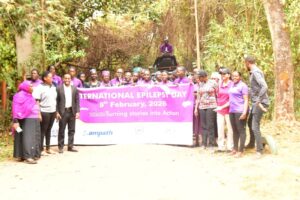
Dianah Wakahasama, Epilepsy Warrior, joyfully welcomes Epileptic patients to mark World Epilepsy Day 2026 in Trans Nzoia County, a region in Western Kenya. The annual event is held to sensitize the public and enhance the doctor-patient relationship.
Wakahasama has been battling epilepsy since childhood, a condition she has been raising awareness about, that one can lead a normal life despite the condition.
“I call myself an epilepsy warrior, because it has been a journey, with the help of epilepsy specialists, and taking our medication on time, as instructed by the physician. An epilepsy patient has to routinely take the medication as advised by the doctor without failing,” she said.
According to her, sticking to medication is key to recovery, as it is not a one-day process. Renny Kiplagat, another epilepsy warrior, narrates his journey. Despite many hurdles, including challenges of accessing medication in Hospitals, Kiplagat has remained resilient.
“Our medication within hospitals in the county is commendable. The primary challenge is access; the medicines are quite expensive, and some patients are required to take their medication three times a day, but many fail to obtain the necessary medicines when needed. Sticking to medication and doctors’ guidance has helped me lead a normal life. Unless I mention to someone I am epileptic, it is difficult to casually tell them,” Kiplagat proudly said.
Like Wakahasama, Kiplagat said it has been three years since he last had a seizure and was admitted to a hospital, as his seizures were extreme. He attributed the recovery to following the doctor’s guide on medication and taking the medication as prescribed.
In Sub-Saharan Africa, epilepsy has often been associated with a curse and black magic, and to some extent, possession by evil spirits. Mary Tulula, a caregiver to an epileptic patient and a Community Health Promoter (CHP), says she stayed with her child for years, moving around churches and native doctors for a solution, as she had been told her child had been bewitched.
“ I believed someone had cast a spell on my child. It was quite a challenge. I went for prayers believing she was possessed,” she said.
She later realized, after prayers failed to change the situation, that the condition can be managed through medication; now a champion through community health services, creating awareness on the need of parents with epileptic children to seek divine prayers and visit native doctors for a cure.
“I’m grateful to the doctors for enlightening us about this. My child was first diagnosed with Meningitis. Two months later, we learned it was epilepsy. She suffered a series of seizures. As CHP, we have sessions every Thursday. Across the county, we bring and encourage patients that it is a non-communicable disease and it can be managed,” she explained.
Dr Emmanuel Mwengi, Head of non-communicable disease at the Wamalwa Kijana Teaching and Referral Hospital, says the region fully believes it is a curse, but efforts are underway to explain to residents that it is a neurological condition, which can be cured, and patients can get assistance.
“In this region, many believe that epilepsy is a curse or demonic possession. We are currently trying to demystify that by creating awareness that epilepsy is a medical condition that affects the brain, and it can be treated, and patients can lead a normal life,” Dr Mwengi explained.

He notes that the misinformation and myths surrounding epilepsy form part of why so many affected patients hide for fear of being judged by the community. He further observes that the statistics accounted for are more than the number unaccounted for by the county.
“I believe the statistics unaccounted for surpass those that have been accounted for. Parents are still hiding children in hospitals due to stigmatization. However, we have had community meetings bringing leaders, stakeholders, and church leaders to create awareness among our people that it is a non-communicable disease and neither a curse nor a cast of evil spirits,” Dr Mwengi added.
Adding to Mwengi’s remarks, Dr Jane Von, from AMPATH and an advocate of epilepsy, says two or more seizures recorded on a person is a clear sign that one is epileptic and should visit the doctor, further dismissing claims of epilepsy being a curse of possession by evil spirits.
“It is a disease of the brain, and as we all know, we need our brain for normal function and humanity in totality; any failure is what results in seizures. When a patient has more than two seizures, we call it epilepsy. It is a disease of the brain and not a curse or evil spirit invasion,” she stated.
According to Dr Silas Wambulwa, a resident doctor for epileptic patients, Trans Nzoia County has more than 1,000 patients. This is according to a report of a sensitization exercise conducted in 2025 by epilepsy advocates.
“Previously, we only had 700 patients in our records, but I’m grateful to CHPs who have brought in patients after a successful awareness campaign in 2025. I’m glad to report that we have been able to minimize deaths caused by epilepsy. Patients are no longer experiencing seizures as medicines are currently available in all our facilities within the county,” Silas noted.
Data from the Ministry of Health, Kenya Medical Research Institute (KEMRI), and Kenya Association for the Welfare of People with Epilepsy (KAWE) indicate that an estimated 800,000 to 1,000,000 Kenyans live with epilepsy.
Approximately 17 to 20 per 1,000 people in Kenya suffer from epilepsy, and high cases are reported in rural areas as compared to urban settings.
According to the World Health Organisation (WHO), Epilepsy is a chronic non-communicable disease of the brain that affects people of all ages. Around 50 million people worldwide have epilepsy, making it one of the most common neurological diseases globally. Nearly 80 per cent of people with epilepsy live in low and middle-income countries.
It is estimated that up to 70 per cent of people living with epilepsy could live seizure-free if properly diagnosed and treated. The risk of premature death in people with epilepsy is up to three times higher than for the general population. Three-quarters of people with epilepsy living in low-income countries do not get the treatment they need.
Dr Wambulwa advised the general public to make a habit of attending medical check-ups, particularly when involved in accidents leading to head injuries. Other causes of epilepsy, according to the WHO, include brain damage from prenatal or perinatal causes like loss of oxygen or trauma during birth and low birth weight.
The rest are Congenital abnormalities or genetic conditions with associated brain malformations; a severe head injury; a stroke that restricts the amount of oxygen to the brain; an infection of the brain, such as meningitis, encephalitis or neurocysticercosis. Certain genetic syndromes and a brain tumour are also major causes of epilepsy.

According to the WHO, seizures from affected patients vary depending on where in the brain the disturbance first starts and how far it spreads. Other temporary signs include: loss of awareness or consciousness, disturbances of movement, sensation (including vision, hearing and taste), mood, or other cognitive functions.
People with epilepsy tend to have more physical problems, such as fractures and bruising from injuries related to seizures, as well as higher rates of psychological conditions, including anxiety and depression.
With technology taking over the world, Diana Wakahasama says they have taken the fight digital, aligning with the 2026 theme, “Putting Awareness Into Action.” The team has introduced a wristband and QR scan code to all patients, making identification and first aid response easier.
“We have wristbands with the patient’s name and contact details of an individual to call in case of any emergency. They are worn by patients. The wristbands have QR codes, a step-by-step first aid guide in English and Kiswahili, and details of a doctor and the disability office,” she explained.
She further highlighted that they are creating awareness on medical first aid assistance to save epilepsy patients, moving away from traditional methods that have reportedly contributed to the deaths of patients.
“We have the guide in the wristband. We are moving away from traditional methods to resuscitate the patient after a seizure, like putting spoons in their mouth, waiting for a mother with twins to put you between her legs. The wrist has details of patients, making it easier for the patients to be traced once they get seizures far away from home,” said Dana
Dr Wambulwa further added that the county has made efforts to ensure all facilities within have seven varieties of epilepsy medication. This has made it almost impossible for patients to miss dosses that could result from a shortage.
“Our population struggle more because of stigma than seizures”, said Dana.
Like Tulula, Wakahasama and Kiplagat, Dr Von called on society to show empathy to those suffering from epilepsy.
“I have worked with epilepsy patients for over 20 years, taking care of them before, during and after seizures. I have never had epilepsy, which means it is not contagious. I want to emphasise that epilepsy is not contagious and people with seizures do need help when they are seizing. Extending help to these patients is very important,” she emphasised.
Calls have also been made to religious leaders to guide their congregations with accurate information, as doctors raised some concerns about religious leaders claiming to ‘cast out demons and curses’ from epileptic patients. Doctors Von, Mwengi and Wambulwa emphasized that epilepsy is a brain condition that can be treated and managed, with patients able to lead normal lives thereafter.