For a long time, limited furniture supply has negated learning in Ghana. Learners in countless public schools sit on bare floors, kneel on concrete, or lean over broken desks to write. It is a dire situation that was confirmed by the 2024 report of the Education Management Information System (EMIS), which estimated that approximately 2.3 million pupils in basic schools lacked proper seats or standardized writing materials.
The report stated that the lack of furniture contributed to reduced engagement, affected posture and handwriting, and hindered the effectiveness of teachers in classroom.
Public schools in the rural and some peri-urban areas face the worst conditions. Some communities report that only 35% of their schools have adequate desks. In some districts, schools have gone more than five years without receiving replacements.
Amidst the shortage of furniture lies another challenge. Plastic waste continues to accumulate in homes, markets, and open dumps. The burning of these plastic pollutes the air that children breathe as choked gutters deteriorates the perennial flooding and damage property.

Across many communities, plastic is both a health hazard and an environmental burden. These two challenges of classroom discomfort and plastic pollution affect the same children in different ways. While one denies them a dignified learning space, the other compromises their well-being.
It is this connection that motivated a Ghanaian innovator to embark on an ambitious mission to create practical solutions.
Makafui Awuku is an innovator, environmentalist, and circular economy expert.
Over the years, he has contributed directly to Ghana’s national climate and waste management policy landscape. Key among them was his contribution to the Plastic Waste Management Policy, which was passed into law in 2020.
Through his outfit, he works across several areas such as policy advocacy, product innovation, recycling solutions, training, public installations, and startup incubation.
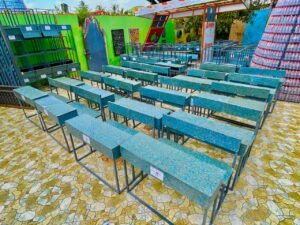
Some of his works include producing roofing tiles, flower pots and plastic school desks, all made from processed plastic waste.
Makafui has also trained 15,000 young people in Ghana, Nigeria and Liberia, and engaged with universities such as the University of Michigan, the University of Toronto and the University of Brighton as a guest lecturer.
Speaking with the Africa Feature Network during an interview, Makafui noted that the school desk deficit is severe and widespread.
“There is a $2 million school deficit in our schools. We are talking about schools where there are no desks for the children to learn on,” he said. In many communities across the country, Makafui also observed how plastic waste was being burned in the open, directly endangering young people.
These two realities formed the basis for his idea of using waste to solve a learning challenge.
“Plastic waste is being burnt in communities, and children are inhaling poisonous gases. Instead of choking our gutters, we should be able to turn the plastic waste into school desks,” he noted.
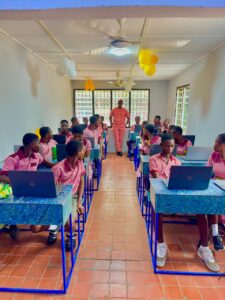
For more than five years, Makafui worked on research and product testing to develop a desk made entirely from recycled plastic waste.
Although Mckingtorch Africa had already worked on several recycling and innovation projects, the school desk was designed specifically to meet the needs of Ghana’s education sector.
The aim was to create a durable, low-maintenance, and long-lasting desk that could withstand heavy classroom use while reducing the volume of plastic waste in communities.
Makafui explained that after years of development, the desks were finally commercialized and are already in use after they have been tested by the Ghana Standards Authority and the Council for Scientific and Industrial Research (CSIR).
“We already have 400 desks in more than 12 schools,” he said.
The desks have been installed in schools across Greater Accra, the Northern Region, and the Ashanti Region.
He added that a computer lab in Accra has also been fitted with the recycled-material desks.
According to Makafui, his innovation does not only address the furniture deficiency but also helps reduce plastic pollution.
“This year alone, we’ve processed over 20 tons of plastic waste,” he noted.
This reduces the burning of plastic in communities and expands the recycling value chain.
The initiative has already created direct and indirect jobs for young people.
Rather than collecting plastic directly, Mckintorch Africa buys processed waste from women who work within the existing value chain. These women collect and aggregate plastics and then sell them to recyclers.
This model, he said, offers them a more stable source of income and strengthens a sector where women are often underpaid.
“I’ve created more than 15 jobs for young people with indirect jobs up to 50,” Makaufi noted.
The desks currently in schools have already brought relief in classrooms that had gone years without new furniture. He explained that the feedback from schools has been positive so far. Although the installations are recent, teachers have begun using them immediately, with the schools expressing satisfaction with their quality and durability.
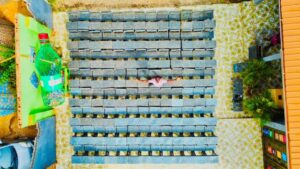
The initiative received further recognition when it was selected under the Paris Agreement Funding Program of the Global Environment Facility. As part of this programme, the Ministry of Environment, Science and Technology chose Makafui’s work as one of twelve projects aimed at reducing emissions from waste.
Through this partnership, the organisation will be able to deliver more desks to public schools.
Makafui disclosed that a commitment has already been made, and resources have been allocated for the production of these desks for selected schools.
“There’s a grant with the Ghana government for us to produce 500 desks, which will happen in 2026,” said Makafui.
Aside from government-linked programs, Makafui said other private individuals and organizations fund other desk installations in some schools through their corporate social responsibility commitments.
Although progress has been made, Makafui acknowledges that the scale of the problem requires broader support and increased production capacity.
“Two million desks are a lot of desks. It’s not something that you do in a few weeks or a few months,” Makafui noted.
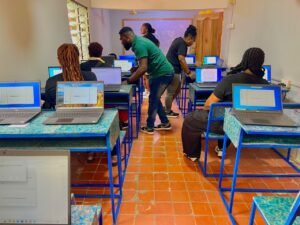
To meet the growing demand, Makafui is working on expanding production infrastructure. He is raising $1 million to build a factory that is capable of employing up to 1,000 people.
“I’m trying to raise one million dollars to build a factory that can employ up to a thousand people,” he said.
He also hopes to collaborate with the government to establish factories in ten regions to decentralise production and reach rural schools more quickly.
He notes that the President of Ghana, John Dramani Mahama, has expressed the government’s desire to shift from wooden desks to recycled-material furniture. Makafui sees this as a major step toward creating a larger national market for sustainable products.
“The president stated that he wants the country to move away from making school desks from wood to making them from recycled material.”
This direction, he believes, could influence procurement policies, encourage more partnerships, and expand the role of recycling in solving public-sector challenges.
Makafui believes that projects like his need collective support from policy makers, schools, civil society, companies, and ordinary citizens.
He is hopeful that more organizations will invest in recycled-material desks, and not only see them as furniture but also as contributions to climate action, education, and community wellbeing.
“We should all support these kinds of projects so that we can scale. There are sustainable jobs to be created, and if we implement this successfully in Ghana, we can replicate it in other countries with similar challenges,” he said.
This story was featured in the just-launched Luminate Africa Journal first edition of The Africa Feature Network’s end-year magazine, and can be downloaded on our website at the Journal page.