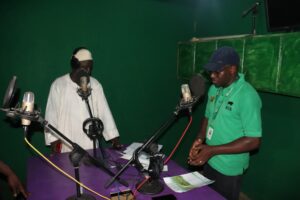
On a dry evening in Tcholliré, North Region of Cameroon, a family gathers around a battery-powered radio as the day’s heat fades from the savanna. A radio drama is playing in Fulfudé, the widely spoken local language of the area. Behind the microphone is Haman Saidou, station manager of “Radio Vie et Développement” of Tcholliré and the voice narrating the acclaimed drama “Ndzimzana: Bassiri Becomes a Friend of the Elephants”. The story follows a respected hunter who abandons poaching and chooses instead to protect the very forest he once exploited.
Stories like this are not new. Across Africa, development initiatives have long used radio to inspire reflection, amplify socially-aligned messages and encourage behaviour change. What is new, however, is the context in which this broadcast is being heard – a time of accelerating ecological pressure, technological disruption, and renewed debate about whose voices truly shape community action.
As newsrooms worldwide accelerate the integration of Artificial Intelligence (AI) into reporting, editing and distribution, a sharp debate has emerged: advocates see efficiency and expanded reach, while critics warn of eroded nuance, amplified misinformation and marginalized local voices. This year’s World Radio Day theme: “AI is a tool, not a voice,” celebrated on 13 February captures that tension.
Yet far from global media hubs, a quieter, grounded response is unfolding in northern Cameroon. In communities bordering Benue National Park, where elephants still roam and poachers persist, community radio stations are demonstrating that while technology may support journalism, the authority and trust of the airwaves still rest firmly in human hands.
In fact, Northern Cameroon offers a starkly different reality. Here, electricity is unreliable, internet access limited, and wildlife conservation challenges immediate. Elephants still migrate through farmland to retrace their ecological passage. Illegal hunting continues despite years of law enforcement. And most people still rely on radio as their primary source of information.
The question is not whether AI will transform journalism globally. It is whether it is relevant at all in places like this.
A recent initiative, JOSENORCAM (Journalisme en soutien de l’écosystème du Nord Cameroun), set out to answer a precise question: can modestly resourced community radio measurably shift public attitudes toward conservation in one of Cameroon’s most ecologically fragile regions?
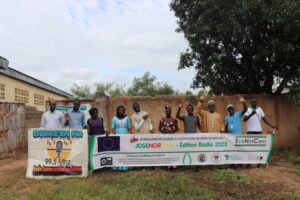
Launched in 2022 under the European Union–funded EcoNorCam project – implemented by Wildlife Conservation Society in partnership with Centre pour l’Environnement et le Développement (CED) and Forêts et Développement Rural (FODER) – the campaign supported 4 community radio stations in the North Region to produce conservation-focused journalism, public service announcements and radio drama. The goal was not technological novelty, but meaningful reach among rural communities surrounding Benue National Park.
Out of 14 eligible community radio stations, eight submitted complete applications, including three led by women journalists. A nine-member jury ultimately selected four stations whose proposals stood out for their editorial strength, creativity, and deep community relevance.

FM Rey-Bouba produced 10 micro-programmes, 10 public service announcements, and five magazine segments addressing climate change and human–wildlife conflict.
Mont Atlantika FM, Poli delivered one magazine programme, one micro-programme, and five radio spots focused on peaceful coexistence and the fight against illegal hunting. Derké’en FM, Ngong developed two magazine programmes and two radio spots highlighting the critical role of communities in anti-poaching efforts. Radio Vie et Développement, Tcholliré produced a powerful five-episode radio drama, Ndimzana, portraying the gradual transformation of a hunter into a committed conservation advocate.
Following an orientation workshop to refine schedules, budgets and editorial strategies, the radio programmes were broadcasted from November 2022 to January 2023, reaching wide local audiences. Project supervision reports indicate that more than 2,700 broadcasts aired during the three-month period in Fulfudé, Toupouri, Moundang, Fali and French, with Mont Atlantika FM exceeding its planned output more than tenfold. Yet output alone does not necessarily translate into measurable impact.
“Broadcast frequency tells you very little about behaviour change,” reflects Dr. Léopold Ngodji, Communication Expert and Lecturer-Researcher at the University of Garoua, who was not involved in the project. “The real question is whether people truly internalize what they hear — and whether that changes their decisions when their livelihoods are on the line.”
In Northern Cameroon, poaching is rarely ideological. More often, it is about empty granaries, insecure roads, failed harvests and limited alternatives. Critics of conservation communication warn that radio messages, however compelling, can oversimplify the hard survival choices that families face.
“People don’t hunt because they haven’t heard the message,” says a Garoua-based conservation policy analyst who requested anonymity. “They hunt because the alternatives are fragile.”
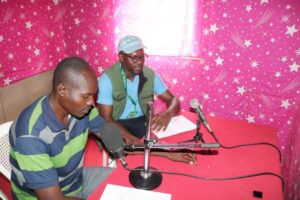
The organizers of the JOSENORCAM campaign acknowledge these realities. It was not designed to replace enforcement or economic support. Its goal was to rebuild trust between conservation authorities and communities and to reposition community radio from a passive broadcaster to an active facilitator of dialogue. For Djenabou Djam Weli, Manager of Radio FM Rey-Bouba, who emerged the first-place winner of JOSENORCAM, the initiative marked a turning point.
“Before JOSENORCAM, we spoke about conservation occasionally,” Djenabou explains. “After the project, we understood that wildlife issues are not just environmental topics; they are development issues. Climate change, farming losses, human–wildlife conflict, bush burning and what have you…these are daily realities for our listeners.”
In Tcholliré, Haman Saidou, Manager of Radio Vie & Développement and narrator of the five-episode drama Ndimzana, experienced a similar transformation.
“When we produced Ndimzana, it was the first time many listeners heard a conservation story that did not blame the hunter,” he says. “People came to the station to discuss it. Some even told us they saw themselves in the character.”
Rather than portraying poachers as villains, the drama followed a hunter grappling with declining wildlife, family pressure and community expectations before choosing to protect the forest. Monitoring reports describe extended discussions in village meetings and spontaneous debates after broadcasts.
“For us as broadcasters,” Haman adds, “we realized that conservation communication must respect people’s dignity. If you attack them, they switch off. If you tell their story honestly, they listen.”
Yet skepticism remains. “There is always a temptation to romanticize storytelling,” Dr. Ngodji cautions. “Drama can open the door to dialogue. But it can also create the feeling that something has changed, even when underlying conditions remain the same.”
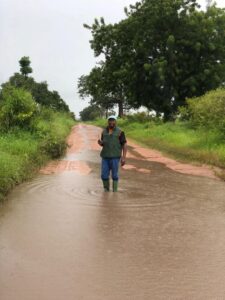
To test that tension, EcoNorCam staff interviewed more than 50 listeners across Ngong, Poli, Rey-Bouba and Tcholliré. What emerged was not blind enthusiasm but thoughtful demand: live call-in sessions with conservation officials, clearer explanations of wildlife laws, and tangible incentives for participation. That appetite for dialogue may be the campaign’s most significant outcome.
Unlike algorithm-driven content feeds designed for prediction and optimization, community radio in Northern Cameroon remains conversational and deeply local. Presenters shift languages mid-broadcast when they sense confusion.
Schedules adjust around planting seasons and market days. Programmes evolve because someone walks into the station with a pressing concern. Community radio stations operate with aging equipment, unreliable electricity and volunteer labour. Without sustained support not limited to funding, even the most powerful programming risks fading.
As global debates focus on AI and the future of journalism, Northern Cameroon highlights a different challenge. Here, the question is not whether AI will replace journalists. It is whether journalists working at the margins will be adequately resourced at all. For now, in villages where power outages are common but radios still hum at dusk, the voices of broadcasters like Djenabou Djam Weli and Haman Saidou continue to bridge conservation policy and lived experience.