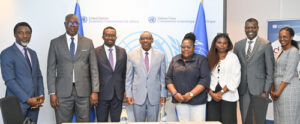
UNECA representatives and the FAJ delegation // Photo Courtesy
The United Nations Economic Commission for Africa (UNECA) and the Federation of African Journalists (FAJ) are exploring ways to strengthen development reporting across the continent by improving journalists’ access to credible data, research and technical expertise.
In a discussion held in Addis Ababa, Ethiopia, on 4 November 2026, UNECA Executive Secretary and United Nations Under-Secretary-General Claver Gatete and Federation of African Journalists (FAJ) President Omar Faruk Osman explored opportunities for stronger institutional cooperation to improve African journalists’ access to development information.
The discussions focused on strengthening journalists’ capacity to report on Africa’s economic and social development priorities, particularly the implementation of the Sustainable Development Goals (SDGs).
A major issue raised during the engagement was the need to equip journalists with reliable information and the technical knowledge required to examine development policies and their impact on communities. Access to credible research and data can help reporters investigate how public programmes are implemented, assess their outcomes and explain development issues beyond official announcements.
Gatete reaffirmed UNECA’s commitment to facilitating journalists’ access to credible information and evidence. He emphasised the importance of reporting that reflects African perspectives and priorities while communicating development challenges through people-centred solutions.
Improved access to institutional research and expertise would give journalists greater opportunities to examine development interventions, identify gaps in implementation and report on approaches that are delivering results. It would also help connect commitments made under the SDGs with the realities experienced by communities across the continent.
Independent journalism and public accountability
FAJ President Omar Faruk Osman underscored the importance of independent journalism in helping citizens understand government policies and decisions that affect their lives.
“Independent journalism plays an important role in helping people understand the decisions and policies that shape their lives and in supporting informed public debate on Africa’s development,” Osman said.
He noted that access to reliable information allows citizens to participate meaningfully in public affairs and contribute to discussions about the continent’s future.
The meeting also highlighted information integrity and access to credible information as important elements of inclusive and sustainable development.
Osman welcomed UNECA’s willingness to deepen engagement with media organisations, noting that stronger institutional cooperation would help journalists explain Africa’s development priorities and ensure the continent’s perspectives are represented in global conversations.
Journalists’ working conditions remain a concern
Beyond access to information, the FAJ delegation raised concerns about the working and economic conditions of journalists, calling for greater protection and support for public interest journalism.
The concerns point to another challenge facing independent reporting across Africa. Journalists need the resources and professional conditions to investigate complex development issues, undertake field reporting and scrutinise decisions made by public institutions.
The FAJ delegation included Treasurer Maria Luisa Rogério and Steering Committee Member Jean-Claude Coulibaly.
From discussions to practical action
The UNECA–FAJ engagement opens the possibility of a more structured relationship between development institutions and African media organisations.
Regular media briefings, specialised training on economic and social development reporting, direct engagement between journalists and researchers, and improved access to institutional publications and datasets could provide practical avenues for cooperation.
These opportunities are particularly relevant to solutions journalism, which examines how communities and institutions are responding to social and economic challenges. Access to reliable research and technical expertise would help journalists investigate the evidence behind these interventions, assess their results and document lessons that could inform similar efforts elsewhere.
However, neither institution announced specific programmes, funding commitments, implementation timelines or measurable targets following the meeting. The next step will be translating the willingness expressed by both sides into practical arrangements that journalists can access and benefit from.
Stronger cooperation between UNECA and FAJ could help bridge the gap between development research and public understanding. Its significance will ultimately depend on whether journalists gain more consistent access to credible information and whether that access translates into reporting that better explains Africa’s development priorities, progress and remaining challenges.