The world celebrated InterInternational Women’s Day 2026 under the theme “Giving to Gain,” and one woman stands out in her drive to forge gender equality through generous giving. With a mindset of generosity and collaboration, her efforts in supporting women in Science, Engineering, Mathematics, and Technology (STEM) in Cameroon have stood out.
Experts say STEM produces seasoned scientists/professionals who contribute to building a scientific and technology-driven, innovative, and developing society.
However, statistics from the World Bank, the Cameroon Ministry of Women Empowerment, and Family indicate that only 15% of Cameroonian women hold a master’s or PhD qualification, despite summing up to over 50% of the country’s population. There are only six women among the seventy scientists from Cameroon who studied in Germany under scholarships from the Alexander von Humboldt Foundation.
To turn the tide, Prof. Rosemary Tonjock Kinge , an Associate Professor of Mycology and Phytopathology, heading the Department of Plant Sciences at the University of Bamenda in Cameroon’s restive Northwest region, is extending her kindness to nurture the next generation of women in STEM.
Thanks to the opportunity from the Humboldt Foundation-Georg Forster Fellowship in Germany for advanced researchers, she fine-tuned her career as a high-level scientist and researcher. She is using her energy to give back to society, driving change, bringing more women into the field of STEM, with the realization that there are very few female scientists in Cameroon.

Before she returned from Germany, she was already a mentor.
“I was mentoring female researchers on their career prospects, publications, grant writing, leadership skills, and available life-changing scholarships, fellowships, and grants.” With the guiding principle, “we rise by lifting others”, Rosemary Tonjock is striving to ensure that more women sit at the table where important scientific decisions affecting society are taken.
Rosemary Tonjock, who belongs to specialized associations where she mentors women, such as the Higher Women Consortium and the Cameroon Professional-Oriented Network for Women (CaPROWN). She is also a mentor in the Organization of Women in Science for the Developing World (OWSD) and serves as the technical and logistics secretary at the Cameroon Academy of Young Scientists.
The Humboldt Alumni Networking Award motivated her to onboard more women into STEM. “And I won in 2024 alongside two others, from different countries, a grant of 30000 euros, for a three- year initiative called PROFAESTEM, Promoting Female Academic Excellence in STEM through innovative mentoring to reduce the gender gap in STEM. We guide women on how to write manuscripts, project role models from podcast stories, increase knowledge by organizing bimonthly webinar presentations, peer reviews, and joint publications,” she says.
Thanks to the PROFAESTEM mentoring app created for the project, Rosemary Tonjock organizes capacity-building seminars in grant and scientific writing, public speaking, leadership skills, communicating research findings, entrepreneurship, and matching mentors and mentees.
She started a webinar series where young scientists, including master’s and doctoral students, make presentations on various subjects.
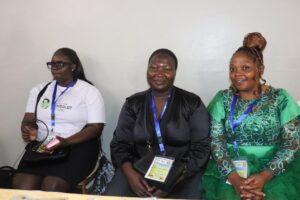
“We choose a topic of interest, select presenters, I edit and verify PowerPoint presentations, set up webinar time and date, and then produce flyers for the presentations, and by so doing, they acquire research and public speaking skills,” says Tonjock.
“The PROFAESTEM website is set to present STEM role models in videos from Cameroon and around the world. Their journey into STEM, successes, challenges faced, and how to overcome those challenges. This is another sort of motivation”, reiterates Tonjock.
To share knowledge with a wider society, Rosemary Tonjock has convened conferences in various fields, including biodiversity conservation and molecular biology, and a collaborative workshop with the Cameroon Professional Research-oriented Women Network (CaPROWN).
The Humboldt Conference in Bafoussam in November 2025, with many young female scientists in attendance, is one of the latest on her sleeves.
“This is the first conference that I am organizing for the Humboldt Foundation on gender networking in STEM, and it’s transdisciplinary for sustainable development.
The Foundation has an extensive alumni sponsorship, and this conference is just one of them. They sponsored me with equipment and supported a retained fellowship while I was coming home,” says Rosemary.
Rosemary Tonjock, who has an impressive career in Mycology and Plant Science, with 83 publications to her credit, challenged policymakers, researchers, educators, and leaders to be intentional about building and sustaining gender networks in STEM.
“Let us mentor young female scientists, not only to succeed, but to belong, move beyond representation to true inclusion. Through networks we build confidence, create opportunities, and revive the narrative of who belongs in STEM,” she emphasized.
Vera Nsoh, A young female scientist from the University of Bamenda, who attended the conference, said, “I have been exposed to different opportunities of mentorship and networking, and it is encouraging to know such opportunities are available for young researchers and the availability of experienced mentors like Rosemary Tonjock, who is a role model .”

Tonjock’s mentorship programme is yielding fruit.
“Two young scientists were awarded the Humboldt scholarship and the German Academic Exchange Service (DAAD) scholarship. Many are winning grants for their research work, and one is working at the Humboldt alumni hub in Yaounde”, she said.
However, the work Tonjock has been doing has not been without challenges. The dire sociopolitical situation in the Anglophone regions, internet access, and retrogressive culture have been hindrances to her dream. Husbands often challenge the idea of their wives travelling and working long hours in the laboratory. This, Tonjock says, slows women’s growth and their ability to publish.
“As a mentor, I tell young female scientists/researchers to share their vision with their future husbands, tell them what it entails.”
While the need to seek more funding is ever-present, research funds from the Ministry of Higher Education are a windfall.
As a mother of six, Rosemary, who has toured 26 countries, planned her travel when the children are in boarding school. She had to rely on her family, which provided a strong support system.
Rosemary Tonjock’s interest in the sciences and quality research began in 2004 while she was pursuing her master’s degree at the University of Buea in the Southwest region of Cameroon. The mentor encouraged Rosemary Tonjock to look for scholarships.

“I would go and buy time in a cybercafé and search for scholarships.” Her breakthrough came when she stumbled upon the TWAS-CAS scholarship. “In 2008, for the first time, I left Cameroon for China.”, she said
This was the beginning of her path to becoming the associate professor of Mycology and Phytopathology she is today. She was able to attend the University of Free State in Bloemfontein, South Africa, and the University of Florida, Gainesville, United States of America, thanks to the scholarships she won: The postdoctoral fellowship from the Agricultural Consortium of South Africa and the Fulbright Fellowship. She spent 18 months on the Georg Forster Experienced Research Fellowship at the University of Bayreuth, Germany.
“The Humboldt Fellowship is very interesting. And like a woman, it made me realize that I have attained my potential in academics, as one of the six women in the alumni of the Humboldt Fellows and 70 men as of 2024, in Cameroon,” Rosemay Tonjock says.