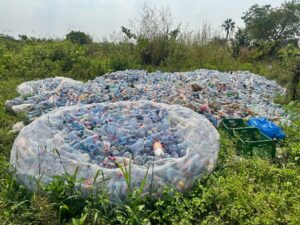
There is a constant production of waste in cities, just as our lungs produce breath. In places like Ho, Ghana’s Volta Regional capital, where urbanization is rapidly expanding, the critical question is not whether waste exists, but what can be done about it.
Even for a regional capital dubbed the ‘Oxygen City’, due to its relatively decent sanitation, there are still individuals who dump waste indiscriminately, hoping nobody complains too loudly.
Waste management across major urban areas in Ghana has been a challenge.
Urbanization has brought about a fair share of unhygienic challenges, particularly waste piles in the streets. Collection systems have stretched thin because recycling has become an afterthought. The result manifests in clogged drains, polluted waterways, flooding and communities that bear the environmental cost of a reactive system.
Traditional approaches to waste management focus on collecting garbage and landfill practices to keep waste out of sight.
However, two young men, Mark Benjamin and Roger Kofi Gyening, think that this approach is both lazy and outdated.
The duo, armed with degrees in Human Resource Management and Information Technology (IT), decided to embark on an entrepreneurial journey to treat waste like data rather than just garbage. After several weeks of waste management courses, they embarked on an incubation programme at the digital innovation hub of Node8 in Ho, nurturing their idea.
The two created Wasteman Ghana, a sanitation startup with a mission to implement this radical idea, especially in a country that often struggles to keep its waste systems in pace with urban growth.
The young entrepreneurs describe Wasteman Ghana as a “waste-data company.”
As complex as it sounds, the idea is surprisingly practical. Instead of just collecting waste, the company analyzes patterns behind it. Where does waste come from? How much is produced? What percentage could be recycled or recovered?
Speaking to The Africa Feature Network, Mark said the data is beginning to take shape and would gradually fill in the “no data” vacuum in the sector.
The company aims to optimize waste movement in communities by combining waste collection services with data analytics and technology.
This involves identifying inefficiencies, improving recycling opportunities, and reducing the amount of material that ends up polluting the environment.

Their strategy also leans heavily on the well-known trio of sustainability principles of ‘reduce, reuse, and recycle’. The difference is that Wasteman Ghana tries to apply those ideas operationally.
They have recently acquired shredders and a plastic washer, enhancing their capabilities to handle recyclables.
The young founders, however, say the company is in dire need of financial support to establish a waste transfer station to centralize sorting and processing of materials that are not properly segregated at source, in addition to a waste truck with a compactor.
This will bolster their journey toward becoming an independent waste processor.
While existing waste systems treat people as passive participants, Wasteman Ghana takes a different approach by focusing on community engagement alongside technical solutions. The company works with local communities, businesses, and public institutions to encourage waste segregation, recycling, and responsible disposal practices.
The young founders say education campaigns and outreach programmes are part of the model, indicating that the idea, although simple, is often overlooked.
“When people understand the system, they are more likely to participate in it.” One of Wasteman’s major goals is behavioural change. Though not glamorous, it is critical. “Sustainability is not just a goal,” says Mark.
“We may never reach zero waste, but that doesn’t mean we should take zero action,” reiterates Mark.
Wasteman Ghana is still relatively young, with barely two years of operation. The company’s ambitions, however, stretch much further into a vision aimed at helping transform the waste management landscape in Ghana by integrating technology, sustainability, and community collaboration.
Mark says waste management systems are complicated because they include logistics, infrastructure policy, economics, and human behaviour.
Changing these requires persistence, patience and money. Still, innovation in this sector tends to begin exactly the way Wasteman Ghana is approaching it through small interventions, better data, stronger partnerships, and a willingness to challenge old assumptions.
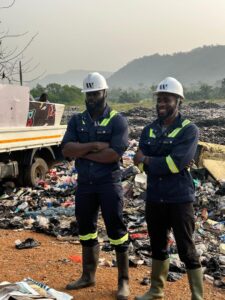
The company has so far distributed over 200 multiple waste bins, specially designed to handle waste segregation, with beneficiaries including schools, households, hostels and public offices.
Their ideas have received multiple awards, including the MTN Accelerator award and the Sustainability Startup of the Year award, indicating their impact in the sector.
They also participated in the Ghana Climate Innovation Centre incubation programme. Wasteman Ghana has become a relatively successful green job creator, a quintessential example of a self-sustaining, eco-friendly circular economy. It currently employs 15 individuals directly and has created over 50 indirect jobs in a plastic buyback programme.
According to the International Labour Organisation (ILO), the circular economy has the potential to create about 18 million green jobs by 2030. Additionally, the World Climate Summit estimates that approximately 65 million new low-carbon jobs could be generated by the same year. Green jobs and the circular economy are potential solutions to address unemployment and population growth.
There is, however, a need to develop effective strategies to localize these concepts, ensuring the creation of jobs that meet the needs of our population while being environmentally friendly. Experts also believe that the circular economy’s compatibility with Ghana’s largely informal economy makes it especially beneficial for people at the grassroots level.
A major drawback to a flourishing green economy, however, is the societal perceptions towards jobs in waste management. The perceived unattractiveness of the sector is further exacerbated by poor working conditions. This calls for a critical need to disabuse such mentality while dcreating proper working conditions to make waste management jobs more attractive.
Wasteman Ghana is also involved in rigorous advocacy against antagonistic attitudes and stigma directed at sanitation workers. Mark believes these educational campaigns are needed to shift societal perception, since they are critical in waste management. However, solutions like the one being tested by Wasteman Ghana suggest that environmental problems often look overwhelming due to the systems around them. For cities across Ghana, that shift could also mean that there will be fewer polluted drains, decreased flooding, healthier communities, and a new mindset towards how waste is treated.
Mark says Wasteman Ghana’s outlook in five years is to become a household name. He, however, acknowledges the logistical challenges and funding needs to support its growth and to encourage more youth participation in waste management.