The Nairobi River originates from a wetland complex, specifically the Ondiri Swamp, which historically served as a vital, clean-water lifeline (“Enkare Nairobi” or “place of cool waters”) for the Maasai and Kikuyu communities.
Its basin consists of several main rivers and tributaries, including the Ngong, Mathare, Gitathuru, Ruiruaka, Kamiti and Mbagathi. These flow eastward, eventually joining the Athi River, which empties into the Indian Ocean. The river flows as a small stream through the Dagoretti area and then into the city centre.
It originates from the Ondiri Swamp in Kikuyu, a natural waterway that was already in existence when the colonial railway depot was established nearby around 1899.
The term Nairobi River was once a cool name to hear. The river was breathtaking. Tourists thronged the city to catch a glimpse of the river. The experience is not the same today. Following the 1899 establishment of a railway depot, the Nairobi River became heavily polluted. Rapid urbanization and indutrialization made it difficult to manage waste discharge from the increasing population.
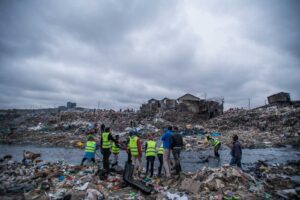
As I walk along the Riverside stretch of the Nairobi River in Nairobi’s Central Business District area, the sight before me is both heartbreaking and deeply troubling. The river can no longer flow freely, choked by heaps of garbage and clogged with dirt. “Flying toilets”, plastic bags used for defecation and disposed of by throwing, lie scattered along the river banks.
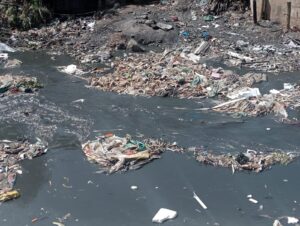
Car repair workshops servicing automobiles are operating along the riverbank, draining dirty oil and chemicals directly into the stream. A lifeline cutting through the city has become a channel of pollution. The stench rising from the Nairobi River is overwhelming. Yet life goes on along its banks. A huge population of city vendors rise every morning to hawk products along this river. I stop to buy a mango from one of the vendors, but the evidently unhygienic state scares me.
Not far from here, street children splash and bathe in the same polluted water. They are not alone. Some residents wash their clothes there too, especially mechanics, whose greasy overalls add to the contamination.
I strike up a conversation with one of the street boys. With a light laugh, he tells me, “Hapa ni home. Hata hii mto ikisafishwa, lazima tuoge hapa, tupunguze joto.” Speaking in Swahili, he says that they drink the water despite its condition. “Kama ni mara yako ya kwanza, utaumia, lakini sisi wenye tumeishi mtaa tangu tuanze maisha, tumezoea, tunakunywa na kula kama chakula, kwani inapunguza makali ya njaa. Ni chafu, ina harufu lakini sasa tufanye nini?”
Which translates to: (If it is your first time drinking this water, it will affect you; for us, we are used to it. It is our food and drink at the same time, which helps reduce hunger. It is very dirty, foul smell, but now what else can we do?)”
His words are painful. This raises the importance of eliminating street families in the city and taking them to rescue centres.
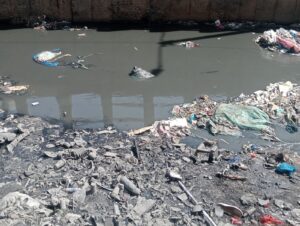
A resident, Karanja John, says they have seen the river being cleaned several times, but within months, it is clogged again with sacks and waste, or even sometimes, cleaning starts and stops midway.
According to him, fumes and oil discharged from nearby factories are what make the water unsafe. The whitish layer floating on the surface, he explains, is largely oil residue.
He believes the government must find a lasting solution, even if it means fencing off the river, to restore and protect it. During heavy rains, the situation worsens. Sewage water overflows onto the main road and pathways, creating health hazards to city dwellers. Vehicles speed through the flooded stretch, splashing the filthy water onto helpless pedestrians. The stench becomes even more unbearable, hanging heavily in the air. It leaves one wondering just how high the risk of disease is in this area, where residents and traders are constantly exposed to contaminated water and hazardous waste.
Government Intervention
Large-scale dredging, solid waste extraction and the construction of 60 kilometers of new sewer lines are currently being managed by the Nairobi Rivers Commission. The direct discharge of raw waste into the river, which has long been recognized as one of the primary sources of contamination, is anticipated to be greatly reduced by the sewer infrastructure, particularly along densely populated areas like Riverside.
The project has included a socio-economic component in addition to environmental repair. Thousands of young people have participated in cleanup and rehabilitation projects through the Climate WorX program, which connects environmental restoration to job creation and community ownership.
In addition, the river corridor has been declared a Special Planning Area (SPA), effectively freezing new developments within designated zones. The regeneration project is being presented not only as an environmental intervention but also as a structural solution meant to reclaim the Nairobi River as a secure ecological and economic asset for the city, with significant cleanup efforts scheduled to be finished by January 2027.
The recent heavy downpour which claimed lives and destroyed properties of immense value, prompted the pronouncement of more drastic measures by the County Government in an attempt to curb the likely dangers of floods. With plans to vacate Nairobi residents and businesses in riparian areas almost kicking off, Governor Johnson Sakaja has assured the city dwellers an orderly City. All these efforts are geared towards coming up with a permanent solution to constant pollution and untidiness in the city.
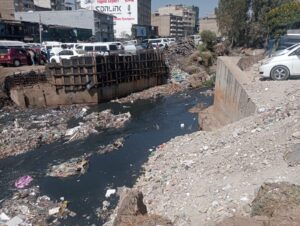
President William Ruto and Nairobi Governor Johnson Sakaja formalized an arrangement to work together to improve the city, a move that elicited mixed reactions among the populace and political leaders. While jointly inspecting the ongoing sewer line construction along the Nairobi River in the Lucky Summer area, the duo defended their working plan.
Public health experts have warned that families who live, work, and trade near contaminated water are constantly exposed to diseases such as cholera, typhoid and severe skin infections. Food vendors working in the noxious air are particularly at risk, as are kids playing or taking a bath in the river. They advise locals to stay away from the contaminated water and to wash their hands with detergents.