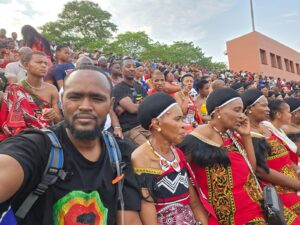
One People Africa founder Masilo Mafa holding the Kenyan flag and Mustapha Konvict in Eswatini just before they attend the Umhlanga-Reed Dance. One of the highlights of the One People Africa Tour 2025 //Photo courtesy.
Visa rejection, visa revocation, or delays of approval resulting from bureaucratic procedures can be daunting. Every day, nationals, both local and foreign, throng immigration departments seeking approval for their travels. It is a process often defined by hurdles. The high costs of visa approval and cumbersome immigration procedures have adversely affected cross-border travel, particularly in Africa. With unnoticeable technological advancements to automate services, customer service has been a nightmare. To preserve Africa’s potential socioeconomic prowess, private bodies have stepped up to change the status quo.
With a vision of a united Africa beyond colonial boundaries, One People Africa, a South African-based organisation under the leadership of its founder, Masilo Mafa, partnered with its Kenyan-based ambassador, Mustapha Konvict, to address visa-related challenges that have stifled Africa’s socioeconomic potential. The One People Africa’s 2025 tour, which covered over 9 countries and a whopping 16000km+ on two wheels, was a demonstration of the zeal of a dream so dear to Africans’ hearts.

“I have ever spent ungodly hours at the border post waiting to be processed, and I know how frustrating it can be”, a melancholic confession from Masilo, that unearthed the ordeals that travellers undergo at border posts and immigration departments to get a visa.
It is midday, and a Kenyan biker under the alias name Mustapha Konvict is embarking on a transformative journey to champion a visa-free Africa. Mombasa bikers have ridden all the way to Kenya’s capital, Nairobi, to join other bikers in flagging off Konvict.
In the recent past, activities around biking have flourished in Kenya. This time, Kenyan bikers, in a camaraderie spirit, geared up, ready to convoy Mustapha to the Namanga border, to cross into Tanzania in a rush to beat the set 9-day travel deadline to Africa’s southernmost part. Partnering with a South African-based organisation, “One People Africa”, the team is seeking to push for the elimination of visa barriers across the continent.
For decades, Africa has been grappling with economic and logistical hurdles, often caused by stringent visa requirements. The organisers and participants of the visa-free Africa initiative are on a mission to showcase the urgent need for a widened intra-African connection and unity among Africans.
“We aim to bring a Visa-less Africa because there is no need for an African to apply for a Visa to go to Africa. Complicated visa processes are hindrances to brotherhood spirit,” said Mustapha.
Matters related to visa processes fall under the purview of immigration. This time, a people-centred approach initiated by the people is brewing, calling the African governments to fast-track the process.
“We also have a collaboration with visual artists to paint art murals across the continent, art being an effective tool of communication”, said Masilo, who reiterated that closed borders bolster weak partnerships and a fragmented Africa, which do not bode well with socio-economic transformation and development.
Borderless Africa is a shared dream that most African leaders have continually preached. During the 24th COMESA summit of Heads of State at the Kenyatta International Convention Centre (KICC) in Nairobi, President William Ruto reiterated the need for open borders.
“By opening our borders, we aim to facilitate the free movement of people, the free movement of goods and services across the continent, a cornerstone for shared prosperity. Kenya has taken the initiative to become “visa-free” for most Africans,” stated Ruto, whose sentiments were echoed by Zimbabwe’s Emerson Mnangagwa.
“We need to remove the remaining barriers to African trade, barriers to investment. Our people, particularly the youths who embody the future of our region, expect and deserve a COMESA that offers them an opportunity for innovation and prosperity”, affirmed Mnangagwa
To make a reality the dream of a united Africa, action had to be taken, an action louder than words. One man, two wheels and one mission; championing a Visa-less Africa. Ready to traverse 9 countries to the southernmost part of the African continent on a two-wheeled BMW GS 1200cc, Mustapha Konvict was unbowed. From Kenya to Tanzania, Zambia, Zimbabwe, Eswatini, South Africa, Namibia, Botswana, Lesotho and back, the journey was marked with a fair share of good and awful experiences at the subsequent border posts.
Asan ardent rider, Konvict embarked on this trip for the second time, having conquered this route in April 2024. Unlike his first trip, where the focus was on fulfilling the spirit of adventure, this time, Mustapha was on a mission —a mission to preach the gospel of visa-free Africa, devoid of bottlenecks that hinder cross-border movement.
In 2024, Kenya introduced a “visa-free” policy that required visitors to complete an online application before leaving their countries of origin. Later, an Electronic Travel Authorisation (ETA) was introduced to replace visa requirements for all visitors. The move to allow citizens of nearly all African countries and other countries outside the African continent to visit without prior authorisation elicited mixed reactions back in Kenya.
Critics challenged President Ruto’s directive to scrap stringent visa policies across the Kenyan borders, which were aimed at detecting and eliminating security threats. This begs the question: could a visa-free policy propagate insecurity within the continent?
“We Africans, our destinies are tied together. However, this should not be misconstrued as a call for unchecked and unregulated movement of people across borders. This is why we are wary of using the phrase ‘borderless Africa’. We would much prefer a ‘Visaless Africa’. The two are not synonymous and imply different things. Countries need to protect and retain their territorial integrity for safety and security reasons. However, the ease and convenience of travel across the continent should be the ambition and priority of all”, clarified Masilo.
In what seemed to address the voiced insecurity concerns tied to the new visa policy, Kenya dropped the ETA requirement for all African countries except Libya and Somalia, where insecurity has been rampant.
At the beginning of 2025, Ghana opened its borders to all African passport holders. Other African nations that granted full visa-free access are: Benin, Gambia, Rwanda and Seychelles. On the other end, Botswana, Burundi, Eswatini, Ethiopia, Lesotho, Malawi, Mozambique, Mauritius, South Africa, South Sudan, Tanzania, Uganda, Zambia, Zimbabwe, Burkina Faso, Comoros, Democratic Republic of Congo, Djibouti, Eritrea, Guinea-Bissau, Madagascar, Mali, Mauritania, Senegal, Somalia, Sudan and Togo are visa-free or may require a visa-on-arrival (VOA).
With most African states shifting to a visa-free status, bureaucratic procedures across African borders are still a nuisance to frequent cross-border travellers, hence One People Africa’s inaugural campaign, pushing the entire leadership of Africa to be intentional about the visa-free policy, as they claim that some policies are on paper but not in practice.
“We want to build a forward-looking community of Africans, creatives, changemakers and leaders. We can build a better Africa and environment for all of us through genuine connections and committed efforts”, said Masilo.
The ride through scenic Africa is an experiential one. It is a ride of purpose with too huge a price, open borders.
“Some of the issues we are fighting are hefty visa charges. Imagine I was charged 150 USD at the Zambian border posts,” said Konvict.
Mustapha’s ride through the Zimbabwean border was smooth. On his previous trip, the clearance process was marred with delays. It is a kind of advancement that, according to Mustapha, should be emulated across the continent.
“Zimbabwe’s border is modernised, and everything is processed online, something many borders still lack”, said Mustapha.
The One People Africa team is ready to receive Mustapha at the South African border, then proceed to Polokwane for a public gathering. Chivhu to Polokwane, a 650km ride, will definitely be an easy task for Mr Konvict, considering the already conquered terrain.
In the company of brother Effort Ruzvidzo, they set out for a 150km ride to Masvingo, where they part ways after breakfast. A solo ride starts from Masvingo, with the better part of the road under construction. This regrettably lags his speed.
“The off-road section was brutal. At one point, I thought I’d outsmart the road and took a smooth stretch that lasted 15km — only to find a huge sign: “ROAD CLOSED”. I had cooked myself,” recounts Mustapha.
Mustapha is forced to ride all the way back to join the rough road. Finally, he wraps up the 150-kilometre rocky terrain with a much-needed 30-minute break before advancing to the Zimbabwe-South Africa border. At the border, the clearance process is seamless.
“What a surprise! Zimbabwe has stepped up. The process is fully digital: QR codes, big display screens, and clear instructions. I was cleared in just 5 minutes,” says Mustapha.
The majority of Africa’s infrastructural development can be attributed to benchmarking. During Mashujaa Day Celebrations in Kenya, Senegal’s Bassirou Diomaye Faye and Kenya’s William Ruto agreed to a visa waiver allowing Citizens of the two countries to travel visa-free for up to 90 days.
The two heads of state also agreed to work together for the success of the 2027 Africa Cup of Nations. This presents an opportunity of great impact, considering Senegal’s stellar record in football. Africa’s growth is undoubtedly dependent on continental collaboration.
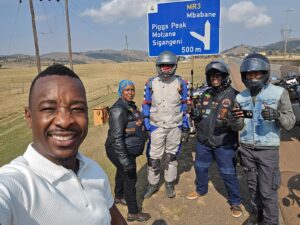
Meanwhile, the One People Africa team patiently waited at the South African border to receive their highly anticipated Kenyan ambassador, Mustapha Konvict.
“The journey continues to Swaziland, where I’ll be welcomed once again. The mission to make Africa visa-free is stronger than ever. We will win this,” said Mustapha.
“We want to see more Africans travelling and exploring Africa, and more trade amongst Africans. It is in the best interest of all of us to ensure that we all thrive, and we will be powerful when we come together”, says Masilo.
As One People Africa reaches out to like-minded organizations for support, Africans have been urged to be accommodating of fellow Africans to expedite the vision of a visa-less Africa.
“We are also looking to work with stakeholders in government, art councils, tourism bodies, agencies and associations, counties and municipalities, embassies and art organizations in this project”, said Masilo.
On October 11, 2025, Mustapha arrived in Kenya after spending over Kshs 800,000 to fund the two-way journey. In a briefing with Africa Feature Network on 18/11/2025, One People Africa shared a glimpse of what to expect in 2026.
“We are currently planning a possible tour of West Africa for 2026. Another project in development is the One People Africa festival in Nairobi. We will share more details on Facebook: One People Africa and Instagram: onepeople_africa”, said Masilo.
With plans anticipated to be more robust and engaging in the future, private bikers have been urged to be part of the dream.
“The biking community must go international for good deeds, and we are not locking anyone out, whether you ride a 100cc or 1300cc; we must work as a team and we are soon making a call”, said Mustapha.
This story has been featured in the just-launched Luminate Africa Journal, the first edition of The Africa Feature Network’s end-year magazine, and can be downloaded from the journal page.