
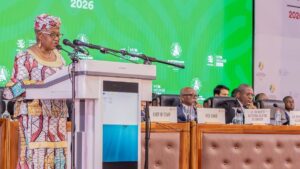
From 26th to 29th March 2026, the usually understated capital of Yaoundé was momentarily transformed into a strategic nerve centre of global economic diplomacy, as it hosted the 14th Ministerial Conference of the World Trade Organisation (WTO MC14). For four intense days, the city became a crossroads where multilateralism met market realities, drawing in a diverse ecosystem of WTO officials, trade negotiators, business leaders, entrepreneurs, development partners, media professionals, and civil society actors.
Beyond the formal plenaries, polished communiqués, and carefully brokered compromises, MC14 revealed something more profound: a shifting global trade landscape in which Africa is no longer a peripheral participant but an increasingly assertive stakeholder. The presence and engagement of African voices signalled both rising expectations and mounting pressure for reform. At the heart of the conference lies a critical, unresolved question; one that transcended technical negotiations and entered the realm of economic justice and structural transformation: can the global trading system evolve to deliver tangible, equitable, and sustained benefits for Africa?
This question is particularly urgent against the backdrop of persistent structural constraints: limited industrial capacity, vulnerability to commodity price shocks, and unequal participation in global value chains. Yet, it is also framed by emerging opportunities, including the operationalisation of the African Continental Free Trade Area (AfCFTA), the continent’s demographic dividend, and the growth of digital and entrepreneurial ecosystems.
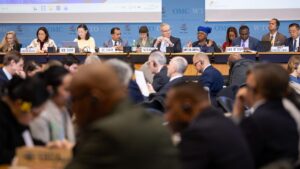
The meeting opened at a time of mounting uncertainty in international commerce. Supply chain disruptions, geopolitical tensions and rising protectionism have tested the resilience of the multilateral trading system. WTO Director-General Ngozi Okonjo-Iweala acknowledged the scale of the challenge, warning that the current system is facing some of its most serious disruptions in decades. She called on member states to show political will in reforming the institution to reflect new global realities.
Although global merchandise trade now exceeds $26 trillion, Africa’s participation remains disproportionately low, accounting for only about 2–3% of global trade, according to estimates from the World Trade Organisation. This marginal share is not merely a reflection of limited trade volume, but more fundamentally a symptom of structural exclusion from high-value segments of global value chains.
As highlighted by Ngozi Okonjo-Iweala, the multilateral trading system is under significant strain, yet its current architecture continues to reproduce unequal outcomes. For Africa, the challenge is therefore twofold: to secure fairer rules within the global system while simultaneously transforming its productive capacity to move from raw commodity exports to value-added production. Without such a shift, the continent risks remaining a peripheral player in a rapidly evolving global trade landscape, despite its vast economic potential.
Africa’s Enduring Trade Dilemma
Africa’s long-standing trade dilemma remains one of participation without transformation. For many economies across the continent, engagement in global trade has yet to translate into broad-based development. Instead, a persistent structural pattern prevails: the export of raw materials alongside the import of higher-value manufactured goods. This imbalance continues to constrain industrialisation, limit value addition, and suppress large-scale job creation.
It was precisely this structural inequity that African delegates brought to the forefront in Yaoundé. Framing the conversation beyond market access, they emphasised the urgent need to reposition Africa within global value chains not merely as a supplier of commodities, but as a competitive hub for processing, manufacturing, and innovation.
Chairing the conference, Cameroon’s Minister of Trade, Luc Magloire Mbarga Atangana, underscored the imperative of building a more inclusive, development-oriented multilateral trading system – one that reflects the realities of developing economies and actively supports their industrialisation ambitions.
The deliberations culminated in the adoption of a reform roadmap, resulting in the Yaoundé Declaration, which aims to modernise the WTO’s functioning and enhance its responsiveness to development concerns. While the declaration signals political intent, its true significance will hinge on whether it catalyses concrete reforms capable of addressing the longstanding asymmetries in global trade.
AfCFTA: Africa’s internal answer
While global reforms remain essential, Africa is advancing its own parallel track through the African Continental Free Trade Area (AfCFTA). Spanning 54 countries and a market of 1.3 billion people, the agreement is expected to reshape intra-continental trade by reducing tariffs and improving market access with the overarching goal of raising intra-African trade from its historical plateau below 20%.

Economists view the AfCFTA as a potential game changer, particularly if it succeeds in fostering regional value chains and anchoring industrial growth. Yet its promise is tempered by uneven implementation: infrastructure gaps, fragmented regulatory frameworks, and persistent constraints in productive capacity continue to impede progress. How these structural bottlenecks are addressed will ultimately determine whether the AfCFTA delivers on its ambition to become a genuine catalyst for structural transformation, rather than remaining an unfinished architecture of intent.
Discussions in Yaoundé brought into sharp relief a set of strategic sectors that will ultimately shape Africa’s trade trajectory not just in terms of participation, but in terms of value capture and economic transformation. Agriculture, manufacturing and value addition, and the digital economy, among other strategic sectors, came sharply into focus.
Agriculture, which employs the majority of the continent’s workforce, emerged as both a cornerstone and a constraint. While Africa holds vast agricultural potential, global subsidy regimes, particularly in advanced economies, continue to distort markets and undermine the competitiveness of African farmers. Beyond market access, delegates emphasised the need for agro-processing, storage infrastructure, and intra-African trade linkages to move the sector up the value chain.
Manufacturing and value addition were equally central to the debate. A strong consensus emerged around the urgency of breaking the long-standing pattern of raw commodity exports. African countries are increasingly being called upon to industrialise at source, transforming minerals, agricultural produce, and other natural resources locally. This shift is seen as critical not only for export diversification but also for job creation, technology transfer, and economic resilience.
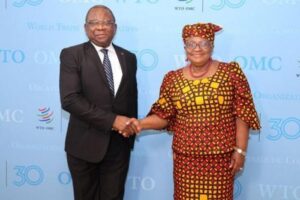
In the digital economy, the extension of the WTO’s moratorium on e-commerce tariffs was broadly welcomed as a signal of continuity within the World Trade Organization framework. However, this optimism was tempered by a growing recognition of Africa’s structural gaps.
Without substantial investment in digital infrastructure, data governance frameworks, and skills development, there is a real risk that the continent could remain a consumer rather than a producer in the global digital marketplace.
Across all three sectors, a unifying insight emerged: Africa’s trade future will depend less on access alone, and more on its ability to build productive capacity, retain value, and compete strategically within evolving global systems.
Beyond the conference halls, the true measure of global meetings lies in their tangible impact on the ground. For business owners and entrepreneurs across Africa, the daily realities remain shaped by persistent barriers: prohibitive transport costs, constrained access to finance, and labyrinthine trade procedures that erode competitiveness before goods ever reach a border.
Against this backdrop, the success of MC14 will be defined not by the ambition of its declarations, but by whether it translates into meaningful improvements in three interconnected areas: (1) trade infrastructure from ports to digital corridors that lowers the cost of moving goods; (2) simplified cross-border transactions, reducing both time and regulatory friction; (3) expanded market access, ensuring that African enterprises can effectively connect to regional and global value chains.
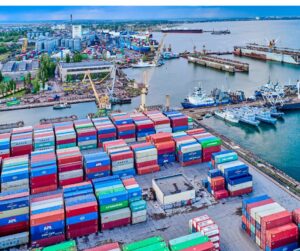
In essence, the transition from policy to practice requires closing the gap between political consensus and operational reality. Without deliberate mechanisms to channel global commitments into investable projects and streamlined procedures, even the most progressive outcomes risk remaining abstract—leaving those on the frontlines of trade to navigate a system that changes far too slowly for their needs.
The WTO MC14 conference concluded with intensive deliberations among its 166 member states, producing the Yaoundé package—a set of five key initiatives aimed at strengthening and reforming the multilateral trading system. These include the Draft Yaoundé Declaration on WTO Reform & World Plan, the Draft Ministerial Decisions on Electronic Commerce, TRIPS Non-Violation & Situation Complaints, and Fisheries Subsidies, as well as a targeted Least Developed Countries (LDC) package.
Together, these measures seek to modernise WTO operations, promote equitable participation, support sustainable trade practices, and enhance development outcomes for vulnerable economies, reflecting a renewed commitment to a more inclusive and responsive global trading system.
The 14th WTO Ministerial Conference in Yaoundé has undeniably refocused global attention on Africa’s place in the international trading system, amplifying long-standing calls for meaningful reform. It has generated a renewed sense of cautious optimism that is grounded in the belief that deeper global engagement, paired with regional frameworks like the AfCFTA, could unlock new pathways for trade, industrialisation, and economic transformation across the continent.
Yet this optimism is tempered by a clear-eyed acknowledgement of past patterns. Without concrete implementation, sustained political resolve, and measurable follow-through, the outcomes of Yaoundé risk remaining largely symbolic; that is, another well-intentioned milestone in a system long criticised for its uneven delivery.
Ultimately, MC14 has laid bare both the scale of the challenge and the breadth of opportunity before Africa. It has elevated the continent’s concerns within global discourse and underscored the urgency of reshaping trade rules to reflect contemporary realities. But whether this moment becomes a genuine turning point will depend on what follows both within the multilateral system and across African economies themselves.
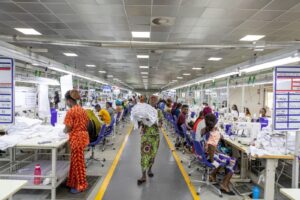
For now, Yaoundé offers a window of hope. Translating that hope into tangible progress, however, will require sustained commitment, decisive policy action, and time. More than a diplomatic gathering, the conference served as a litmus test for the credibility and future relevance of the multilateral trading system.
For Africa, it reaffirmed a dual imperative: to advocate for fairer global trade rules while accelerating regional integration, strengthening productive capacity, and securing a more strategic foothold in global value chains.
In the end, the true measure of success will lie not in the declarations adopted, but in their ability to catalyse real change; hence, transforming ambition into industrial growth, jobs and inclusive prosperity for African economies.


