
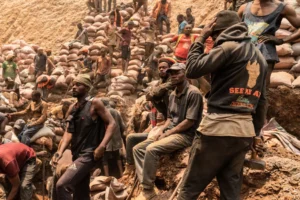
A general view of artisanal miners working at the Shabara artisanal mine near Kolwezi in the Democratic Republic of Congo on October 12, 2022 /photo courtesy Junior Kannah / AFP
Conflict-related disruption could cost a large-scale mining project with capital expenditure between three billion and five billion US dollars according to a research conducted by the Harvard Kennedy School and the University of Queensland. The study, which involved interviews and case analysis to quantify how community conflict translates into financial cost for extractive companies, established that cumulatively, about twenty million US dollars could be lost per week in delayed production.
According to a World Development paper paper published in October 2022, one quarter of mining operations in Africa experience social conflict. At least twenty-five per cent of mining operations in Africa, based on analysis from mining companies included in the study, had nearby social conflicts including blockades, protests, or strikes.
These figures highlight a critical reality for the mining sector. Legal permits and financial resources are no longer sufficient to guarantee smooth operations. Communities, traditional authorities, regulators, and political actors exert influence that can accelerate, delay, or completely halt projects. For companies that underestimate this influence, the cost is immediate and often irreversible.
It is against this backdrop that Veridicor’s Licence To Operate approach has established its prominence. The firm focuses on measuring, assessing, and strengthening the relationships between companies and the various stakeholders that shape the operational environment. Veridicor provides actionable insight into risks that could compromise project continuity by positioning stakeholder approval as a central business concern rather than a peripheral social obligation.
At the helm of the company is former Director of General Development at the USAID Loren Stoddard who serves as Founder the Chief Executive Officer. Loren’s career spans decades at the intersection of diplomacy, trade, and emerging markets characterized by high political and social risk. He has championed the idea that the most pressing challenges for mining companies are relational rather than technical or financial.
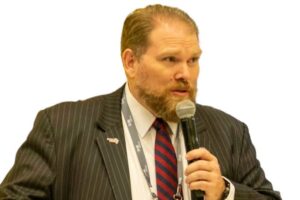
In an exclusive interview with The Africa Feature Network, Loren said that while companies often assume that securing regulatory compliance and deploying capital will automatically translate into operational continuity, the reality is that it is just one of the foundational approaches to getting legitimacy. “A lot needs to be done from there”, he said. He maintains that the communities who live near, govern, and regulate mining operations hold equal or greater influence over a project’s success. Under his leadership, Veridicor has positioned itself as a bridge between corporate strategy and social legitimacy, helping companies navigate complex and dynamic stakeholder landscapes.
The company’s methodology emphasizes field engagement, rigorous stakeholder mapping, and continuous monitoring of trust. Unlike traditional risk assessments that focus narrowly on what could go wrong, Veridicor evaluates whether the strength of relationships and trust is sufficient to withstand pressure. It then translates these assessments into strategic guidance, advising executives and boards on the actions required to maintain legitimacy throughout a project’s lifecycle.
In Africa, where mining operations are frequently intertwined with land rights, community livelihoods, and national development priorities, these interventions have proven particularly vital. The firm’s research consistently shows that stakeholder support is neither automatic nor permanent. It must be actively nurtured through consistent engagement and responsive decision-making.
While mining remains the company’s most visible sector, Veridicor’s Licence To Operate framework has applications across multiple industries where social and political legitimacy is critical. In energy, for example, the firm works with developers of solar, wind, and power infrastructure projects to anticipate and address community concerns before they escalate into operational delays.
In large-scale infrastructure and construction projects, Veridicor assists companies in understanding local governance dynamics and community expectations that could affect timelines or permits. Even in manufacturing, technology, and services, where public scrutiny of operations can affect reputations and regulatory compliance, the company helps organizations evaluate and strengthen the trust that enables continuity. The same principles apply to development projects and non-governmental organizations operating in sensitive communities, ensuring that social legitimacy underpins operational strategy.
A central pillar of their work is Veridicor University, a professional training platform designed to build internal capacity within organizations to manage stakeholder legitimacy proactively. The initiative equips staff and executives with the knowledge and tools required to anticipate, assess, and act on social and political risks through structured courses, workshops, and certification programs. The platform moves it from an ad hoc function to a strategic discipline, a shift that Stoddard argues is critical for industries where social license determines operational outcomes by professionalizing stakeholder engagement.
Under Stoddard’s leadership, the company has cultivated a team that combines expertise in diplomacy, business strategy, and industry specialization. This multidisciplinary approach allows the firm to provide insights that are both practical and grounded in a deep understanding of local contexts. The company’s approach is proactive rather than reactive, ensuring that companies can act strategically before conflicts escalate, rather than scrambling to resolve them after delays or disruptions occur.
The impact of Veridicor’s work is increasingly evident as the global demand for critical minerals rises and the competition for extractive resources intensifies. Projects that fail to secure broad-based support risk becoming stalled or stranded, regardless of technical or financial merit. Companies that invest in understanding and maintaining trust experience fewer disruptions, greater regulatory confidence, and more stable long-term operations. In this sense, Veridicor’s Licence To Operate approach transforms what has traditionally been viewed as a social obligation into a core operational advantage, aligning business continuity with sustainable stakeholder engagement.
In a sector where tens of millions of dollars can be lost in a single week due to relational failures, the ability to anticipate and manage stakeholder expectations is no longer optional. Loren has positioned the company at the forefront of a revolution in how mining and other high-impact industries manage legitimacy through combining rigorous assessment, strategic advisory, and professional capacity building through Veridicor University


