
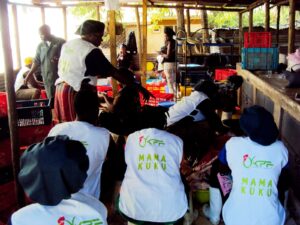
“Kuku Mama” at work, Photo | Norman Nyandega
Africa faces a deep youth unemployment crisis. Despite a growing workforce, the number of available jobs remains limited. In 2023, the International Labour Organization (ILO) estimated that roughly 62 million young people in sub-Saharan Africa were neither employed nor formally educated, nor in training. It is a whopping figure which translates to nearly a quarter of Africa’s youth bulge.
In Kenya, unemployment poses a significant challenge, with nearly 75% of the population under 35 years old. As opposed to the olden days, when education was equated to socioeconomic success, a college diploma no longer guarantees a job. Formal employment remains elusive, leaving informal work or subsistence farming as the only fallback plan for many young people.
In the wake of the job crisis in Africa, the story of Kenya Poultry Farmers Limited (KPF) stands out as a pathway from struggle to enterprise. From a small backyard chicken business, the company has carved out a space and left a socioeconomic footprint. From creating employment opportunities to supporting smallholder farmers, poultry farming has become a viable livelihood for hundreds.
Hezron Oluoch is a sole proprietor whose idea of poultry farming was formalized in 2010 as a student preparing for the final exams. Resources were limited, but he was unbowed. Back at home, Hezron had to forgo further education to pave the way for his siblings. A short visit to his cousin in Western Kenya’s Kisumu City changed his perspective. Hezron borrowed most of the poultry farming equipment from his cousin, a retired poultry farmer.

The modest earnings from his newly found venture enabled him to pursue a Diploma in Business Management at the Kenya Institute of Management while running the business. He later graduated with a Bachelor in Project Planning and Management from the University of Nairobi in 2015.
With the rising demand for poultry, Hezron formally registered the enterprise.
As a success story, KPF received a $5,000 grant from the Tony Elumelu Foundation in 2016. This was a boost that catalysed the business expansion. Farm stock increased, eggs and chicks were added to the product line, and the business diversified into animal feeds.
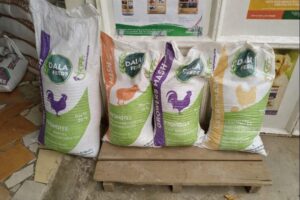
Strategic partnerships with companies such as Unga Feeds, Sigma Feeds, and Kenchic boosted the business. KPF’s clientele grew beyond borders with organizations such as Silverlands Tanzania, Impex Watering Solutions, the Bill & Melinda Gates Foundation, and Hendrix Machinery formalizing business partnerships through purchases and support. Today, KPF owns Dala Feeds, a feed manufacturing plant, alongside its poultry business.
KPF has also transformed the socioeconomic status of farmers through its Inclusive Contract Farming (ICF) model.
“Many people hesitate to engage in large-scale farming for fear they may not get a ready market. But with a guaranteed market, they are willing to explore,” said Hezron.
KPF provides poultry training and extension services, sells farm inputs at subsidized rates, and buys back mature chickens, ensuring farmers’ efforts are never wasted. Over 1,000 smallholder farmers now benefit, including those managing as few as 50 chickens.
Angeline, a smallholder farmer, kick-started a poultry farming venture with 50 chickens. Within five years, she managed over 600 chickens and now owns two large chicken houses. Her living conditions have improved from a mud house to a permanent home, illustrating the transformative potential of farming.
KPF’s activities have boosted the regional economy through employment for jobless youths. In 2015, the company had just one employee. Today, it employs 17 full-time staff. The organization emphasizes hands-on training and open opportunities for youth. Those without prior experience are not exempt. Fatuma Obuya, Operations Supervisor, says, “We do not have strict employment policies; anyone teachable can grow here. The skills gained are transferable and valuable.” Employees also receive financial assistance to pursue further education.
KPF has pioneered “Kuku Mama” — or “Chicken Woman” — a women-led initiative that began in February 2025. Women operate the slaughterhouse, prepare chicken for sale, and earn an average of $200 monthly. For many, this income has raised school fees and improved living standards.
Janet Atieno, a single mother, was introduced to Kuku Mama after leaving what she termed a troubled marriage. Today, her business thrives, her children attend school, and she enjoys good housing. Florence Anyango, chairperson of Kuku Mama, has seen her children advance academically, with her eldest now a teacher, another in university, and the youngest preparing for medical school. By the time this story was prepared, Kuku Mama had 23 members, with an expansion plan in the pipeline.
The impact extends beyond poultry. Maize farming has increased as KPF purchases maize for its feed mill, boosting the local economy. Chicken, once a luxury for the privileged, is now accessible to average households through Kuku Mama, offering affordable portions at around $0.25. With greater access to protein and eggs, the initiative also contributes to improved food security and community health.
To tighten its agricultural grip and maximize returns, KPF plans to acquire a soya extruder machine to reduce feed costs by 60%, explore sustainable uses for chicken feathers, and create a centralized operation consolidating all activities under one roof.
This story has been featured in the just-launched Luminate Africa Journal, the first edition of The Africa Feature Network’s end-year magazine, and can be downloaded from the journal page.


Nice