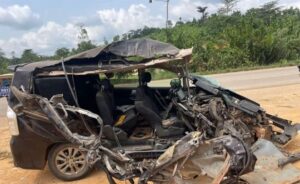
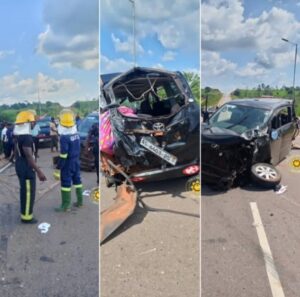
The growing use of the Toyota Voxy minivan as a commercial transport vehicle in Ghana has generated a nationwide discourse. The car’s choice has been enabled by its convenience, say the drivers. However, the rising accidents on the roads are linked to Voxy.
The Minivan’s benefits have been outweighed by the risks, as a significant number of Ghanaian lives are lost on the road day in and day out.
In 2025 alone, 2,949 people lost their lives in reported road crashes in the country, which is the highest in Ghana in 35 years.
To establish the root causes of the high rate of road crashes involving the minivan, the National Road Safety Authority (NRSA) constituted a Technical Committee.
The technical working committee was set up on February 12th 2026, in the wake of increased road crashes in the country, which reached a historic high level in 2025.
Committee members were drawn from a range of major state and non-state bodies like the Ghana Standards Authority (GSA), the Driver and Vehicle Licensing Authority (DVLA), the Ghana Road Transport Coordinating Council (GRTCC), the NRSA, Toyota Ghana, and the Chartered Institute of Logistics and Transport (CILT).
The committee was mandated to establish if the conversion of the vehicle from right-hand drive to left-hand drive contributed to witnessed crashes; whether the vehicles were suitable for commercial use on Ghana’s roads, analyse crash data and road safety trends involving Toyota Voxy, and make recommendations to ensure safety on the road.
A report by the Committee revealed that over 7,000 Toyota Voxy vehicles imported into the country have been converted from right to left-hand drive, thereby violating the country’s road traffic laws. The importation of right-hand drive vehicles itself contravenes Ghana’s Customs Act 891 of 2015.
The committee found that over 7,257 Toyota Voxy vehicles had been registered in the country without any evidence of ministerial approval. It added that all of these vehicles had undergone conversion from right-hand drive to left-hand drive.
The report added that site visits to garages performing right-to-left-hand-drive conversions revealed that hundreds of workshops across the country were engaged in the illegal trade.
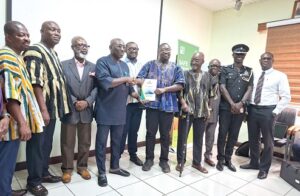
A mechanical engineer and Chairman of the Technical Committee, Dr Godwin Kafui Ayetor, who presented the report to NRSA’s Director-General, Mr Abraham Amaliba, in Accra, said Toyota Voxy vehicles were not fundamentally suitable for use as commercial passenger vehicles because they had not been designed for that purpose.
He stated that the Toyota company designed the Voxy and the Toyota Noah as family minivans or Multi-Purpose Vehicles for private, everyday transport, primarily for young middle-class families in Japan and similar markets.
The technical committee’s report also revealed that some of the conversions from right to left-hand drive were done in Dubai, with a bigger percentage, roughly 90%, done in Ghana.
In some cases, the services of these conversion centres are outsourced to countries such as Burkina Faso, Benin, and Togo.

Again, the report indicated that economic pressures pushed the drivers of minivans to overspeed.
For instance, the report indicated that the drivers were given a monthly target of between GH¢3,500 and GH¢4,000 to fully cover the minivan’s total cost within three years. The exhaustion of doing multiple trips without rest contributed to accidents.
Some transport operators and drivers in Ghana have rejected the NRSA report. They demanded to know the rationale which the authorities used to ban the minivan. The drivers questioned why the Mercedes-Benz Sprinter van, which has been on record as causing accidents, was not banned.
It is a fact that these Sprinters have been involved in road crashes over the years, largely due to issues such as over-speeding, driver fatigue and occasional overloading.
However, authorities argued that these concerns had not resulted in calls for a ban, largely because the Sprinter is purpose-built for commercial passenger transport and meets both safety and engineering requirements.
Concerns about the safety of the Toyota Voxy minivan, on the other hand, go beyond driver conduct to questions of vehicle design, structural modifications and regulatory compliance.
The Commercial Transport Operators of Ghana (CTOG), led by its National Chairman, Mr Asonaba Nana Wiredu, has petitioned the NRSA to reconsider its decision by engaging stakeholders to find a more sustainable solution to the Voxy issue and subsequently the high rate of road crashes in the country.
“The Toyota Voxy is a popular and reliable vehicle widely used for commercial transport, and its ban will cause significant hardship for many families”, said Asonaba.
Some Toyota Voxy drivers operating at Kaneshie in Accra have vowed to resist any attempt to enforce the ban, insisting that operating the vehicle commercially to earn a decent income is preferable to engaging in illegal mining, known as galamsey, which destroys the environment and pollutes water bodies.
Seth Kwame Fosu, a driver operating between Kaneshie and Tarkwa, said the challenge is largely due to impatience among some drivers, but added that the NRSA should educate the drivers rather than enforcing the ban.
A Station representative at Kaneshie, Kwame Amponsah, explained that drivers were professionally trained and operate under well-structured supervisory systems.
A passenger, Madam Mary Quarshie, said commuters have no choice but to board such vehicles, although they may prefer safer ones to board to their respective destinations.
A holistic approach is needed to address the Toyota Voxy issue. The ongoing national debate also raises pertinent questions for policymakers.
How did the Voxy vehicle pass through all the regulatory processes put in place by the relevant institutions without any of the institutions raising a red flag? How did the Voxy not receive any ministerial approval, as highlighted in the NRSA’s technical committee report?
There is a need for stricter enforcement of importation laws, certification of conversion centres, targeted training for drivers, and setting realistic operational standards for drivers.
The lapses identified by the report show that there are deeper issues in Ghana’s transportation sector, such as weak regulations and enforcement gaps.
Notably, the Inter-City State Transport Company Limited (ISTC) is recognised as Ghana’s most organised and safety-conscious transport company, thanks to its rigorous driver recruitment, formal training programmes and centralised operational oversight. While no transport company is immune to accidents, industry experts believe the ISTC’s structured approach contributes to its relatively strong safety record on Ghana’s roads.
A report by the Business & Financial Times states that ISTC remains “the most reliable, safe and efficient transport company in the country.” It attributed this to strict driver recruitment and training systems.
For instance, a person who wants to be a driver of the company should be between 35 and 45 years old with a driving license “F” and should have worked privately or otherwise for five years.
Once prospective drivers have been shortlisted, they are taken on a group test drive. On their return, they begin intensive training in driving techniques and modern road signs at the renowned Training School in Accra for three months and subsequent refresher courses quarterly.
After the training, this group is taken on a tour of the whole country to familiarise themselves with the ISTC routes. After the group has completed these trainings, they are allocated buses and, in the initial stages, assisted by senior colleagues.
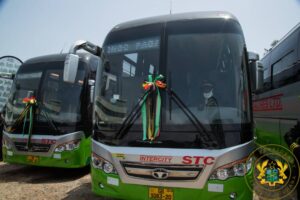
The drivers are strictly cautioned to drive within speed limits and avoid unnecessary overtaking. While on their respective routes, they are mandated to make scheduled stops at designated intervals to rest and perform routine maintenance as part of a broader safety measure aimed at preventing breakdowns and accidents.
Analysts suggest that elements of the ISTC’s system could be adopted to enhance safety in the informal transport sector.
However, replicating this within Ghana’s largely informal transport sector remains a challenge due to cost implications, weak regulatory enforcement and resistance from operators who prioritise daily earnings over safety compliance.
The Toyota Voxy minivan concerns present an opportunity for the authorities to rethink road transport safety in Ghana. The challenge for policymakers does not lie in restricting only unsafe vehicles but in scaling proven safety models across the broader transport sector.