
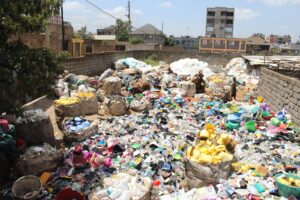
The World Bank reports that approximately 2.01 billion tonnes of Municipal Solid Waste (MSW) are generated each year globally, with projections indicating an increase to 3.4 billion tonnes by 2050.
In Africa, the United Nations Environment Programme (UNEP), working together with the Waste and Circular Economy Africa Program, estimates that the continent produced around 125 million tonnes of MSW in 2012, with projections of 244 million tonnes by 2025. Sub-Saharan Africa alone accounted for 174 million tonnes in 2016.
Major urban centres, including Lagos, Johannesburg and Nairobi, bear the greatest burden of this escalating waste crisis. In Njiru, a residential estate in Nairobi, Jacktech System Communication, a company run by Eunice Kapere and Jacob Ondere, is tackling the challenge.
The company transforms waste into usable end products. Jacktech System Communication also runs a pilot program aimed at creating community awareness and promoting environmental sustainability within Nairobi and its environs.
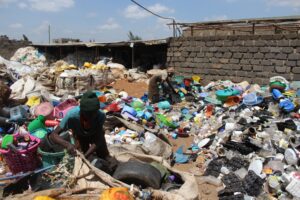
When Eunice started the business, it grew out of conviction and a deep desire to champion environmental conservation. She had previously worked as a sorting staff member in a company that transformed waste into reusable products, an experience that shaped her sustainability enthusiasm.
“This is something that I have cherished for quite a long time, and my greatest motivation is to see a clean and safe environment,” Eunice said during an interview with Luminate Africa Journal.
The environmental entrepreneur said that because it is impossible to eliminate waste, the priority should be to invent ways to manage it responsibly while creating economic opportunities. She emphasized that the waste sector can become a multi-million-dollar industry if well-structured and supported.
“We just went through the World Bank data and that of UNEP, and you can tell for sure that this industry can generate millions of dollars if we are intentional. Solving the waste crisis while at the same time creating jobs for many,” Eunice noted.
As a visionary conservation champion, Eunice says that surviving in the industry requires sheer determination and discipline, especially for women, because the sector remains male-dominated.
Jacob Ondere, Eunice’s husband, was initially cautious about quitting his formal employment to join the business. Eunice, however, had already made up her mind to move the idea forward out of personal conviction.
“Initially,” Jacob says, “I thought it was a dirty job and I could not venture into it. In fact, I tried to discourage her, but being a woman of substance, she insisted that this is what she had made up her mind to do.”

As time passed, Ondere would balance his job with supporting Eunice at the site. When he finally became convinced that the business had strong social and economic potential, he resigned to join the company fully, taking up the role of Executive Director in charge of operations.
“I later learnt that she was not doing it professionally, so I decided to give her support. From there, I registered the company and started working formally,” said Ondere.
Jacob notes that while the company has made notable progress in production, major financial gaps continue to slow down its growth. With proper funding, the company plans to invest in value addition, which involves transforming waste into final products that generate higher returns than crushed material.
At Jacktech System Communication, the waste processing cycle begins with sourcing materials from different dumpsites in Nairobi, transporting them to the facility, sorting them, crushing them and packaging them for sale. The companies that buy the crushed materials pelletize them through an extrusion machine before moulding them into pellets.
The company has employed 17 workers directly and about 30 indirectly, with most of them women. Jacob says the women-to-men ratio aligns with international guidelines aimed at empowering women who are often marginalized in economic spaces.
“The aim is to empower more women. Apart from being marginalized, they are more dedicated to work compared to men. But we also balance because we have men, mostly youths, who are also doing great jobs here,” Jacob noted.
Felix Otieno, a youthful driver at the company, has spent the past year waking up before dawn to be on the road by 4 AM to source waste from dumpsites. He aspires to run his own environmental conservation company one day. Felix attributes his strong work ethic to Eunice, who he says rose from a humble background to become an inspiring advocate for environmental protection.

“The greatest lesson I have learnt from working with this company is the power of consistency and hard work. I thank God for the opportunity to be part of this noble initiative. While I earn from my work, my motivation comes from the solutions we are offering to address the environmental crisis, which is now a global issue,” said Felix.
As the firstborn in his family, Felix says his family relies on him, a responsibility that pushes him to give his best at work, knowing that his effort helps keep his household going. As he often says, “We left home to change home.” He is now focusing his ambitions on Kisumu and remote parts of Nyanza in Western Kenya, where he believes many people have not fully embraced waste management opportunities.
Rose Atieno, who has worked at the company for six months, says it has provided her with a steady income to fund her children’s education and meet the demanding costs of urban life. She hopes to continue contributing to environmental conservation.
Alongside its recycling operations, Jacktech System Communication, founded in 2013 and headquartered in Nairobi, is a dedicated company providing sustainable solutions to climate-related challenges. As an environmental ambassador, the company leads programmes that promote ecological conservation, climate resilience and community empowerment.
The organisation runs awareness, advocacy and training initiatives that educate communities on climate sustainability and responsible environmental practices.
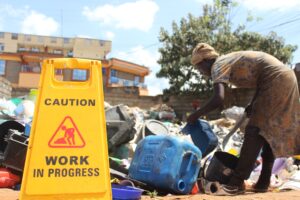
Jacktech System focuses on conserving natural resources and promoting environmental responsibility through paper recycling, clothing and plastics. It also conducts extensive tree-planting activities to reduce the impacts of extreme weather cases, including droughts, floods and storms.
In addition, the company supports community well-being by removing pollutants from rivers and other water sources to ensure access to clean and safe drinking water. Its efforts aim to enhance environmental resilience and improve the overall quality of life in the communities it serves.
Jacktech System Communication’s achievements have been made possible through strong partnerships with the national government, NCBA Bank Kenya PLC, the Kenya Climate Innovation Centre, the Knowledge and Innovation Community, Equity Bank Kenya and Shining Hope for Communities. The organisation says its focus with its partners is to build a healthy nation rooted in mutual respect, open communication, trust and shared growth.
Through Jacktech System Communication, Eunice, Jacob and their team are showing that environmental conservation is not only an urgent necessity but also an economic opportunity. Their work reflects a growing movement across Africa, where communities and innovators are redefining how the continent responds to climate change and waste management.
This story was featured in the just-launched Luminate Africa Journal first edition of The Africa Feature Network’s end-year magazine, and can be downloaded on our website at the Journal page.


