
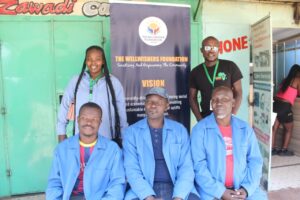
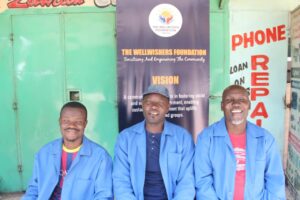
“I am a product of Well-wishers…”, utters Paul Andega, chairman of the Well-wishers Foundation, as we grab seats for an interview in their Mathare office.
Growing up in one of the largest informal settlements in Africa, Paul says that life was challenging. It was a struggle to afford daily meals and raise school fees. As hardship pushed countless minors out of school with cases of teenage pregnancy burgeoning, Paul’s story was different. Amidst the economic struggle, Paul’s academic burden was lifted by well-wishers to the post-secondary level.
The World Health Organisation report of 2024 indicated that every year, an estimated 21 million girls aged 15 to 19 in developing nations become victims of teenage pregnancy, as approximately 12 million of them give birth.
In Kenya, informal settlements have recorded a high increase in the number of teenage pregnancies, with the United Nations Sexual and Reproductive Health Agency 2022 report estimating that 330,000 adolescent girls become pregnant each year, the majority of whom come from low-income settings.
With rising cases of teen pregnancies, drug abuse, and crime in Mathare, Paul felt a need to bridge this gap through a sustainable approach other than short-term solutions. After engaging a few like-minded friends, they founded the Well-wishers Foundation as a community outreach organisation in 2015.
Silas Nyaoko Ongei, the organisation’s secretary, says the decision to join Well-wishers was informed by his upbringing in Mathare and the desire to give back to the community.
“I have been born and bred in this area. Growing up, I faced a lot of challenges, and I relate to ghetto life. I remember at some point my mother, who took care of me and my other siblings, had to take me to the village to study due to financial struggles she faced as a single mother in the slum,” Ongei recalls.
Ongei says that crime claimed many lives, with his own friends and neighbours killed either by the mob or police officers after being caught in the crime. He believes that the Well-wishers Foundation will address the vice.
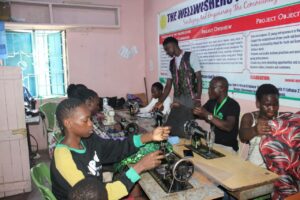
As of today, the organisation, Paul says, has transformed the lives of 30 teen mothers with employability skills in tailoring and beauty therapy. They are now in the third batch, with about 20 currently in class.
Cynthia Omondi, a mother of twin girls, is part of the last cohort that graduated in October 2025. Omondi shares her experience from being a teen mother to getting a second chance in life to make a difference.
Navigating the demanding responsibilities of motherhood and studies was not easy for Cynthia, but her determination outshone the harsh realities of life. All she wanted was to make a difference in life and be in a position where she could take care of her two daughters and look after her siblings.
Just like Cynthia, Mitchell Atieno has also redefined her purpose through Well-wishers. Atieno, who got pregnant at the age of 17 when she was about to transition to Form Four, says that life became unbearable.
“I got my son at the age of 17. I was about to go to Form Four when this happened, and truly, life was so harsh,” said Atieno.
A staunch rugby player, she defied all odds and resumed her secondary studies. This she did vehemently, not unbowed by stigma and the harsh realities of life in Mathare.
While she, Atieno, admits she did not have difficulty staying in school since she was partly sponsored, thanks to her outstanding rugby skills, back home, life was unbearable. Atieno, who is part of the cohort that graduated, is back at Well-wishers to hone her skills in fashion design, this time majoring in different outfits. The Well-wisher Foundation has welcomed her.
Over and above that, while many male youths in the slums still struggle to embrace skills as part of sustainable solutions to joblessness, Gravince Otieno, a 19-year-old boy, sits among the teen mothers, paving his path to becoming a fashion designer. He says his passion for fashion and design keeps him focused.
“Both my mother and father are fashion designers, and I have always loved to be a designer. I chose to be here not only to get skills but also to keep myself busy and avoid peer pressure. You know, it’s the origin of crime and drug abuse here in the slums,” Gravince said.
Richard Elvis, a Bachelor of Arts in Hospitality and Hotel Management graduate from Mt. Kenya University, is the lead facilitator at Well-wishers Training Centre. Asked why he did not pursue his career in hospitality, Elvis says it was a decision shaped by his love for the arts and fashion design.
“I have always loved fashion, and it was evident from the onset that I would be a fashion designer. This is the path I’m pursuing. It’s my purpose,” he says.
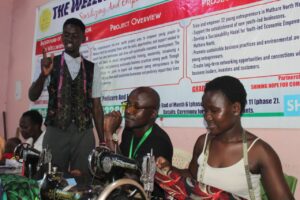
While he did not study fashion from the beginning, he intensified his pursuit while in his second year at Mt. Kenya University. When the COVID-19 pandemic hit, and schools got closed, Elvis used the time to get training from designers who believed in him. He tapped into the social media space and spent most of his time studying fashion on YouTube.
Away from fashion and design, we meet Immaculate Achieng, a facilitator at the training centre enclosed in a 12 by 14 cube partitioned into two rooms. She is the youngest of all present. The size of the room has not stopped her from training her students.
Like many of those she is training, Immaculate also got pregnant when she had just enrolled for her college studies and had to balance motherhood and caring for her grandmother, who she says played the role of a mother after her own mother passed away.
“I was not bold enough to go back to school after giving birth due to fear of stigmatization. I felt like I had failed my grandmother by not going back even after fees had been paid,” she says.
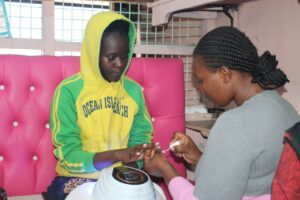
She, however, charted a new path in beauty and has been training teen mothers at the facility in beauty therapy.
Lack of funding and support from development partners is one of the major challenges facing the Well-wishers Foundation. As we conclude our interview, Paul makes a rallying call for support to help the organization reach more youths and advance the advocacy even to male youths.
“We are hoping to transform the lives of not less than 500 youths in Nairobi in the next 5 years, but our greatest challenge is finance. We have a plan to not only train them but also link them to the market,” Paul notes.
This story was featured in the just-launched Luminate Africa Journal first edition of The Africa Feature Network’s end-year magazine, and can be downloaded on our website at the Journal page.


