
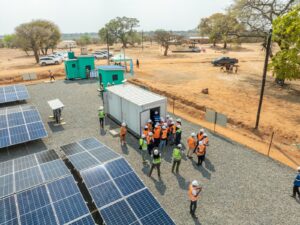
A Photo from a site visit to a mini-grid operated by Ignite Energy Access in Petauke, Zambia, provided by The Rockefeller Foundation and Sustainable Energy for All.
The growing energy inequalities across rural and peri-urban Africa, and the silent suffering they continue to impose on families, have become an increasingly urgent concern for leaders attempting to understand why development has stalled in regions that should be thriving. According to UN Sustainable Development Goals, around 600 million Africans still lack reliable access to electricity, which is nearly half the continent’s population.
Sub-Saharan Africa now carries the heaviest burden of global energy poverty, with the region accounting for 85 percent of the world’s population without electricity, a sharp rise from 50 percent in 2010, according to the World Bank Group’s Tracking SDG 7 – The Energy Progress Report 2025.
It is this widening power gap, where some communities experience steady growth while others remain trapped in cycles of energy poverty, that Andrew Herscowitz , CEO of the Mission 300 Accelerator, has been working to address across multiple global forums. Mission 300, a joint initiative of the the World Bank World and the African Development Bank, supported by The Rockefeller Foundation , the Global Energy Alliance for People and Planet, and Sustainable Energy for All, aims to confront one of the continent’s most persistent barriers to progress: reliable access to electricity.
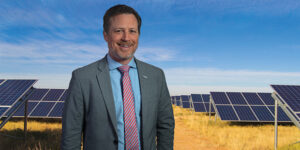
In an exclusive interview with Luminate Africa Journal, Herscowitz explained that this very gap became the catalyst for Mission 300’s creation, prompting institutions to unite around a bold, community-centred electrification model designed to transform energy access for millions of African households.
In this feature, we explore the steps Mission 300 has taken to address power gaps across Africa, the innovations and partnerships driving progress, and the transformative impact on communities, entrepreneurs, women and youth across the continent.
Andrew Herscowitz believes that the power revolution in Africa is the most effective approach to transforming the continent through modern agriculture, manufacturing and technological tools like Artificial Intelligence (AI).
“Mission 300 fuels small businesses, enables modern agriculture and manufacturing, and equips young people with the tools, including AI access, to seize emerging opportunities,” he said, adding that the initiative is driving inclusive growth for Africa’s expanding population.
Bridging the Energy Divide
The challenges of energy inequality are stark. In Zambia, for instance, rural electricity access had long lagged behind urban centres, leaving families reliant on kerosene lamps or diesel generators. Schools could only operate during daylight, health facilities struggled to run basic diagnostic equipment and small businesses faced prohibitive energy costs. Mission 300 approached this problem not as a technical gap but as a structural challenge demanding coordinated action.
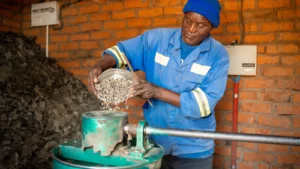
In the Petauke District of Eastern Zambia, mini-grid projects now power hundreds of homes and businesses. The Tembo family, who previously depended on diesel generators, now operates two sunflower oil extractors using renewable electricity. This shift cut operating costs by nearly two-thirds and enabled expansion, creating jobs and increasing local agricultural output.
According to the World Bank report on Progress of Mission 300, Tanzania illustrates a similar story. Over 5.7 million people have gained access to electricity since Mission 300 projects began, with an additional 6.25 million expected by 2030. Farmers now use electrically powered irrigation, increasing yields and reducing vulnerability to drought. Health clinics operate continuously, storing vaccines and running essential medical equipment. Small manufacturers, previously limited by power outages, now produce consumer goods and agro-processed products for regional markets.
The report further established that in Côte d’Ivoire, Mission 300 has connected 2.2 million people, with another 1.6 million projected by 2030. The access to electricity has enabled small enterprises to expand, improved community health outcomes, and created pathways for youth engagement in local economies. The focus on distributed renewable energy, including mini-grids and stand-alone solar systems, ensures that even remote communities gain sustainable power while private operators provide maintenance and management.
Mission 300 places strong emphasis on human capital, particularly through youth and women-led initiatives. The Mission 300 Fellowship, funded by the Rockefeller Foundation, is a two-year program deploying early- to mid-career Africans to Compact Delivery and Monitoring Units in participating countries. From over 3,000 applicants, 22 candidates were shortlisted from 15 countries. Six are already deployed in Lesotho, Niger, Chad, Mauritania, Burundi and Senegal, supporting governments in implementing National Energy Compacts and up to 11 more are expected to deploy by early next year.
Hope Mriti, an ODI fellow based in Lesotho, explained the significance of the fellowship, noting that it provides a platform that contributes to national electrification by transferring skills intergenerationally.
“Africa has a youthful population and this is already seen in the ODI Mission 300 Fellowship, where we have amazing, talented youth do amazing things in their countries. So we can already see this talent, this capability. And what the Mission 300 fellowship seeks to do is to amplify the already existing talent in the youth and give them a platform where they can work, interact and contribute to the electrification of the nation. Said Mriti, noting that it is important to bring the youth on board to ensure the sustainability and inter-generational transfer of skills, so that the baton is passed from the older generation to the younger, not excluding them but also having room for collaboration.
Youth and women have also been central in using electricity for technological innovation. Training centers powered by mini-grids now offer coding and AI classes, digital literacy programs and entrepreneurship support. These initiatives create pathways for young people to engage in knowledge-based economies, ensuring that electrification contributes to both economic growth and skill development.
The scale of Mission 300 is underpinned by strategic partnerships across governments, private sector actors, philanthropies and development institutions. The Global Energy Alliance has committed $12 million to support distributed renewable energy companies to gain access to technical assistance, results-based financing and equipment aggregation services in key Mission 300 countries, including Nigeria, Sierra Leone and Madagascar.
In Zambia, the Energy Demand Stimulation Incentive (ZEDSI), launched with SEforALL and supported by the Rockefeller Foundation, links electricity supply to consumption by providing performance-based grants to mini-grid operators. This mechanism ensures sustainability while encouraging local communities to maximize productive energy use.
National Energy Compacts have been central to Mission 300’s approach. By committing to policy reforms, investment planning, and improved governance structures, governments create an environment conducive to private investment. Thirty countries across Africa are now advancing these compacts, ensuring that electrification is accompanied by systemic sector reform.
Andrew Herscowitz emphasized the importance of these collaborations, terming them critical in the Mission 300 power goal
“Our partnerships with governments, the private sector, development institutions, and philanthropies have been central to Mission 300’s progress. Together, we are delivering affordable power, improving utility efficiency, attracting private investment, and ensuring reliable and sustainable electricity access.” He said
Andrew noted that the mission’s technical and staffing support to African governments has been essential to ensuring that government. Can succeed in achieving the ambitious goals they committed to achieving on their National Energy Compacts.
Through these partnerships, Mission 300 has mobilized over $50 billion in financing, allowing more than 150 projects to advance across 40 countries. These collaborations have accelerated project timelines, improved reliability of energy delivery and enabled large-scale deployment of distributed renewable energy solutions.
Mission 300 has already connected 32 million people in 39 countries, with the target to to reach nearly 250 million more through World Bank projects and 50 million through African Development Bank initiatives by 2030. Distributed renewable energy deployment is estimated to generate 1.7 million direct jobs annually, including installers, electricians and small enterprise operators, with millions more benefiting indirectly through education, healthcare and local businesses.
In the Democratic Republic of Congo (DRC) the Mwinda Fund, supported by the Global Energy Alliance, provides technical assistance and results-based financing to mini-grid operators.
In Tanzania, small manufacturers and local enterprises have reported revenue increases of 40 to 60 percent within a year of gaining electricity access.
Monitoring mechanisms embedded within Mission 300 ensure accountability and track progress. Compact Delivery and Monitoring Units report on compact implementation & electrification progress as well as unstick bottlenecks that drive implementation of Mission 300 in the country.
Energy consumption, infrastructure performance, job creation and community engagement with compact implementation and electrification progress as well as unstick bottlenecks that drive implementation.
These systems provide governments, investors and development partners with data-driven insights, enabling adaptive management and targeted interventions to improve outcomes.
The integration of electricity into productive use has had far-reaching effects. Farmers diversify crops, improve food security and expand into agro-processing. Schools increase student retention and improve educational outcomes. Health facilities reduce preventable mortality by keeping equipment running and storing essential medications. Local entrepreneurs grow businesses that were previously unsustainable due to lack of reliable power. These changes are creating ripple effects across communities, strengthening social cohesion and fostering economic resilience.
Mission 300 represents more than an energy initiative. It is a transformation engine for Africa. By addressing energy inequality, empowering youth and women, fostering innovation, and building partnerships across sectors, the program demonstrates how access to electricity can reshape the development trajectory of entire regions. From rural Zambia to Niger, Mauritania, DRC, and Côte d’Ivoire, the impacts are measurable, profound, and scalable.
The Mission is establishing a model for sustainable electrification that prioritizes economic productivity and social inclusion by combining infrastructure, human capital development, and policy reforms.
This is the lead story in the just-launched Luminate Africa Journal, the first edition of The Africa Feature Network’s end-year magazine, and can be downloaded from the journal page.


